Swope Park in Kansas City in Jackson County, Missouri — The American Midwest (Upper Plains)
Ethnic Enrichment Commission
Photographed by Duane and Tracy Marsteller, June 30, 2024
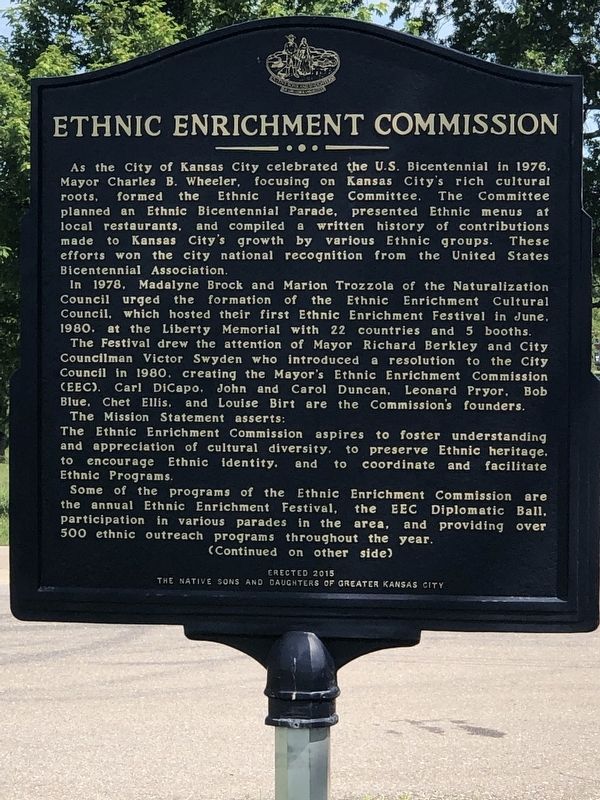
1. Ethnic Enrichment Commission Marker, Side One
As the City of Kansas City celebrated the U.S. Bicentennial in 1976, Mayor Charles B. Wheeler, focusing on Kansas City's rich cultural roots, formed the Ethnic Heritage Committee. The Committee planned an ethnic Bicentennial Parade, presented ethnic menus at local restaurants, and compiled a written history of contributions made to Kansas City's growth by various ethnic groups. These efforts won the city national recognition from the United States Bicentennial Association.
In 1978, Madalyne Brock and Marion Trozzola of the Naturalization Council urged the formation of the Ethnic Enrichment Cultural Council, which hosted their first Ethnic Enrichment Festival in June, 1980, at the Liberty Memorial with 22 countries and 5 booths.
The Festival drew the attention of Mayor Richard Berkley and City Councilman Victor Swyden who introduced a resolution to the City Council in 1980, creating the Mayor's Ethnic Enrichment Commission (EEC). Carl DiCapo, John and Carol Duncan, Leonard Pryor, Bob Blue, Chet Ellis, and Louise Birt are the Commission's founders.
The Mission Statement asserts:
The Ethnic Enrichment Commission
this page online
Some of the programs of the Ethnic Enrichment Commission are the annual Ethnic Enrichment Festival, the EEC Diplomatic Ball, participation in various parades in the area, and providing over 500 ethnic outreach programs throughout the year.
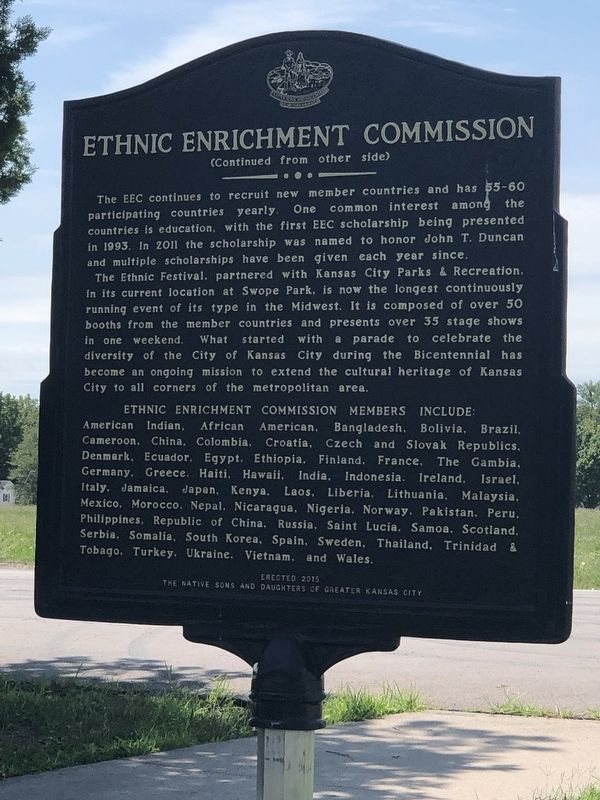
The EEC continues to recruit new member countries and has 55-60 the participating countries yearly. One common interest among the countries is education, with the first EEC scholarship being presented in 1993. In 2011 the scholarship was named to honor John T. Duncan and multiple scholarships have been given each year since.
The Ethnic Festival, partnered with Kansas City Parks & Recreation, in its current location at Swope Park, is now the longest continuously running event of its type in the Midwest. It is composed of over 50 booths from the member countries and presents over 35 stage shows in one weekend. What started with a parade to celebrate the diversity of the City of Kansas City during the Bicentennial
Photographed by Duane and Tracy Marsteller, June 30, 2024
2. Ethnic Enrichment Commission Marker, Side Two
Ethnic Enrichment Commission members include:
American Indian, African American, Bangladesh, Bolivia, Brazil, Cameroon, China, Colombia, Croatia, Czech and Slovak Republics, Denmark, Ecuador, Egypt, Ethiopia, Finland, France, The Gambia, Germany, Greece, Haiti, Hawaii, India, Indonesia, Ireland, Israel, Italy, Jamaica, Japan, Kenya, Laos, Liberia, Lithuania, Malaysia, Mexico, Morocco, Nepal, Nicaragua, Nigeria, Norway, Pakistan, Peru, Philippines, Republic of China, Russia, Saint Lucia, Samoa, Scotland, Serbia, Somalia, South Korea, Spain, Sweden, Thailand, Trinidad & Tobago, Turkey, Ukraine, Vietnam, and Wales.
Erected 2015 by The Native Sons and Daughters of Greater Kansas City. (Marker Number 43.)
Topics and series. This historical marker is listed in these topic lists: Education • Government & Politics. In addition, it is included in the Kansas City - Native Sons and Daughters of Greater Kansas City series list. A significant historical month for this entry is June 1980.
Location. 39° 0.45′ N, 94° 32.335′ W.
Photographed by Duane and Tracy Marsteller, June 30, 2024
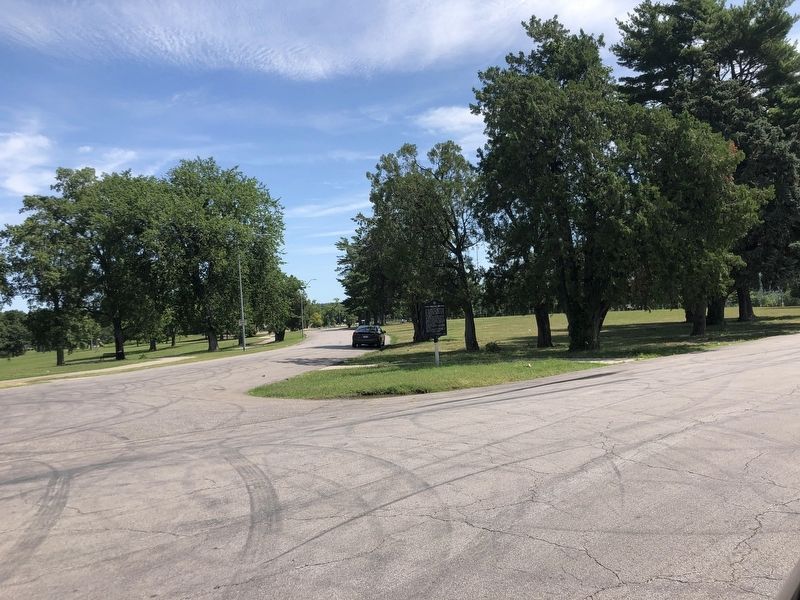
3. Ethnic Enrichment Commission Marker

Regionally, this marker is in the American Midwest, in the Lewis & Clark Corridor, in the Corn Belt, and on the Santa Fe Trail Corridor. Globally, it is in North America, the Western Hemisphere, the Western World, and the Anglosphere. Historically, it finds itself in what was once the territory of the Mississippian Culture, the Louisiana Purchase, and the Antebellum South.
Other nearby markers. At least 8 other markers are within walking distance of this marker: Kansas City's First Public Golf Course (about 400 feet away, measured in a direct line); Delbert J. Haff (approx. 0.3 miles away); "Boston" Adams' House (approx. 0.3 miles away); Battle of Westport (approx. half a mile away); Pratt's Artillery (approx. 0.6 miles away); Marmaduke's Defense Line, October 23, 1864 (approx. 0.7 miles away); The Battle of Westport, October 21-23, 1864 (approx. 0.7 miles away); The Log House, October 23, 1864 (approx. 0.7 miles away). Touch for a list and map of all markers in Kansas City.
Also see . . . Ethnic Enrichment Commission of Kansas City. The commission's home page. (Submitted on July 22, 2024, by Duane and Tracy Marsteller of Murfreesboro, Tennessee.)
Credits. This page was last revised on August 15, 2024. It was originally submitted on July 22, 2024, by Duane and Tracy Marsteller of Murfreesboro, Tennessee. This page has been viewed 180 times since then and 28 times this year. Photos: 1, 2, 3. submitted on July 22, 2024, by Duane and Tracy Marsteller of Murfreesboro, Tennessee.
