Scranton in Lackawanna County, Pennsylvania — The American Northeast (Mid-Atlantic)
The Century Club of Scranton
612 Jefferson Avenue
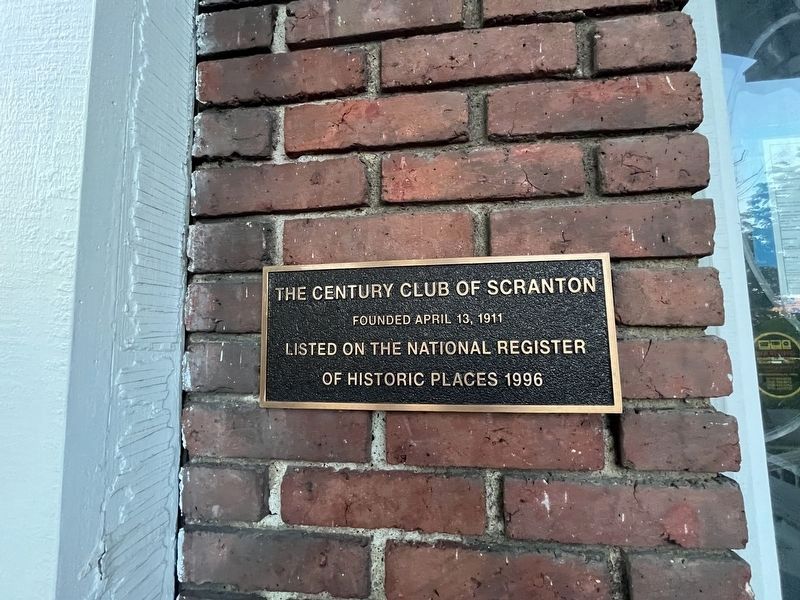
Founded April 13, 1911
Listed on the National Register
of Historic Places 1996
Topics. This historical marker is listed in these topic lists: Architecture • Fraternal or Sororal Organizations. A significant historical date for this entry is April 13, 1911.
Location. 41° 24.681′ N, 75° 39.325′ W. Marker is in Scranton, Pennsylvania, in Lackawanna County. It is on Jefferson Avenue just north of Olive Street, on the right when traveling north. Touch for map. Marker is at or near this postal address: 612 Jefferson Ave, Scranton PA 18510, United States of America. Touch for directions.

Regionally, this marker is in the Wyoming Valley. It is also in the American Northeast, in the Mid-Atlantic, in Appalachia, and specifically in Northern Appalachia. Globally, it is in North America, the Western Hemisphere, the Western World, and the Anglosphere. Historically, it finds itself in what was once the Haudenosaunee (Iroquois) Confederacy and also one of the original Thirteen Colonies.
Other nearby markers. At least 8 other markers are within walking distance of this marker: "A State of Giving, A City of Hope"
this page online
Also see . . . National Register of Historic Places Nomination Form for The Century Club.
This form was prepared in 1995 by Marion T. Spellman, Chairman of National Register Project, The Century Club of Scranton. The statement of significance can be found on page 6:
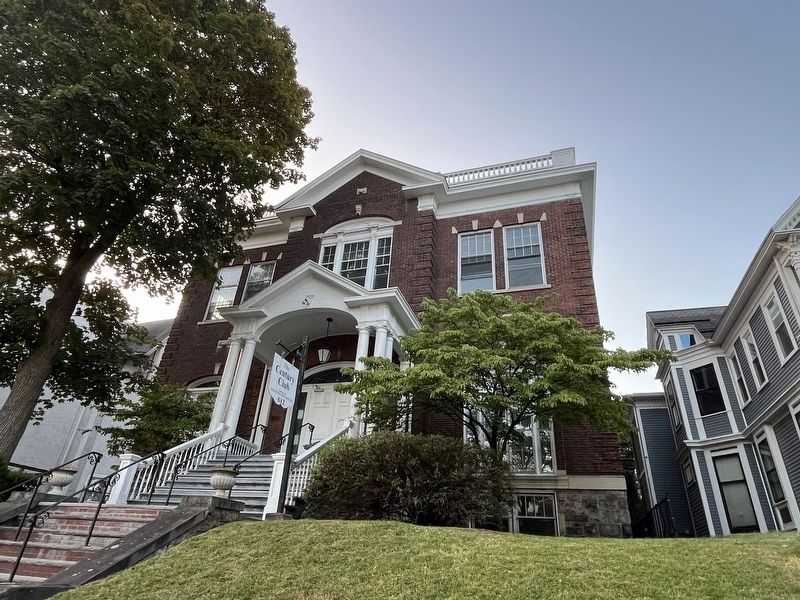
The Century Club of Scranton meets Criterion A for social history as a strong example of an early 20th century middle and upper class private women's club founded for civic improvement and social interaction in Scranton. The Club also meets Criterion C as a strong architectural example in the community of the Colonial Revival style.(Submitted on July 22, 2024, by Devry Becker Jones of Washington, District of Columbia.)
Early in the 20th century, the city of Scranton,Pennsylvania experienced great prosperity and growth. Coal was king, the iron industry flourished and Scranton's lace products were world-renowned. It was during this era that women of the prosperous families in the community, having the luxury of time, felt the need to explore outlets for civic activities and educational pursuits. As a result, a remarkable women's club, The Century Club of Scranton, came into existence.' Within the time span of two years, the need for a large space to hold meetings initiated the building of a clubhouse - the first women's clubhouse in Scranton. Funding for this building came from various sources. The primary one, by William Worthington Scranton was used to secure a property, in the city, at 612 Jefferson Avenue. Work began on November 15, 1913. This was the beginning of a dream come true for these women and prophetically foreshadowed the important work that was to follow. The Century Club of Scranton was completed on October 5, 1914 and since its dedication the building has been used continuously as a clubhouse. Throughout all those years, its meeting rooms, lounges, auditorium as well as its exteriorfacade have retained their integrity. You have only to enter its double doors with leaded glass sidelights and semi- elliptical fanlight and glimpse the lavish woodwork and curving staircase to experience the flavor of its past glory.
Credits. This page was last revised on July 22, 2024. It was originally submitted on July 22, 2024, by Devry Becker Jones of Washington, District of Columbia. This page has been viewed 332 times since then and 42 times this year. Photos: 1, 2, 3. submitted on July 22, 2024, by Devry Becker Jones of Washington, District of Columbia.
