Geuzenveld-Slotermeer in Amsterdam, North Holland, Netherlands — Northwestern Europe
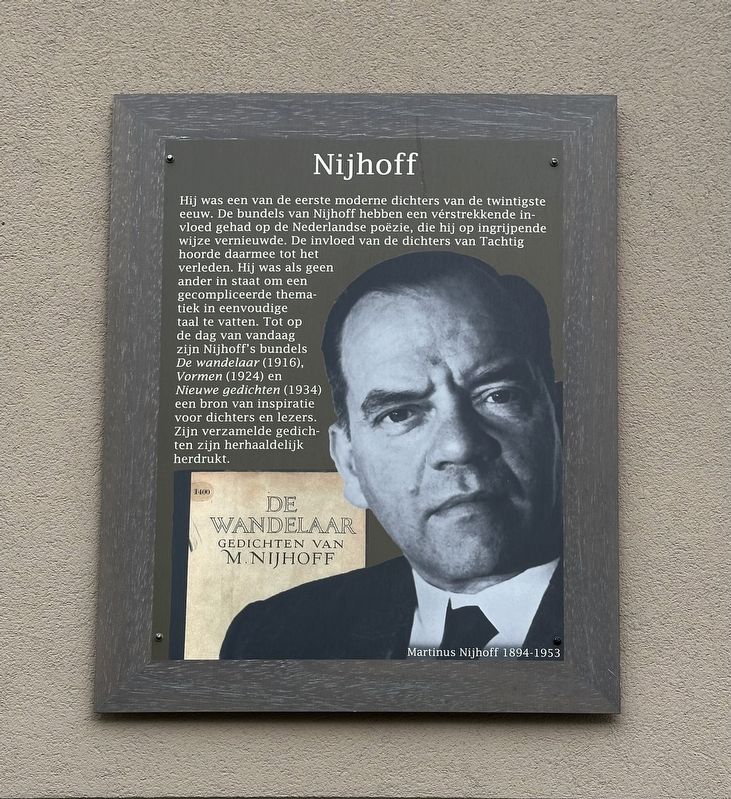
Nijhoff
Photographed by Andrew Ruppenstein, July 7, 2024
1. Nijhoff Marker

Martinus Nijhoff 1894-1953
Hij was een van de eerste moderne dichters van de twintigste eeuw. De bundels van Nijhoff hebben een vérstrekkende invloed gehad op de Nederlandse poëzie, die hij op ingrijpende wijze vernieuwde. De invloed van de dichters van Tachtig hoorde daarmee tot het verleden. Hij was als geen ander in staat om een gecompliceerde thematiek in eenvoudige taal te vatten. Tot op de dag van vandaag zijn Nijhoff's bundels De wandelaar (1916), Vormen (1924) en Nieuwe gedichten (1934) een bron van inspiratie voor dichters en lezers. Zijn verzamelde gedichten zijn herhaaldelijk herdrukt.
He was one of the first modern poets of the twentieth century. Nijhoff's collections have had a far-reaching influence on Dutch poetry, which he radically renewed. The influence of the poets of Tachtig (the movement of Eighty) was therefore a thing of the past. Like no other, he was able to summarize a complicated theme in simple language. To this day, Nijhoff's collections De wandelaar (“The Walker”) (1916), Vormen (“Forms”) (1924) and Nieuwe gedichten (“New Poems”) (1934) are a
this page online
Erected by Geef Straten Een Gezicht.
Topics and series. This historical marker is listed in this topic list: Arts, Letters, Music. In addition, it is included in the Give Streets a Face / Geef Straten Een Gezicht series list.
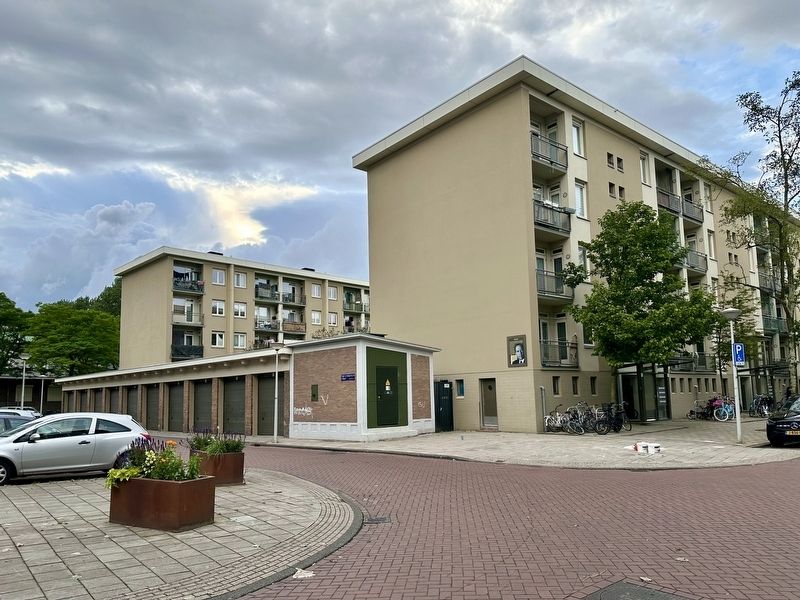
Location. 52° 22.656′ N, 4° 49.133′ E. Marker is in Amsterdam, Noord-Holland (North Holland). It is in Geuzenveld-Slotermeer. It is on Van Moerkerkenstraat. Touch for map. Marker is at or near this postal address: Van Moerkerkenstraat 4, Amsterdam, Noord-Holland 1064 HK, Netherlands. Touch for directions.

Regionally, it is in Europe, the European Union, Atlantic Europe, the Benelux Low Countries, the Schengen Area, Western Europe, and the Western World. Historically, it finds itself in what was once the Holy Roman Empire.
Other nearby markers. At least 8 other markers are within walking distance of this marker: Van Moerkerken (within shouting distance of this marker); Du Perron (about 120 meters away, measured in a direct line); Krijn Breuer (about
Photographed by Andrew Ruppenstein, July 7, 2024
2. Nijhoff Marker - wide view
Related marker. Click here for another marker that is related to this marker.
Also see . . . Martinus Nijhoff (Wikipedia).
Excerpt: Martinus Nijhoff (20 April 1894, in The Hague – 26 January 1953, in The Hague) was a Dutch poet and essayist. He studied literature in Amsterdam and law in Utrecht. His debut was in 1916 with his volume De wandelaar ("The wanderer"). He then gradually expanded his reputation by his unique style of poetry: not experimental, like Paul van Ostaijen, yet distinguished by the clarity of his language combined with mystical content. He was a literary craftsman who employed skilfully various verse forms from different literary periods.(Submitted on July 23, 2024, by Andrew Ruppenstein of Lamorinda, California.)
Some of his best-known works include Het Uur U ("U Hour", 1936) and the long poem Awater(1934). A number of individual sonnets also rose to fame, particularly De Moeder de Vrouw ("The Mother the Woman/Wife") commemorating the opening of a bridge over the river Waal near Zaltbommel. Joseph Brodsky considered the poem Awater one of the grandest poems of the 20th century.
Credits. This page was last revised on July 23, 2024. It was originally submitted on July 23, 2024, by Andrew Ruppenstein of Lamorinda, California. This page has been viewed 142 times since then and 14 times this year. Photos: 1, 2. submitted on July 23, 2024, by Andrew Ruppenstein of Lamorinda, California.
