Parachute in Garfield County, Colorado — The American Mountains (Southwest)
The Battlement Creek Fire of 1976
Photographed by Cosmos Mariner, July 14, 2024
1. The Battlement Creek Fire of 1976 Marker
Inscription.
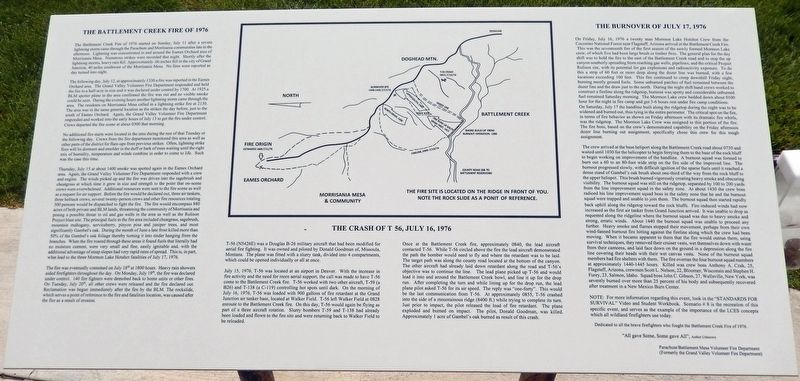
The Battlement Creek Fire of 1976. . , The Battlement Creek Fire of 1976 started on Sunday, July 11 after a severe lightning storm came through the Parachute and Morrisania communities late in the afternoon. Lightning was concentrated in and around the Eames Orchard area of Morrisania Mesa. Numerous strikes were recorded that night. Shortly after the lightning storms, heavy rain fell. Approximately .06 inches fell in the city of Grand Junction, 40 miles southwest of the Morrisania Mesa. No fires were reported as day turned into night. , The following day, July 12, at approximately 1330 a fire was reported in the Eames Orchard area. The Grand Valley Volunteer Fire Department responded and held the fire to a half-acre in size and it was declared under control by 1700. At 1925 a BLM spotter plane in the area confirmed the fire was out and no visible smoke could be seen. During the evening hours another lightning storm came through the area. The residents on Morrisania Mesa called in a lightning strike fire at 2130. The area was in the same general location as the strikes the day before, just to the south of Eames Orchard. Again, the Grand Valley Volunteer Fire Department responded and worked into the early hours of July 13 to get the fire under control. Crews departed the fire scene at about 0300 that morning. , No additional fire starts were located in the area during the rest of that Tuesday or the following day. Crews from the fire department monitored this area as well as other parts of the district for flare-ups from previous strikes. Often, lightning strike fires will lie dormant and smolder in the duff or bark of trees waiting until the right mix of humidity, temperature and winds combine in order to come to life. Such was the case this time. , Thursday, July 15 at about 1400 smoke was spotted again in the Eames Orchard area. Again, the Grand Valley Volunteer Fire Department responded with a crew and engine. The winds picked up and the fire was driven into the sagebrush and cheatgrass at which time it grew in size and strength to the point that on-scene crews were overwhelmed. Additional resources were sent to the fire scene as well as a request for air support. Before the fire would be declared out, three air tankers, three helitack crews, several twenty-person crews and other fire resources totaling 300 persons would be dispatched to fight the fire. The fire would encompass 880 acres of both private and BLM lands, threatening the community of Morrisania and posing a possible threat to oil and gas wells in the area as well as the Rulison Project blast site. The principal fuels in the fire area included cheatgrass, sagebrush, mountain mahogany, serviceberry, pinyon pine and juniper trees, and most significantly Gambel's oak. During the month of June a late frost killed more than 50% of the Gambel's oak foliage thereby turning it into tinder hanging from the branches. When the fire roared through these areas it found fuels that literally had no moisture content, were very small and fine, easily ignitable and, with the additional advantage of steep slopes had very rapid rates of spread. This is, in part, what lead to the three Mormon Lake Hotshot fatalities of July 17, 1976. , The fire was eventually contained on July 18th at 1800 hours. Heavy rain showers aided firefighters throughout the day. On Monday, July 19th, the fire was declared under control. 140 fire fighters were demobed back to home units or other fires. On Tuesday, July 20th, all other crews were released and the fire declared out. Reclamation was begun immediately after the fire by the BLM. The rockslide, which serves a point of reference to the fire and fatalities location, was caused after the fire as a result of erosion. , The Crash of T-56, July 16, 1976 , T-56 (N5426E) was a Douglas B-26 military aircraft that had been modified for aerial fire fighting. It was owned and piloted by Donald Goodman, of Missoula, Montana. The plane was fitted with a slurry tank, divided into 4 compartments, which could be opened individually or all at once. , July 15, 1976, T-56 was located at an airport in Denver. With the increase in fire activity and the need for more aerial support, the call was made to have T-56 come to the Battlement Creek fire. T-56 worked with two other aircraft, T-59 (a B-26) and T-138 (a C-119) controlling hot spots until dark. On the morning of July 16, 1976, T-56 was loaded with 900 gallons of fire retardant at the Grand Junction air tanker base, located at Walker Field. T-56 left Walker Field at 0828 enroute to the Battlement Creek fire. On this day, T-56 would again be flying as part of a three aircraft rotation. Slurry bombers T-59 and T-138 had already been loaded and flown to the fire site and were returning back to Walker Field to be reloaded. , Once at the Battlement Creek fire, approximately 0840, the lead aircraft contacted T-56. While T-56 circled above the fire the lead aircraft demonstrated the path the bomber would need to fly and where the retardant was to be laid. The target path was along the county road located at the bottom of the canyon. The other aircraft had already laid down retardant along the road and T-56's objective was to continue the line. The lead plane picked up T-56 and would lead it into and around the Battlement Creek bowl, and line it up for the drop run. After completing the turn and while lining up for the drop run, the lead plane pilot asked T-56 for its air speed. The reply was “one-forty”. This would be the last communication from T-56. At approximately 0855, T-56 crashed into the side of a mountainous ridge (8400 ft.) while trying to complete its turn. Just prior to impact, the pilot released the load of fire retardant. The plane exploded and burned on impact. The pilot, Donald Goodman, was killed. Approximately 1 acre of Gambel's oak burned as result of this crash. , The Burnover of July 17, 1976 , On Friday, July 16, 1976 a twenty man Mormon Lake Hotshot Crew from the Coconino National Forest near Flagstaff, Arizona arrived at the Battlement Creek Fire. This was the seventeenth fire of the first season of the newly formed Mormon Lake crew, of which five had been large brush or timber fires. The general plan for the day shift was to hold the fire to the east of the Battlement Creek road and to stop the up canyon southerly spreading from reaching gas wells, pipelines, and the critical Project Rulison site, with its potential for gas explosions and radioactivity exposure. To do this a strip of 60 feet or more deep along the dozer line was burned, with a few locations exceeding 100 feet. This fire continued to creep downhill Friday night, burning mostly ground fuels. Some unburned patches of fuel remained between the dozer line and the draw just to the north. During the night shift hand crews worked to construct a fireline along the ridgetop, burnout was spotty and considerable unburned fuel remained Saturday morning. The Mormon Lake crew bedded down about 0100 hour for the night in fire camp and got 5-6 hours rest under fire camp conditions. On Saturday, July 17 the handline built along the ridgetop during the night was to be widened and burned out, thus tying in the entire perimeter. The critical spot on the fire, in terms of fire behavior as shown on Friday afternoon with its dramatic fire whirls, was the ridgetop. The Mormon Lake Crew was assigned to this portion of the fire. The fire boss, based on the crew's demonstrated capability on the Friday afternoon dozer line burning out assignment, specifically chose this crew for this tough assignment. , The crew arrived at the base heliport along the Battlement Creek road about 0730 and waited until 1030 for the helicopter to begin ferrying them to the base of the rock bluff to begin working on improvement of the handline. A burnout squad was formed to burn out a 60 to an 80-foot wide strip on the fire side of the improved line. The burnout progressed slowly, with difficult ignition of the sparse fuels until it reached a dense stand of Gambel's oak brush about one-third of the way from the rock bluff to the upper helispot. This brush burned vigorously creating heavy smoke and obscuring visibility. The burnout squad was still on the ridgetop, separated by 100 to 200 yards from the line improvement squad in the safety zone. At about 1430 the crew boss radioed his line improvement squad boss in the safety zone that he and the burnout squad were trapped and unable to join them. The burnout squad then started rapidly back uphill along the ridgetop toward the rock bluffs. Fire-induced winds had now increased as the first air tanker from Grand Junction arrived. It was unable to drop as requested along the ridgeline where the burnout squad was due to heavy smoke and strong, erratic winds. About 1440 the burnout squad was unable to proceed any further. Heavy smoke and flames stopped their movement, perhaps from their own wind-fanned burnout fire hitting against the fireline along which the crew had been moving. When it became apparent to them that the fire would outrun them, using survival techniques, they removed their cruiser vests, wet themselves down with water from their canteens, and laid face down on the ground in a depression along the fire line covering their heads with their wet canvas vests. None of the burnout squad members had fire shelters with them. The fire overran the four burnout squad members at approximately 1440-1445 hours. Killed was crew boss Anthony A. Czak, 25, Flagstaff, Arizona, crewmen Scott L. Nelson, 22, Bloomer, Wisconsin and Stephen H. Furey, 23, Salmon, Idaho. Squad boss John C. Gibson, 27, Wellsville, New York, was severely burned over more than 25 percent of his body and subsequently recovered after treatment in a New Mexico Burn Center. , NOTE: For more information regarding this event, look in the "STANDARDS FOR SURVIVAL" Video and Student Workbook. Scenario # 8 is the recreation of this specific event, and serves as the example of the importance of the LCES concepts which all wildland firefighters use today. ,
Dedicated to all the brave firefighters who fought the Battlement Creek Fire of 1976., ”All gave Some, Some gave All”, Author Unknown, Parachute/Battlement Mesa Volunteer Fire Department , (Formerly the Grand Valley Volunteer Fire Department).
The Battlement Creek Fire of 1976 started on Sunday, July 11 after a severe lightning storm came through the Parachute and Morrisania communities late in the afternoon. Lightning was concentrated in and around the Eames Orchard area of Morrisania Mesa. Numerous strikes were recorded that night. Shortly after the lightning storms, heavy rain fell. Approximately .06 inches fell in the city of Grand Junction, 40 miles southwest of the Morrisania Mesa. No fires were reported as day turned into night.
The following day, July 12, at approximately 1330 a fire was reported in the Eames Orchard area. The Grand Valley Volunteer Fire Department responded and held the fire to a half-acre in size and it was declared under control by 1700. At 1925 a BLM spotter plane in the area confirmed the fire was out and no visible smoke could be seen. During the evening hours another lightning storm came through the area. The residents on Morrisania Mesa called in a lightning strike fire at 2130. The area was in the same general location as the strikes the day before, just to the south of Eames Orchard. Again, the Grand Valley Volunteer Fire Department
Click or scan to see this page online
responded and worked into the early hours of July 13 to get the fire under control. Crews departed the fire scene at about 0300 that morning.
No additional fire starts were located in the area during the rest of that Tuesday or the following day. Crews from the fire department monitored this area as well as other parts of the district for flare-ups from previous strikes. Often, lightning strike fires will lie dormant and smolder in the duff or bark of trees waiting until the right mix of humidity, temperature and winds combine in order to come to life. Such was the case this time.
Thursday, July 15 at about 1400 smoke was spotted again in the Eames Orchard area. Again, the Grand Valley Volunteer Fire Department responded with a crew and engine. The winds picked up and the fire was driven into the sagebrush and cheatgrass at which time it grew in size and strength to the point that on-scene crews were overwhelmed. Additional resources were sent to the fire scene as well as a request for air support. Before the fire would be declared out, three air tankers, three helitack crews, several twenty-person crews and other fire resources totaling
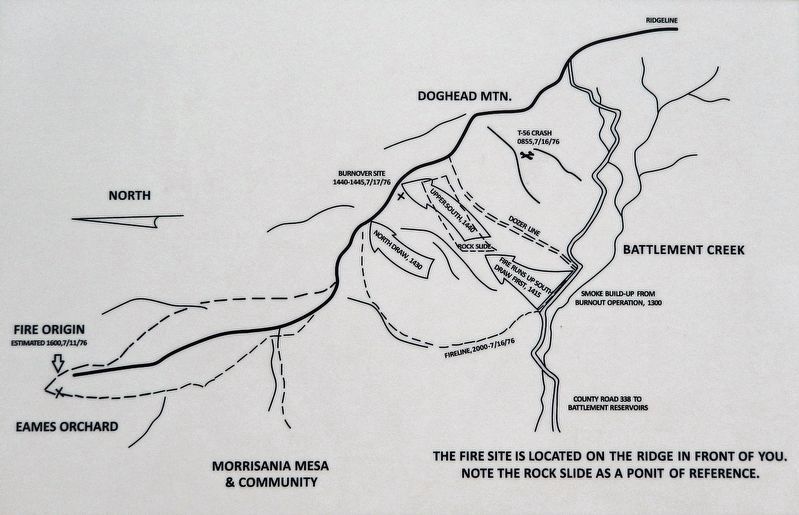
2. Marker detail: Battlement Creek Fire Map
300 persons would be dispatched to fight the fire. The fire would encompass 880 acres of both private and BLM lands, threatening the community of Morrisania and posing a possible threat to oil and gas wells in the area as well as the Rulison Project blast site. The principal fuels in the fire area included cheatgrass, sagebrush, mountain mahogany, serviceberry, pinyon pine and juniper trees, and most significantly Gambel's oak. During the month of June a late frost killed more than 50% of the Gambel's oak foliage thereby turning it into tinder hanging from the branches. When the fire roared through these areas it found fuels that literally had no moisture content, were very small and fine, easily ignitable and, with the additional advantage of steep slopes had very rapid rates of spread. This is, in part, what lead to the three Mormon Lake Hotshot fatalities of July 17, 1976.
The fire was eventually contained on July 18th at 1800 hours. Heavy rain showers aided firefighters throughout the day. On Monday, July 19th, the fire was declared under control. 140 fire fighters were demobed back to home units or other fires. On Tuesday, July
Photographed by Cosmos Mariner, July 14, 2024
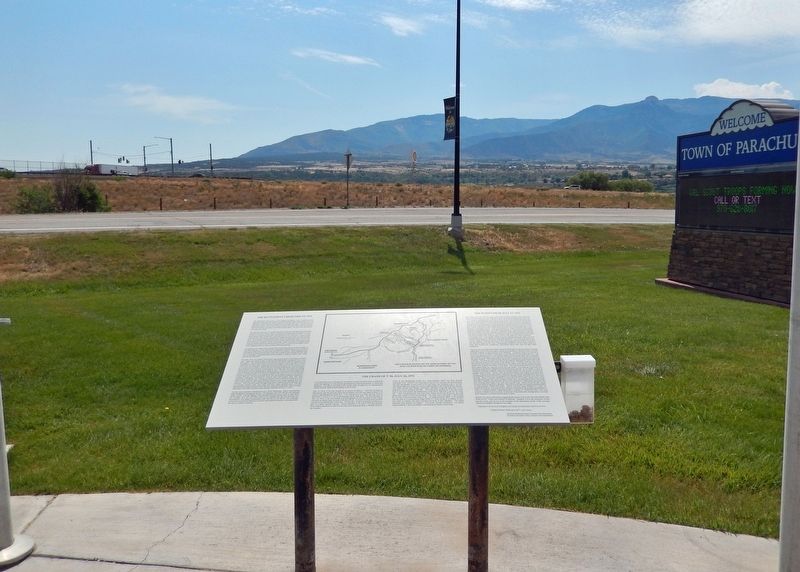
3. The Battlement Creek Fire of 1976 Marker
20th, all other crews were released and the fire declared out. Reclamation was begun immediately after the fire by the BLM. The rockslide, which serves a point of reference to the fire and fatalities location, was caused after the fire as a result of erosion.
The Crash of T-56, July 16, 1976 T-56 (N5426E) was a Douglas B-26 military aircraft that had been modified for aerial fire fighting. It was owned and piloted by Donald Goodman, of Missoula, Montana. The plane was fitted with a slurry tank, divided into 4 compartments, which could be opened individually or all at once.
July 15, 1976, T-56 was located at an airport in Denver. With the increase in fire activity and the need for more aerial support, the call was made to have T-56 come to the Battlement Creek fire. T-56 worked with two other aircraft, T-59 (a B-26) and T-138 (a C-119) controlling hot spots until dark. On the morning of July 16, 1976, T-56 was loaded with 900 gallons of fire retardant at the Grand Junction air tanker base, located at Walker Field. T-56 left Walker Field at 0828 enroute to the Battlement Creek fire. On this day, T-56 would again be flying as part of a
Photographed by Cosmos Mariner, July 14, 2024
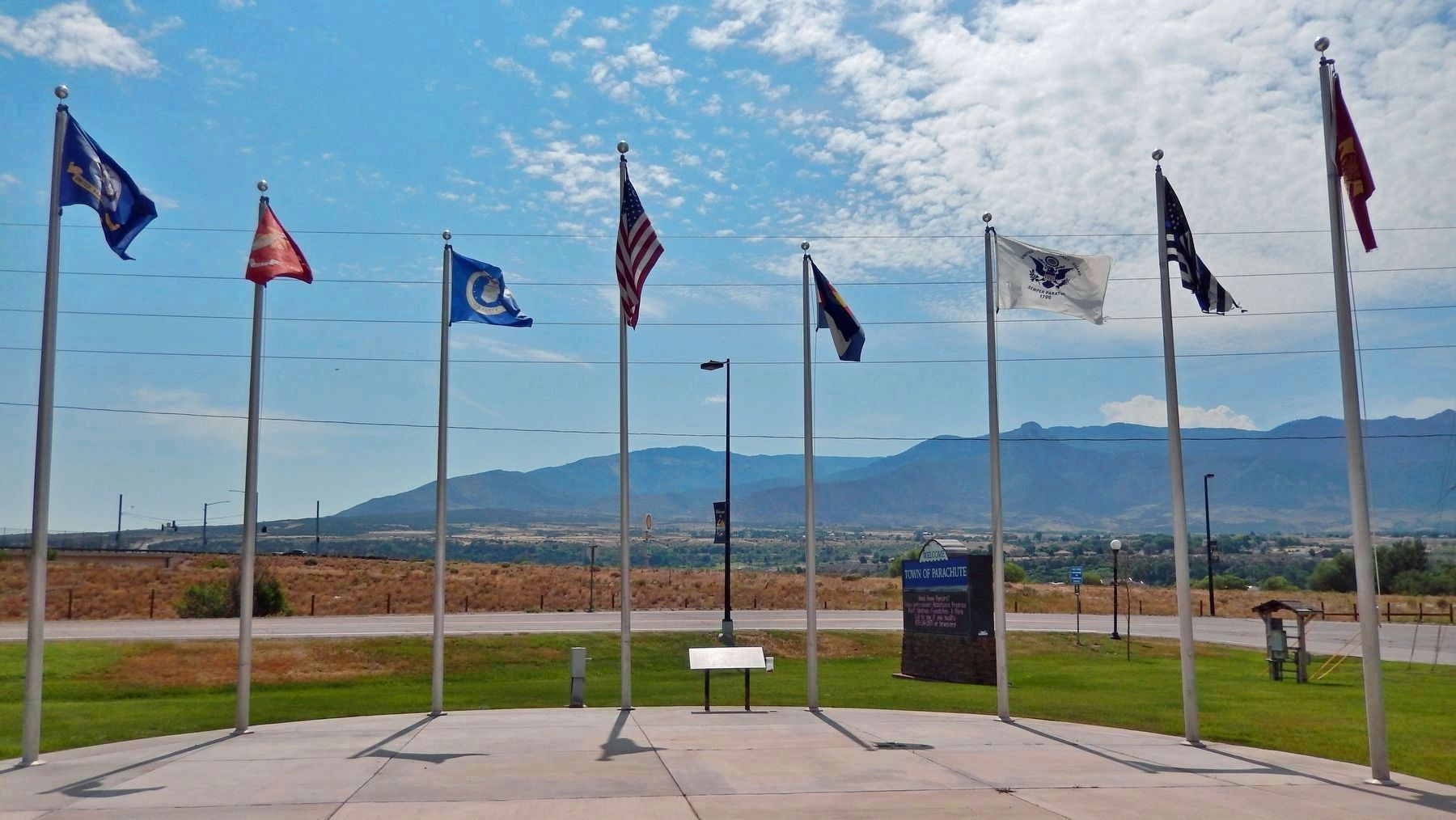
4. Battlement Creek Firefighters Memorial Plaza
Looking southeast; marker is located at the center; East 1st Street is in background.
three aircraft rotation. Slurry bombers T-59 and T-138 had already been loaded and flown to the fire site and were returning back to Walker Field to be reloaded.
Once at the Battlement Creek fire, approximately 0840, the lead aircraft contacted T-56. While T-56 circled above the fire the lead aircraft demonstrated the path the bomber would need to fly and where the retardant was to be laid. The target path was along the county road located at the bottom of the canyon. The other aircraft had already laid down retardant along the road and T-56's objective was to continue the line. The lead plane picked up T-56 and would lead it into and around the Battlement Creek bowl, and line it up for the drop run. After completing the turn and while lining up for the drop run, the lead plane pilot asked T-56 for its air speed. The reply was “one-forty”. This would be the last communication from T-56. At approximately 0855, T-56 crashed into the side of a mountainous ridge (8400 ft.) while trying to complete its turn. Just prior to impact, the pilot released the load of fire retardant. The plane exploded and burned on impact. The pilot, Donald Goodman, was killed. Approximately 1 acre of Gambel's oak burned as result of this crash.
The Burnover of July 17, 1976 On Friday, July 16, 1976 a twenty man Mormon Lake Hotshot Crew from the Coconino National Forest near Flagstaff, Arizona arrived at the Battlement Creek Fire. This was the seventeenth fire of the first season of the newly formed Mormon Lake crew, of which five had been large brush or timber fires. The general plan for the day shift was to hold the fire to the east of the Battlement Creek road and to stop the up canyon southerly spreading from reaching gas wells, pipelines, and the critical Project Rulison site, with its potential for gas explosions and radioactivity exposure. To do this a strip of 60 feet or more deep along the dozer line was burned, with a few locations exceeding 100 feet. This fire continued to creep downhill Friday night, burning mostly ground fuels. Some unburned patches of fuel remained between the dozer line and the draw just to the north. During the night shift hand crews worked to construct a fireline along the ridgetop, burnout was spotty and considerable unburned fuel remained Saturday morning. The Mormon Lake crew bedded down about 0100 hour for the night in fire camp and got 5-6 hours rest under fire camp conditions. On Saturday, July 17 the handline built along the ridgetop during the night was to be widened and burned out, thus tying in the entire perimeter. The critical spot on the fire, in terms of fire behavior as shown on Friday afternoon with its dramatic fire whirls, was the ridgetop. The Mormon Lake Crew was assigned to this portion of the fire. The fire boss, based on the crew's demonstrated capability on the Friday afternoon dozer line burning out assignment, specifically chose this crew for this tough assignment.
The crew arrived at the base heliport along the Battlement Creek road about 0730 and waited until 1030 for the helicopter to begin ferrying them to the base of the rock bluff to begin working on improvement of the handline. A burnout squad was formed to burn out a 60 to an 80-foot wide strip on the fire side of the improved line. The burnout progressed slowly, with difficult ignition of the sparse fuels until it reached a dense stand of Gambel's oak brush about one-third of the way from the rock bluff to the upper helispot. This brush burned vigorously creating heavy smoke and obscuring visibility. The burnout squad was still on the ridgetop, separated by 100 to 200 yards from the line improvement squad in the safety zone. At about 1430 the crew boss radioed his line improvement squad boss in the safety zone that he and the burnout squad were trapped and unable to join them. The burnout squad then started rapidly back uphill along the ridgetop toward the rock bluffs. Fire-induced winds had now increased as the first air tanker from Grand Junction arrived. It was unable to drop as requested along the ridgeline where the burnout squad was due to heavy smoke and strong, erratic winds. About 1440 the burnout squad was unable to proceed any further. Heavy smoke and flames stopped their movement, perhaps from their own wind-fanned burnout fire hitting against the fireline along which the crew had been moving. When it became apparent to them that the fire would outrun them, using survival techniques, they removed their cruiser vests, wet themselves down with water from their canteens, and laid face down on the ground in a depression along the fire line covering their heads with their wet canvas vests. None of the burnout squad members had fire shelters with them. The fire overran the four burnout squad members at approximately 1440-1445 hours. Killed was crew boss Anthony A. Czak, 25, Flagstaff, Arizona, crewmen Scott L. Nelson, 22, Bloomer, Wisconsin and Stephen H. Furey, 23, Salmon, Idaho. Squad boss John C. Gibson, 27, Wellsville, New York, was severely burned over more than 25 percent of his body and subsequently recovered after treatment in a New Mexico Burn Center.
NOTE: For more information regarding this event, look in the "STANDARDS FOR SURVIVAL" Video and Student Workbook. Scenario # 8 is the recreation of this specific event, and serves as the example of the importance of the LCES concepts which all wildland firefighters use today.
Dedicated to all the brave firefighters who fought the Battlement Creek Fire of 1976.
”All gave Some, Some gave All”, Author Unknown
Parachute/Battlement Mesa Volunteer Fire Department (Formerly the Grand Valley Volunteer Fire Department)
Location. 39° 27.331′ N, 108° 2.996′ W. Marker is in Parachute, Colorado, in Garfield County. It can be reached from the intersection of East 1st Street and Green Street, on the right when traveling south. The marker and Firefighters Memorial plaza are located on the Parachute Visitor Center grounds. Touch for map. Marker is at or near this postal address: 400 East 2nd Street, Parachute CO 81635, United States of America. Touch for directions.
Regionally, this marker is in the Western Slope. It is also in the American Mountain West. Globally, it is in North America, the Rocky Mountains, the Western Hemisphere, the Western World, and the Anglosphere. Historically, it finds itself in what was once Mexico’s Alta California.
Other nearby markers. At least 2 other markers are within walking distance of this marker: The Robbery - The Getaway (a few steps from this marker); Parachute / Battlement Mesa (within shouting distance of this marker).
In 1976, Western Colorado was experiencing a severe fire season caused partly by unusual fuel conditions and heavy lightning activity during dry weather. A severe frost in June killed a high percentage of the leaves on Gambel oak trees. After such a frost, these leaves tend to remain on the branches and are considered one of Colorado’s most flammable fuels. Ten-hour fuels were at 3-5% moisture content. A large-scale high-pressure weather pattern sat over western Colorado, allowing for local weather to be influenced by terrain and diurnal winds averaging 10 to 15 mph in the afternoon with higher gusts. The weather was fair and hot with the temperatures at Grand Junction and Rifle reaching into the mid and upper 90. A fire was reported 40 miles northeast of Grand Junction in the Battlement Creek drainage, burning over an elevation range of 6,200 to 8,400 feet on a steep west-facing slope.
(Submitted on July 23, 2024, by Cosmos Mariner of Cape Canaveral, Florida.)
Credits. This page was last revised on July 24, 2024. It was originally submitted on July 23, 2024, by Cosmos Mariner of Cape Canaveral, Florida. This page has been viewed 358 times since then and 62 times this year. Photos:1, 2, 3, 4. submitted on July 23, 2024, by Cosmos Mariner of Cape Canaveral, Florida.