Bowling Green in Wood County, Ohio — The American Midwest (Great Lakes)
Boom Town
Photographed by Craig Doda, July 21, 2024
1. Boom Town Marker
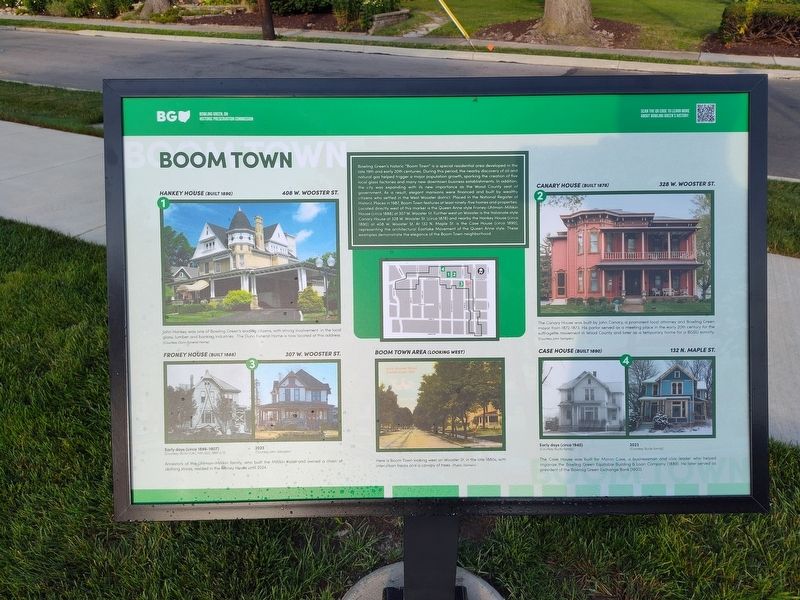
Bowling Green's historic "Boom Town" is a special residential area developed in the late 19th and early 20th centuries. During this period, the nearby discovery of oil and natural gas helped trigger a major population growth, sparking the creation of five local glass factories and many new downtown business establishments. In addition, the city was expanding with its new importance as the Wood County seat of government. As a result, elegant mansions were financed and built by wealthy citizens who settled in the West Wooster district. Placed in the National Register of Historic Places in 1987, Boom Town features at least ninety-five homes and properties. Located directly west of this marker is the Queen Anne style Froney-Uhlman-Millikin House (circa 1888) at 307 W. Wooster St. Further west on Wooster is the Italianate style. Canary House at 328 W. Wooster St. (circa 1878) and nearby the Hankey House (circa 1890) at 408 W. Wooster St. At 132 N. Maple St. is the Case House (circa 1890), representing the architectural Eastlake Movement of the Queen Anne style. These examples demonstrate the elegance of the Boom Town neighborhood.
1 Hankey House (Built 1890) 408 W. Wooster St.
John
this page online
2 Canary House (Built 1878) 328 W. Wooster St.
The Canary House was built by John Canary, a prominent local attorney and Bowling Greent mayor from 1872-1873. His parlor served as a meeting place in the early 20th century for the suffragette movement in Wood County and later as a temporary home for a BGSU sorority.
3 Froney House (Built 1888) 307 W. Wooster St.
Ancestors of the Uhlman-Millikin family, who built the Millikin Hotel and owned a chain of clothing stores, resided in the Froney House until 2024.
4 Case House (Built 1890) 132 N. Maple St.
The Case House was built for Myron Case, a businessman and civic leader who helped organize the Bowling Green Equitable Building & Loan Company (1889). He later served as president of the Bowling Green Exchange Bank (1900).
Boom Town Area (Looking West)
Here is Boom Town looking west on Wooster St. in the late 1880s, with interurban tracks and a canopy of trees.
Erected 2024 by Bowling Green, OH
Photographed by Craig Doda, July 21, 2024
2. Boom Town Marker
Topics. This historical marker is listed in this topic list: Industry & Commerce. A significant historical year for this entry is 1987.
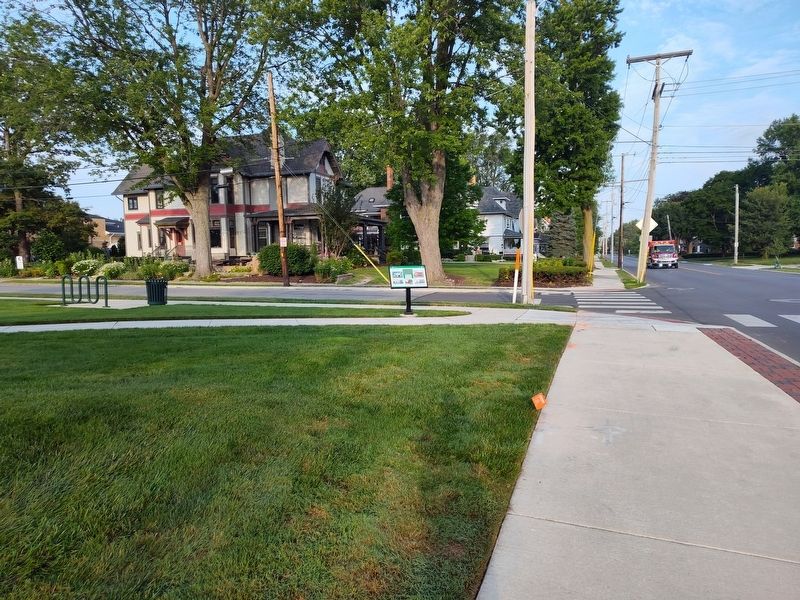
Location. 41° 22.494′ N, 83° 39.188′ W. Marker is in Bowling Green, Ohio, in Wood County. It is on West Wooster Street east of South Grove Street, on the right when traveling east. Touch for map. Marker is at or near this postal address: 222 W Wooster St, Bowling Green OH 43402, United States of America. Touch for directions.

Regionally, this marker is in the Black Swamp, in the Till Plains, and in the Toledo Metropolitan Area. It is also in the American Midwest and in the Corn Belt. Globally, it is in North America, on the Great Lakes, in the Western Hemisphere, in the Western World, and in the Anglosphere. Historically, it finds itself in what was once the Haudenosaunee (Iroquois) Confederacy, the territory of the Mississippian Culture, and the Northwest Territory.
Other nearby markers. At least 8 other markers are within walking distance of this marker: Historic Schools (within shouting distance of this marker); Welcome To Wooster Green (within shouting distance of this marker); Ties That Bind (within shouting distance of this marker); Historic Churches (within shouting distance of this marker); A Legacy of Public Service (about 300 feet away, measured in a direct line); Wiley Post No. 46 (about 400 feet away); Exchange Bank (about 700 feet away); The Four Corners (about 700 feet away). Touch for a list and map of all markers in Bowling Green.
Credits. This page was last revised on July 29, 2024. It was originally submitted on July 24, 2024, by Craig Doda of Napoleon, Ohio. This page has been viewed 433 times since then and 67 times this year. Photos: 1, 2. submitted on July 24, 2024, by Craig Doda of Napoleon, Ohio. • Devry Becker Jones was the editor who published this page.
