Bowling Green in Wood County, Ohio — The American Midwest (Great Lakes)
Historic Churches
Photographed by Craig Doda, July 21, 2024
1. Historic Churches Marker
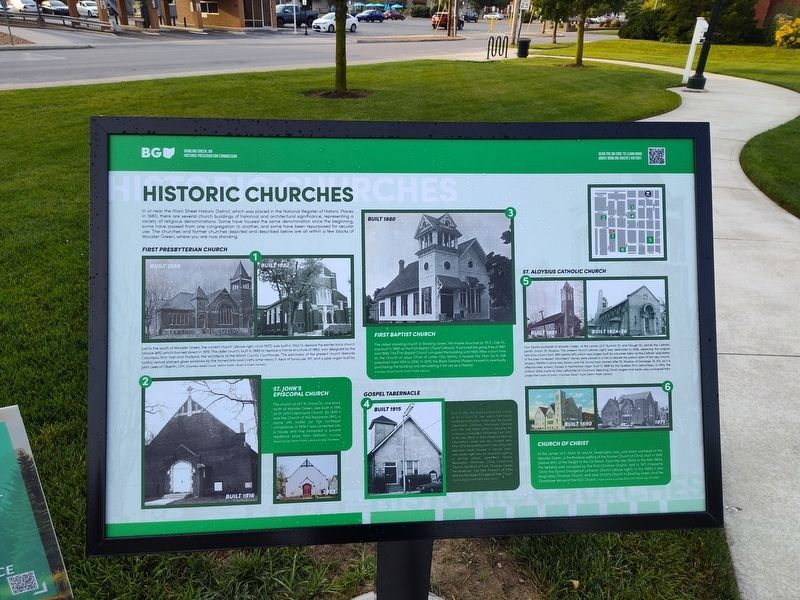
In or near the Main Street Historic District, which was placed in the National Register of Historic Places in 1980, there are several church buildings of historical and architectural significance, representing a variety of religious denominations. Some have housed the same denomination since the beginning, some have passed from one congregation to another, and some have been repurposed for secular use. The churches and former churches depicted and described below are all within a few blocks of Wooster Green, where you are now standing.
1 First Presbyterian Church
Just to the south of Wooster Green, the current church (above right, circa 1970) was built in 1922 to replace the earlier brick church (above left), which burned down in 1919. The older church, built in 1889 to replace a frame structure of 1860, was designed by the Columbus firm Yost and Packard, the architects of the Wood County Courthouse. The sanctuary of the present church features Gothic revival stained glass windows by the famed Arts and Crafts artist Henry F. Keck of Syracuse, NY, and a pipe organ built by John Leek of Oberlin, OH.
2 St. John'S Episcopal Church
The
this page online
3 First Baptist Church
The oldest standing church in Bowling Green, the frame structure at 115 E. Oak St, was built in 1880 as the First Baptist Church (above). It survived the great fires of 1887 and 1888. The First Baptist Church occupied the building until 1969. After a short time as the Church of Jesus Christ of Latter Day Saints, it housed the Plan Do & Talk preschool from 1974 to 2016. In 2019, the Black Swamp Players moved in, eventually purchasing the building and remodeling it for use as a theater.
4 Gospel Tabernacle
Built in 1915, this block-construction church at 123 E. Court St, two and a half blocks northeast of Wooster Green, was the Gospel Tabernacle Christian Missionary Alliance until the mid-1960s, when it became the Unitarian-Universalst Fellowship Holl (left) In the late 1960s, a draft (Selective Service)
Photographed by Craig Doda, July 21, 2024
2. Historic Churches Marker
5 St. Aloysius Catholic Church
Four blocks southeast of Wooster Green, at the corner of S. Summit St. and Clough St, stands the Catholic parish church St. Aloysius. The present church (above right) was dedicated in 1926, replacing the original red-brick church from 1881 (above left), which was largely built by volunteer labor as the Catholic population of the area increased. Volunteers' names were placed in a hat to decide the patron saint of the new church. Aloysius Pfeiffer's name was drown, and the church was named after St. Aloysius of Gonzaga. St. Al's, as it is affectionately known, houses a mechanical organ built in 1998 by the Québec firm Letourneau. In 2014, the brilliant 1930s mural by Felix Lieftuchter of Cincinnati, depicting Christ, angels and saints, was uncovered from under five coats of paint.
6 Church of Christ
At the corner of S. Main St. and W. Washington Ave., one block southeast of the Wooster Green, is the massive edifice of the former Church of Christ, built in 1890 (above left), at the height of the Oil Boom. From the late 1940s to the late 1960s, the building was occupied by the First Christian Church, and in 1971 it became Christ the Savior Evangelical Lutheran Church (above right). In the 1990s it was King's Way Christian Church, and later Christ's Church in Bowling Green and the Downtown Venue of the H2O Church.
Erected 2024 by Bowling Green, OH Historic Preservation Commission.
Topics and series. This historical marker is listed in this topic list: Religion & Religious Structures. In addition, it is included in the Unitarian Universalism (UUism) series list. A significant historical year for this entry is 1980.
Location. 41° 22.474′ N, 83° 39.143′ W. Marker is in Bowling Green, Ohio, in Wood County. It is on South Church Street south of West Wooster Street, on the right when traveling south. Touch for map. Marker is at or near this postal address: 100 S Church St, Bowling Green OH 43402, United States of America. Touch for directions.

Regionally, this marker is in the Black Swamp, in the Till Plains, and in the Toledo Metropolitan Area. It is also in the American Midwest and in the Corn Belt. Globally, it is in North America, on the Great Lakes, in the Western Hemisphere, in the Western World, and in the Anglosphere. Historically, it finds itself in what was once the Haudenosaunee (Iroquois) Confederacy, the territory of the Mississippian Culture, and the Northwest Territory.
Other nearby markers. At least 8 other markers are within walking distance of this marker: Ties That Bind (here, next to this marker); Welcome To Wooster Green (a few steps from this marker); Historic Schools (within shouting distance of this marker); A Legacy of Public Service (within shouting distance of this marker); Boom Town (within shouting distance of this marker); Wiley Post No. 46 (within shouting distance of this marker); The Four Corners (about 500 feet away, measured in a direct line); Exchange Bank (about 500 feet away). Touch for a list and map of all markers in Bowling Green.
Credits. This page was last revised on July 29, 2024. It was originally submitted on July 24, 2024, by Craig Doda of Napoleon, Ohio. This page has been viewed 369 times since then and 112 times this year. Photos: 1, 2. submitted on July 24, 2024, by Craig Doda of Napoleon, Ohio. • Devry Becker Jones was the editor who published this page.
