Bowling Green in Wood County, Ohio — The American Midwest (Great Lakes)
The Four Corners
Photographed by Craig Doda, July 21, 2024
1. The Four Corners Marker
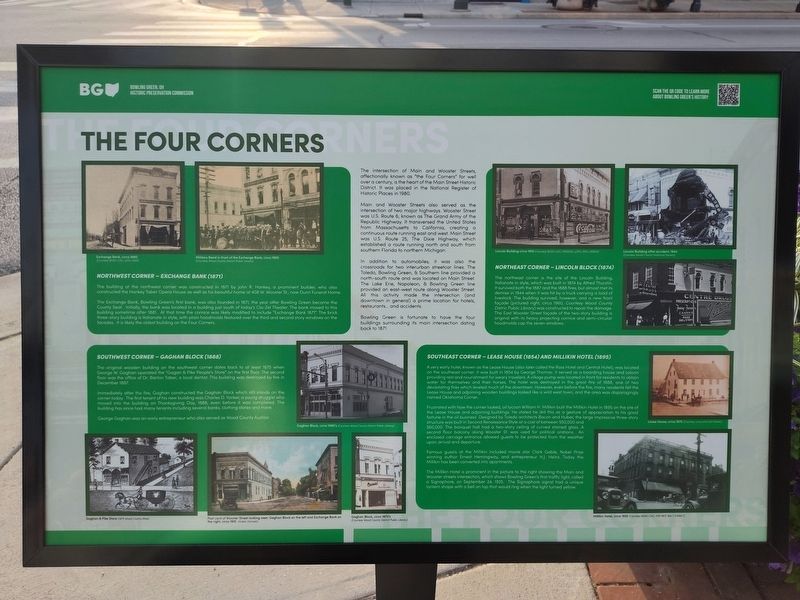
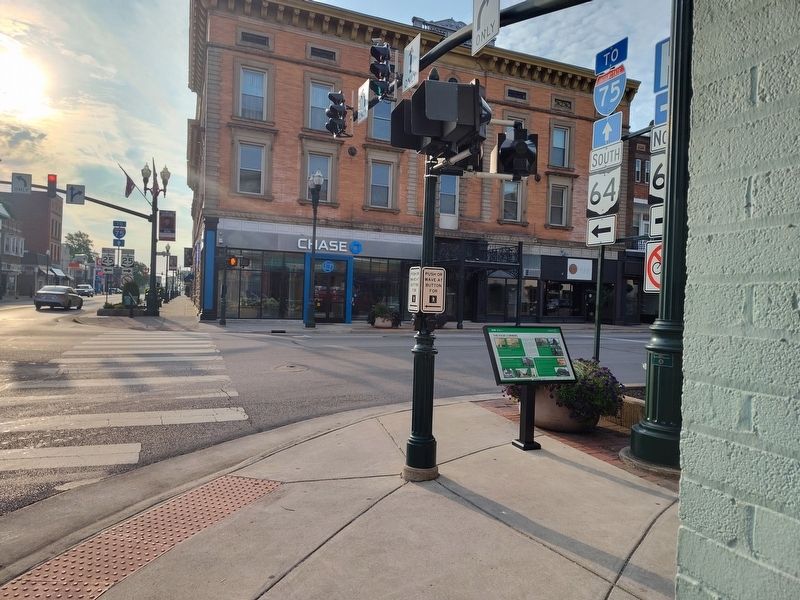
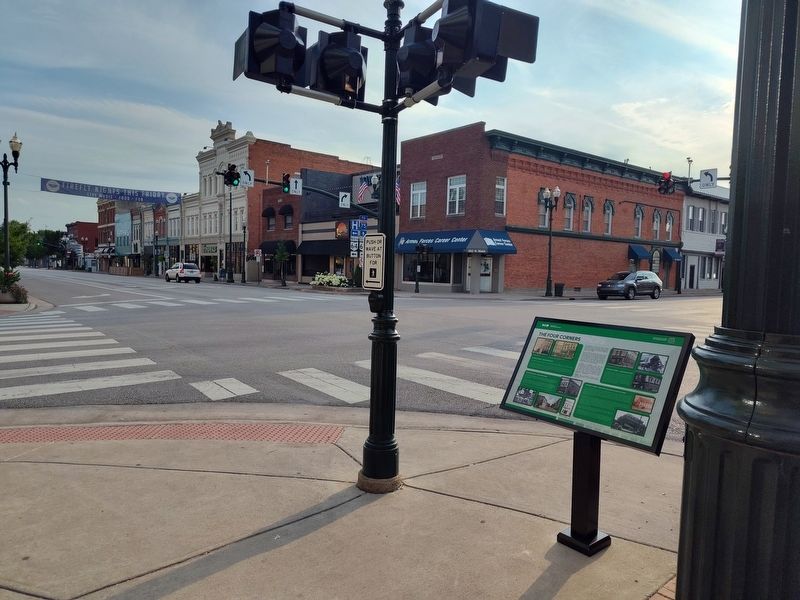
The intersection of Main and Wooster Streets, affectionally known as "the Four Corners" for well over a century, is the heart of the Main Street Historic District. It was placed in the National Register of Historic Places in 1980.
Main and Wooster Streets also served as the intersection of two major highways. Wooster Street was U.S. Route 6, known as The Grand Army of the Republic Highway. It transversed the United States from Massachusetts to California, creating a continuous route running east and west. Main Street was U.S. Route 25, The Dixie Highway, which established a route running north and south from southern Florida to northern Michigan.
In addition to automobiles, it was also the crossroads for two interurban streetcar lines. The Toledo, Bowling Green, & Southern line provided a north-south route and was located on Main Street. The Lake Erie, Napoleon, & Bowling Green line provided an east-west route along Wooster Street. All this activity made the intersection (and downtown in general) a prime location for hotels, restaurants... and accidents.
Bowling Green is fortunate to have the four buildings surrounding
this page online
Northwest Corner - Exchange Bank (1871)
The building at the northwest corner was constructed in 1871 by John R. Hankey, a prominent builder, who also constructed the Hankey Taber Opera House as well as his beautiful home at 408 W. Wooster St., now Dunn Funeral Home.
The Exchange Bank, Bowling Green's first bank, was also founded in 1871, the year after Bowling Green became the County Seat. Initially, the bank was located in a building just south of today's Cla-Zel Theater. The bank moved to this building sometime after 1881. At that time the cornice was likely modified to include "Exchange Bank 1871". The brick three-story building is Italianate in style, with plain hoodmolds featured over the third and second story windows on the facades. It is likely the oldest building on the Four Corners.
Southwest Corner-Gaghan Block (1888)
The original wooden building on the southwest corner dates back to at least 1875 when George W. Gaghan operated the "Gagan & Pike People's Store" on the first floor. The second floor was the office of Dr. Barton Taber, a local dentist. This building was destroyed
Photographed by Craig Doda, July 21, 2024
2. The Four Corners Marker
Immediately after the fire, Gaghan constructed the Gaghan Block which still stands on the corner today. The first tenant of his new building was Charles D. Yonker, a young druggist who moved into the building on Thanksgiving Day, 1888, even before it was completed. The building has since had many tenants including several banks, clothing stores and more. George Gaghan was an early entrepreneur who also served as Wood County Auditor.
Gaghan Block, circa 1990's
Northeast Corner - Lincoln Block (1874)
The northeast corner is the site of the Lincoln Building, Italianate in style, which was built in 1874 by Alfred Thurstin. It survived both the 1887 and the 1888 fires, but almost met its demise in 1944 when it was hit by a truck carrying a load of livestock. The building survived, however, and a new front façade (pictured right, circa 1960, Courtesy Wood County Distric Public Library) was constructed to repair the damage. The East Wooster Street façade of the two-story building is original with its heavy projecting cornice and semi-circular hoodmolds cap the seven windows.
Southeast Corner-Lease House (1854) and Millikin Hotel (1895)
A
Photographed by Craig Doda, July 21, 2024
3. The Four Corners Marker
Frustrated with how the corner looked, oil tycoon William H. Millikin built the Millikin Hotel in 1895 on the site of the Lease House and adjoining buildings. He stated he did this as a gesture of appreciation to his good fortune in the oil business. Designed by Toledo architects Bacon and Huber, the large impressive three-story structure was built in Second Renaissance Style at a cost of between $50,000 and $60,000. The banquet hall had a two-story ceiling of curved stained glass. A second floor balcony along Wooster St. was used for political orations. An enclosed carriage entrance allowed guests to be protected from the weather upon arrival and departure.
Famous guests at the Millikin included movie star Clark Gable, Nobel Prize winning author Ernest Hemingway, and entrepreneur H.J. Heinz. Today the Millikin has been converted into apartments.
The Millikin Hotel is prominent in the picture to the right showing the Main and Wooster streets intersection, which shows Bowling Green's first traffic light, called a Signaphore, on September 24, 1925. The Signaphore signal had a unique lantern shape with a bell on top that would ring when the light turned yellow.
Erected 2024 by Bowling Green, OH Historic Preservation Commission.
Topics. This historical marker is listed in this topic list: Industry & Commerce. A significant historical date for this entry is September 24, 1925.
Location. 41° 22.486′ N, 83° 39.033′ W. Marker is in Bowling Green, Ohio, in Wood County. It is at the intersection of South Main Street (Ohio Route 25) and West Wooster Street, on the right when traveling south on South Main Street. Touch for map. Marker is at or near this postal address: 100 S Main St, Bowling Green OH 43402, United States of America. Touch for directions.

Regionally, this marker is in the Black Swamp, in the Till Plains, and in the Toledo Metropolitan Area. It is also in the American Midwest and in the Corn Belt. Globally, it is in North America, on the Great Lakes, in the Western Hemisphere, in the Western World, and in the Anglosphere. Historically, it finds itself in what was once the Haudenosaunee (Iroquois) Confederacy, the territory of the Mississippian Culture, and the Northwest Territory.
Other nearby markers. At least 8 other markers are within walking distance of this marker: Bowling Green's Interurban & Rail Line (a few steps from this marker); Exchange Bank (within shouting distance of this marker); Commerce & Finance In Old Bowling Green (within shouting distance of this marker); Wiley Post No. 46 (about 300 feet away, measured in a direct line); The Main Street Historic District (about 300 feet away); Historic Main Street (about 300 feet away); The Changing Face of South Main (about 300 feet away); Entertainment For The Decades (about 300 feet away). Touch for a list and map of all markers in Bowling Green.
Credits. This page was last revised on July 29, 2024. It was originally submitted on July 24, 2024, by Craig Doda of Napoleon, Ohio. This page has been viewed 230 times since then and 42 times this year. Photos: 1, 2, 3. submitted on July 24, 2024, by Craig Doda of Napoleon, Ohio. • Devry Becker Jones was the editor who published this page.
