
Bowling Green in Wood County, Ohio — The American Midwest (Great Lakes)
Bowling Green's Interurban & Rail Line
Photographed by Craig Doda, July 21, 2024
1. Bowling Green's Interurban & Rail Line Marker
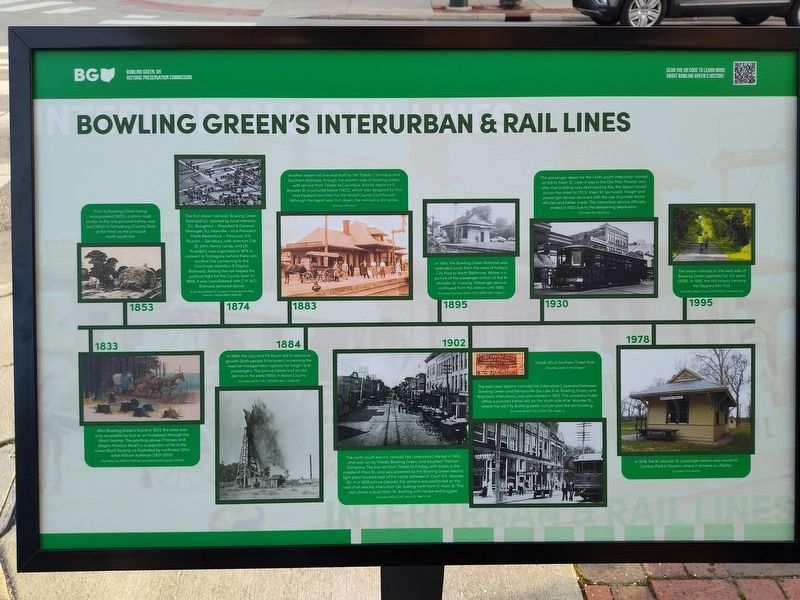
1833
After Bowling Green's found in 1833, the area was only accessible by foot or on horseback through the Black Swamp. The painting above ("Horses and Wagon Mired in Mud") is a depiction of life in the Great Black Swamp as illustrated by northwest Ohio artist William Kuhlman (1927-2015).
1853
Prior to Bowling Green being incorporated (1855), a plank road, similar to the one pictured below, was laid (1853) to Perrysburg (County Seat at the time) as the principal north-south link.
1874
The first steam railroad, Bowling Green Railroad Co. (started by local interests; S.L. Boughton - President & General Manager, A.J. Manville - Vice President, Frank Beverstock - Treasurer, A.A. Thurstin - Secretary, with directors S.W. St. John, Henry Lundy, and J.R. Rudulph), was organized in 1874 to connect to Tontogany (where there was another line connecting to the Cincinnati, Hamilton & Dayton Railroad). Adding the rail helped the political fight for the County Seat. In 1886, it was consolidated with C.H. & D. Railroad, pictured above.
1883
Another steam rail line was built by the Toledo, Columbus and Southern Railroad, through
this page online
1884
In 1884, the Gas and Oil Boom led to explosive growth (both people & factories), increasing the need for transportation options for freight and passengers. The picture below is of an old derrick in the early 1900s in Wood County.
1895
In 1895, the Bowling Green Railroad was extended south from the area of today's City Park to North Baltimore. Above is a picture of the passenger station at the W. Wooster St. crossing. Passenger service continued from this station until 1966.
1902
The north-south electric railroad line (interurban) started in 1902 and was run by Toledo, Bowling Green, and Southern Traction Company. The line ran from Toledo to Findlay, with tracks in the middle of Main St., and was powered by the Bowling Green electric light plant (located east of the tracks, between E. Court & E. Wooster St). In a 1908 picture (above), the camera was
Photographed by Craig Doda, July 21, 2024
2. Bowling Green's Interurban & Rail Line Marker
The east-west electric railroad line (interurban), operated between Bowling Green and Pemberville (by Lake Erie, Bowling Green, and Napoleon interurban), was also started in 1902. The company/ticket office is pictured below left, on the south side of W. Wooster St., where the old City Building peeks out just past the last building.
1930
The passenger depot for the north-south interurban started at 109 N. Main St. Later it was in the Del-Mar Theater and after that building was destroyed by fire, the depot moved across the street to 170 S. Main St. (pictured). Freight and passenger service declined with the use of private motor vehicles and better roads. The interurban service officially ended in 1930 due to the deepening depression.
1978
In 1978, the W. Wooster St. passenger station was moved to Carillon Park in Dayton, where it remains on display.
1995
The steam railroad on the west side of Bowling Green operated for 103 years (1978). In 1995, the old railway became the Slippery
Photographed by Craig Doda, July 21, 2024
3. Bowling Green's Interurban & Rail Line Marker
Erected 2024 by Bowling Green, OH Historic Preservation Commission.
Topics. This historical marker is listed in this topic list: Railroads & Streetcars. A significant historical year for this entry is 1833.
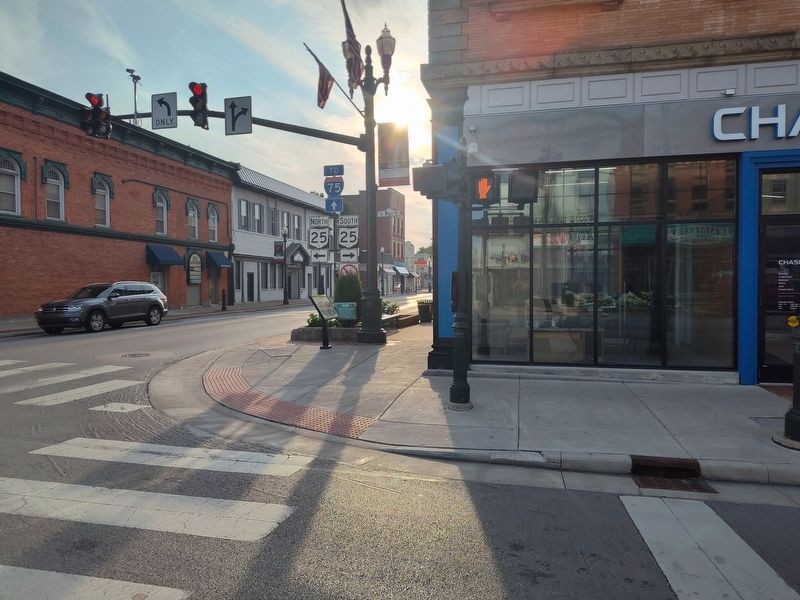
Location. 41° 22.491′ N, 83° 39.018′ W. Marker is in Bowling Green, Ohio, in Wood County. It is at the intersection of South Main Street (Ohio Route 25) and West Wooster Street, on the right when traveling north on South Main Street. Touch for map. Marker is at or near this postal address: 101 S Main St, Bowling Green OH 43402, United States of America. Touch for directions.

Regionally, this marker is in Ohio’s Black Swamp, in the Till Plains, and in the Toledo Metropolitan Area. It is also in the American Midwest and in the Corn Belt. Globally, it is in North America, on the Great Lakes, in the Western Hemisphere, in the Western World, and in the Anglosphere. Historically, it finds itself in what was once the Haudenosaunee (Iroquois) Confederacy, the territory of the Mississippian Culture, and the Northwest Territory.
Other nearby markers. At least 8 other markers are within walking distance of this marker: The Four Corners (a few steps from this marker); Exchange Bank (within shouting distance of this marker); Commerce & Finance In Old Bowling Green (within shouting distance of this marker); Entertainment For The Decades (about 300 feet away, measured in a direct line); The Main Street Historic District (about 300 feet away); The Changing Face of South Main (about 300 feet away); Historic Main Street (about 300 feet away); Wiley Post No. 46 (about 300 feet away). Touch for a list and map of all markers in Bowling Green.
Credits. This page was last revised on July 29, 2024. It was originally submitted on July 24, 2024, by Craig Doda of Napoleon, Ohio. This page has been viewed 778 times since then and 139 times this year. Photos: 1, 2, 3. submitted on July 24, 2024, by Craig Doda of Napoleon, Ohio. • Devry Becker Jones was the editor who published this page.
