Bowling Green in Wood County, Ohio — The American Midwest (Great Lakes)
The Changing Faces of North Main Street
Photographed by Craig Doda, July 21, 2024
1. The Changing Faces of North Main Street Marker
Fire! August 4, 1887 & October 31, 1888
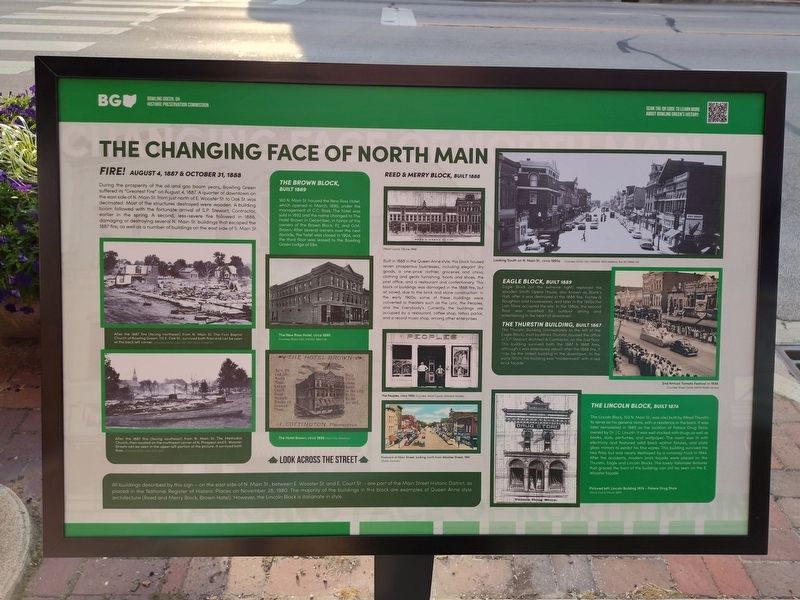
During the prosperity of the oil and gas boom years, Bowling Green suffered its "Greatest Fire" on August 4, 1887. A quarter of downtown on the east side of N. Main St. from just north of E. Wooster St. to Oak St. was decimated. Most of the structures destroyed were wooden. A building boom followed with the fortunate arrival of S.P. Stewart, Contractor, earlier in the spring. A second, less-severe fire followed in 1888, damaging or destroying several N. Main St. buildings that escaped the 1887 fire, as well as a number of buildings on the east side of S. Main St.
After the 1887 fire (facing northeast) from N. Main St. The First Baptist Church of Bowling Green, 115 E. Oak St., survived both fires and can be seen at the back left corner.
After the 1887 fire (facing southeast) from N. Main St. The Methodist Church, then located on the northwest corner of N. Prospect and E. Wooster Streets can be seen in the upper left portion of the picture. It survived both fires.
The Brown Block, Built 1889
160 N. Main St. housed the New Ross Hotel, which opened in March, 1890, under the management
this page online
Reed & Merry Block, Built 1888
Built in 1888 in the Queen Anne style, this block housed seven prosperous businesses, including elegant dry goods, a one-price clothier, groceries and china, clothing and gents furnishing, boots and shoes, the post office, and a restaurant and confectionary. This block of buildings was damaged in the 1888 fire, but all saved, due to the brick and stone construction. In the early 1900s, some of these buildings were converted to theaters such as the Lyric, the Peoples, and the Everybody's. Currently, the buildings are occupied by a restaurant, coffee shop, tattoo parlor, and a record music shop, among other enterprises.
Eagle Block, Built 1889
Eagle Block (on the extreme right) replaced the wooden Smith Opera House, also known as Blank's Hall, after it was destroyed in the 1888 fire. Froney & Boughton sold housewares,
Photographed by Craig Doda, July 21, 2024
2. The Changing Faces of North Main Street Marker
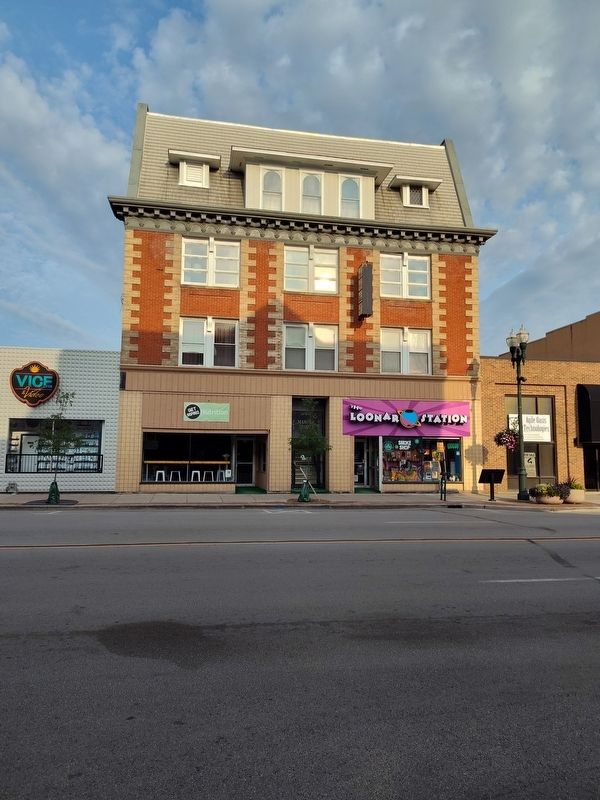
Looking across the street at the marker and the Masonic Temple Wood County Lodge No. 112.
The Thurstin Building, Built 1867
The Thurstin Building (immediately to the left of the Eagle Block), built by Alfred Thurstin, housed the office of S.P Stewart, Architect & Contractor, on the 2nd floor. This building survived both the 1887 & 1888 fires, although it was extensively rebuilt after the 1888 fire. It may be the oldest building in the downtown. In the early 1950s, the building was "modernized" with a red brick façade.
The Lincoln Block, Built 1874
The Lincoln Block, 102 N. Main St., was also built by Alfred Thurstin to serve as his general store, with a residence in the back. It was later remodeled in 1889 as the location of Palace Drug Store, owned by Dr. J.C. Lincoln. It was well stocked with drugs as well as books, dolls, perfumes, and wallpaper. The room was lit with electricity and featured solid black walnut fixtures, and plate glass mirrors to exhibit his fine wares. This building survived the two fires, but was nearly destroyed by a runaway truck in 1944. After the accidents, modern brick facade were placed on the Thurstin, Eagle and Lincoln Blocks. The lovely Italianate features that graced the front of the building, can still be seen on the E. Wooster facade.
All buildings described by this sign - on the east side of N. Main St., between E. Wooster St. and E. Court St. - are part of the Main Street Historic District, as placed in the National Register of Historic Places on November 28, 1980. The majority of the buildings in this block are examples of Queen Anne style architecture (Reed and Merry Block, Brown Hotel). However, the Lincoln Block is Italianate in style.
Erected 2024 by Bowling Green, OH Historic Preservation Commission.
Topics. This historical marker is listed in this topic list: Industry & Commerce. A significant historical month for this entry is March 1890.
Location. 41° 22.554′ N, 83° 39.033′ W. Marker is in Bowling Green, Ohio, in Wood County. It is at the intersection of North Main Street (Ohio Route 25) and West Court Street, on the right when traveling south on North Main Street. Touch for map. Marker is at or near this postal address: 153 N Main St, Bowling Green OH 43402, United States of America. Touch for directions.

Regionally, this marker is in the Black Swamp, in the Till Plains, and in the Toledo Metropolitan Area. It is also in the American Midwest and in the Corn Belt. Globally, it is in North America, on the Great Lakes, in the Western Hemisphere, in the Western World, and in the Anglosphere. Historically, it finds itself in what was once the Haudenosaunee (Iroquois) Confederacy, the territory of the Mississippian Culture, and the Northwest Territory.
Other nearby markers. At least 8 other markers are within walking distance of this marker: Entertainment For The Decades (within shouting distance of this marker); Serving The Citizens of Bowling Green (about 300 feet away, measured in a direct line); Exchange Bank (about 300 feet away); Bowling Green's Interurban & Rail Line (about 400 feet away); The Four Corners (about 400 feet away); Wiley Post No. 46 (about 500 feet away); Court Street Connections (about 500 feet away); A Legacy of Public Service (about 500 feet away). Touch for a list and map of all markers in Bowling Green.
Credits. This page was last revised on July 29, 2024. It was originally submitted on July 24, 2024, by Craig Doda of Napoleon, Ohio. This page has been viewed 336 times since then and 67 times this year. Photos: 1, 2. submitted on July 24, 2024, by Craig Doda of Napoleon, Ohio. • Devry Becker Jones was the editor who published this page.
