Bowling Green in Wood County, Ohio — The American Midwest (Great Lakes)
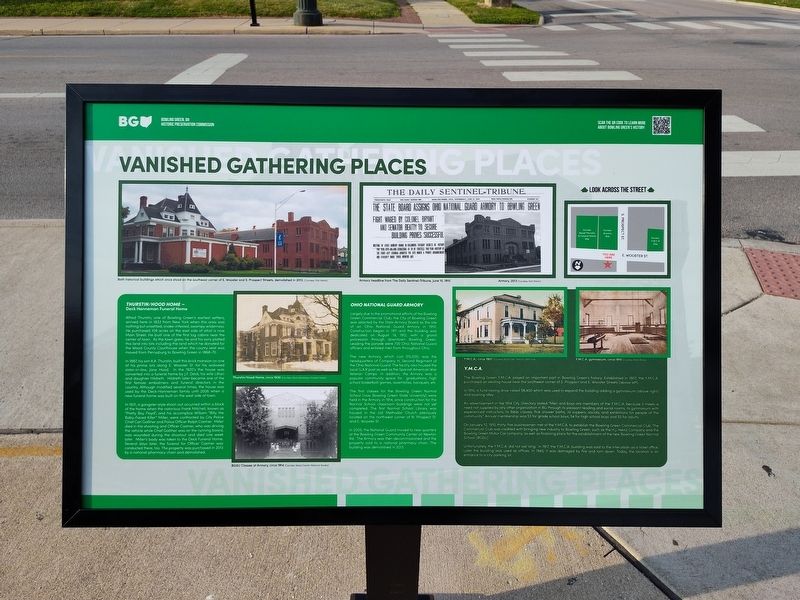
Vanished Gathering Places
Photographed by Craig Doda, July 21, 2024
1. Vanished Gathering Places Marker
Thurstin/Hood Home
Deck Hanneman Funeral Home
Alfred Thurstin, one of Bowling Green's earliest settlers, arrived here in 1833 from New York when this area was nothing but unsettled, snake-infested, swampy wilderness. He purchased 109 acres on the east side of what is now Main Street. He built one of the first log cabins near the center of town. As the town grew, he and his sons platted this land into lots including the land which he donated for the Wood County Courthouse when the county seat was moved from Perrysburg to Bowling Green in 1868-70.
In 1887, his son AA. Thurstin, built this brick mansion on one of his prime lots along E. Wooster St. for his widowed sister-in-law, Jane Hood. In the 1920's the house was converted into a funeral home by J.F. Deck, his wife Lillian and daughter Hildreth. Hildreth later became one of the first female embalmers and funeral directors in the country. Although modified several times, the house was used by the Deck-Hanneman family until 2006 when a new funeral home was built on the west side of town.
In 1931, a gangster-style shoot-out occurred within a block. of the home when
this page online
Ohio National GBuard Armory
Largely due to the promotional efforts of the Bowling Green Commercial Club, the City of Bowling Green was selected by the State Armory Board as the site of an Ohio National Guard Armory in 1910. Construction began in 1911 and the building was dedicated on August 19, 1912, with a grand procession through downtown Bowling Green. Leading the parade were 700 Ohio National Guard officers and enlisted men from throughout Ohio.
The new Armory, which cost $15,000, was the headquarters of Company H, Second Regiment of the Ohio
Photographed by Craig Doda, July 21, 2024
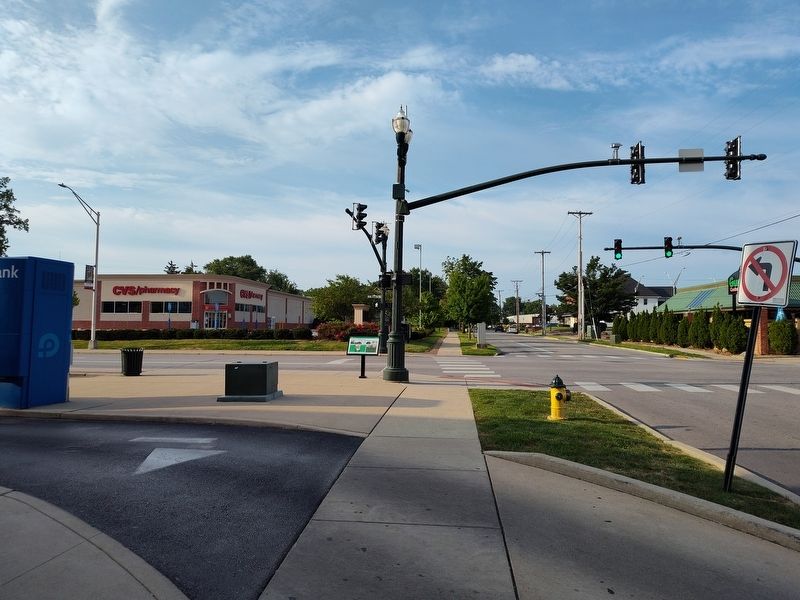
2. Vanished Gathering Places Marker
The first classes for the Bowling Green Normal. School (now Bowling Green State University) were held in the Armory in 1914, since construction for the Normal School classroom buildings were not yet completed. The first Normal School Library was housed in the old Methodist Church previously. located on the northwest corner of N. Prospect St. and E. Wooster St.
In 2005, the National Guard moved to new quarters of the Bowling Green Community Center on Newton Rd. The Armory was then decommissioned and the property sold to a national pharmacy chain. The building was demolished in 2013.
Y.M.C.A.
The Bowling Green YM.C.A played an important part in Bowling Green's history. Established in 1907, the YMCA purchased an existing house near the southwest corner of S. Prospect and E. Wooster Streets (above left).
In 1910, a fund raising drive raised $8,400 which was used to expand the building adding a gymnasium (above right) and bowling alley.
An advertisement in the 1914 City Directory stated "Men and boys are members of the YM.C.A. because it meets a need not supplied by any other organization in BG through its pleasant reading and social rooms, its gymnasium with experienced instructors, its Bible classes, fine shower baths, its suppers, socials, and exhibitions for people of the community. Annual membership was $3 for grade school boys, $4 for high school boys and $5 for adults.
On January 10, 1910, thirty-five businessmen met at the Y.M.C.A. to establish the Bowling Green Commercial Club. The Commercial Club was credited with bringing new industry to Bowling Green, such as the H.J. Heinz Company and the Bowling Green Motor Car company, as well as finalizing plans for the establishment of the new Bowling Green Normal School (BGSU).
Unfortunately, the YMCA. did not last long. In 1917, the YM.C.A. building was sold to the interurban as a ticket office. Later the building was used as offices. In 1945, it was damaged by fire and torn down. Today, the location is an entrance to a city parking lot.
Erected 2024 by Bowling Green, OH Historic Preservation Commission.
Topics. This historical marker is listed in these topic lists: Architecture • Notable Places. A significant historical date for this entry is January 10, 1910.
Location. 41° 22.497′ N, 83° 38.919′ W. Marker is in Bowling Green, Ohio, in Wood County. It is at the intersection of East Wooster Street and North Prospect Street, on the right when traveling west on East Wooster Street. Touch for map. Marker is at or near this postal address: 215 E Wooster St, Bowling Green OH 43402, United States of America. Touch for directions.

Regionally, this marker is in the Black Swamp, in the Till Plains, and in the Toledo Metropolitan Area. It is also in the American Midwest and in the Corn Belt. Globally, it is in North America, on the Great Lakes, in the Western Hemisphere, in the Western World, and in the Anglosphere. Historically, it finds itself in what was once the Haudenosaunee (Iroquois) Confederacy, the territory of the Mississippian Culture, and the Northwest Territory.
Other nearby markers. At least 8 other markers are within walking distance of this marker: Echoes Of The Past: Prospect & Wooster (a few steps from this marker); Court Street Connections (about 300 feet away, measured in a direct line); Bowling Green's Interurban & Rail Line (about 500 feet away); Wood County WWI & WWII Memorial (about 500 feet away); Wood County In The Civil War (about 500 feet away); Wood County Congressional Medal Of Honor Recipients (about 500 feet away); Wood County Persian Gulf War Memorial (about 500 feet away); Wood County Vietnam War Memorial (about 500 feet away). Touch for a list and map of all markers in Bowling Green.
Other markers no longer nearby. Wood County Flag Monument (was about 500 feet away but has been permanently removed); Wood County World War I & II Veterans Memorial (was about 500 feet away but has been permanently removed).
Credits. This page was last revised on July 29, 2024. It was originally submitted on July 24, 2024, by Craig Doda of Napoleon, Ohio. This page has been viewed 261 times since then and 37 times this year. Photos: 1, 2. submitted on July 24, 2024, by Craig Doda of Napoleon, Ohio. • Devry Becker Jones was the editor who published this page.
