Tsentralnyy okrug in Moskva, Russia — Россия (Eastern Europe or Northern Asia)
Бела Кун
⎯⎯⎯
Béla Kun
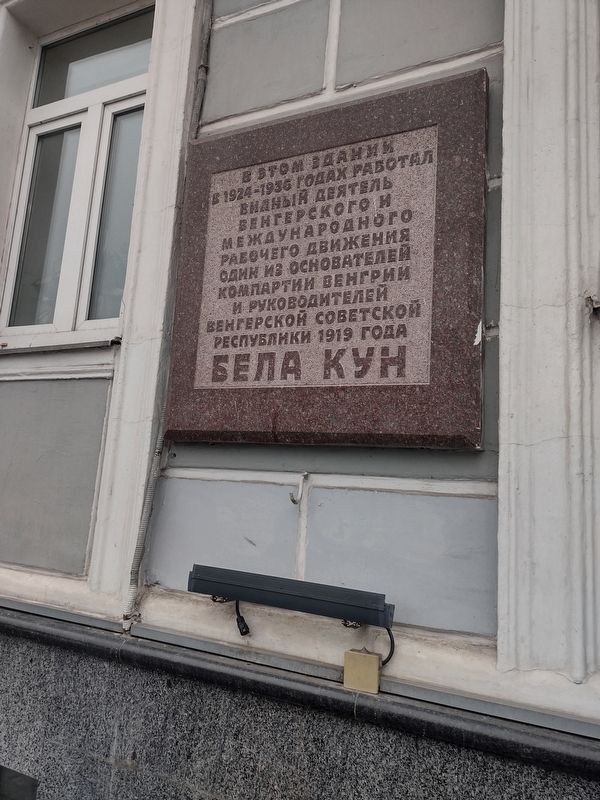
Photographed by Charles Berman, November 29, 2021
1. Béla Kun Marker

в 1924-1936 годах работал
видный деятель
венгерского и
междурародного
рабочего движения
один из основателей
компартии венгрии
и руководителей
венгерской советской
республики 1919 года
Бела Кун
In this
this page online
Topics. This historical marker is listed in these topic lists: Government & Politics • Patriots & Patriotism. A significant historical year for this entry is 1919.
Location. 55° 45.136′ N, 37° 36.678′ E. Marker is in Tsentralnyy okrug, Moskva. It is at the intersection of Vozdvizhenka Street and Mokhovaya Street on Vozdvizhenka Street. The marker is on the south side of Sapozhkovaya Ploshchad'. Touch for map. Marker is at or near this postal address: Vozdvizhenka Street 1, Tsentralnyy okrug, Moskva 12500-9, Russia. Touch for directions.

Regionally, it is on the Pacific Rim. Historically, it finds itself in what was once the Soviet Union and also the Russian Empire.
Other nearby markers. At least 8 other markers are within walking distance of this marker: Antonio Gramsci (here, next to this marker); Хо Ши Мин / Ho Chi Minh (a few steps from this marker); Vladimir Lenin (about 210 meters away, measured in a direct line); Clergy house and monastery cells (approx. 0.3 kilometers away); Aleksandr Pushkin (approx. 0.4 kilometers away); Pyotr Nikolaevich Lebedev (approx. 0.4 kilometers away); Dormition Cathedral (approx. 0.4 kilometers away); Kremlin Dormition Cathedral (approx. 0.4 kilometers away). Touch for a list and map of all markers in Tsentralnyy okrug.
Also see . . . Béla Kun (Wikipedia).
Overview: Béla Kun (born Béla Kohn; 20 February 1886 – 29 August 1938) was a Hungarian communist revolutionary and politician who governed the Hungarian Soviet Republic in 1919. After attending Franz Joseph University at Kolozsvár (today Cluj-Napoca, Romania), Kun worked as a journalist up until the First World War. He served in the Austro-Hungarian Army and was captured by the Imperial Russian Army in 1916, after which he was sent to a prisoner-of-war camp in the Urals. Kun embraced communist ideas during his time in Russia, and in 1918 he co-founded a Hungarian arm of the Russian Communist Party in Moscow. He befriended Vladimir Lenin and fought for the Bolsheviks in the Russian Civil War.(Submitted on July 25, 2024, by Charles Berman of Binghamton, New York.)
Credits. This page was last revised on July 28, 2024. It was originally submitted on July 25, 2024, by Charles Berman of Binghamton, New York. This page has been viewed 139 times since then and 22 times this year. Photo 1. submitted on July 25, 2024, by Charles Berman of Binghamton, New York. • Andrew Ruppenstein was the editor who published this page.
Editor’s want-list for this marker. photo of the marker within its surroundings • Can you help?
