Tsentralnyy rayon in Saint Petersburg in Sankt-Peterburg, Leningrad Oblast, Russia — Россия (Eastern Europe or Northern Asia)
Shell traces
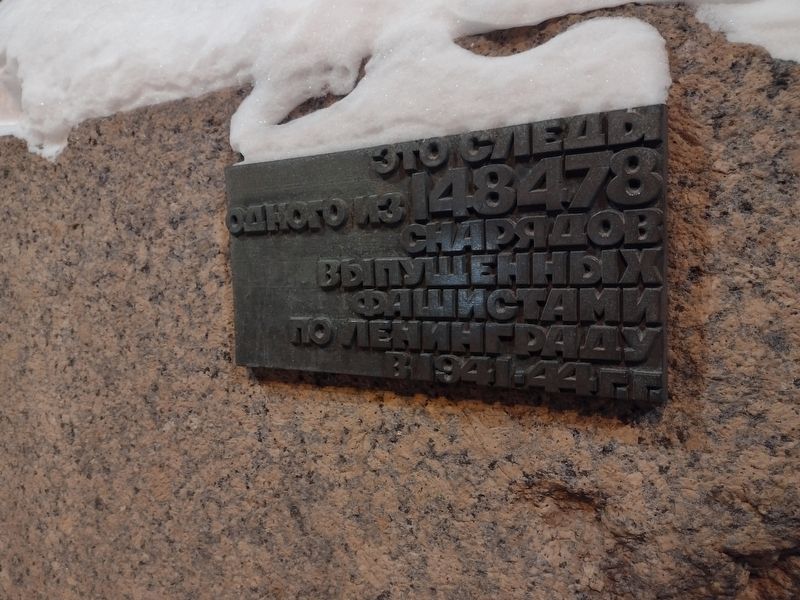
Photographed by Charles Berman, December 1, 2021
1. Shell traces Marker

Это следы
одного из 148478
снарядов
выпущенных
фашистами
по Ленинграду
в 1941-1944 г.г.
Topics. This memorial is listed in this topic list: War, World II.
Location. 59° 56.006′ N, 30° 20.579′ E. Memorial is in Saint Petersburg, Leningrad Oblast, in Sankt-Peterburg. It is in Tsentralnyy rayon. It is on Nevsky Prospekt. The marker is on the north side of the Anichkov Bridge, on the western end. Touch for map. Memorial is in this post office area: Saint Petersburg, Leningrad Oblast 19102-3, Russia. Touch for directions.

Regionally, it is in Europe and on the Pacific Rim. Historically, it finds itself in what was
this page online
Other nearby markers. At least 8 other markers are within 3 kilometers of this marker, measured as the crow flies: S. Shustov 19th Century Architecture (about 150 meters away, measured in a direct line); Yusupova’s House (approx. 0.4 kilometers away); Church of the Entry of the Lord into Jerusalem (approx. one kilometer away); Kulikov Vladimir Evgenievich (approx. one kilometer away); 1924 and 1975 Floods (approx. 1.6 kilometers away); 1824 Flood (approx. 1.6 kilometers away); 1752, 1777 and 1788 Floods (approx. 1.6 kilometers away); Carthouse (approx. 2.3 kilometers away in Sankt-Peterburg). Touch for a list and map of all markers in Saint Petersburg.
Regarding Shell traces. https://en.wikipedia.org/wiki/Siege_of_Leningrad
Also see . . . Siege of Leningrad (Wikipedia).
Overview: The Siege of Leningrad was a prolonged military siege undertaken by the Axis powers and co-belligerent Finland against the Soviet city of Leningrad (present-day Saint Petersburg) on the Eastern Front of World War II. Germany's Army Group North advanced from the south, while the German-allied Finnish army invaded from the north and completed the ring around the city.(Submitted on August 8, 2024, by Charles Berman of Binghamton, New York.)
The siege began on 8 September 1941, when the Wehrmacht severed the last road to the city. Although Soviet forces managed to open a narrow land corridor to the city on 18 January 1943, the Red Army did not lift the siege until 27 January 1944, 872 days (125 weeks) after it began. The siege became one of the longest and most destructive sieges in history, and it was possibly the costliest siege in history due to the number of casualties which were suffered throughout its duration. An estimated 1.5 million people died as a result of the siege…
Credits. This page was last revised on December 7, 2025. It was originally submitted on July 25, 2024, by Charles Berman of Binghamton, New York. This page has been viewed 120 times since then and 14 times this year. Photo 1. submitted on July 25, 2024, by Charles Berman of Binghamton, New York. • Andrew Ruppenstein was the editor who published this page.
