Hurley in Ulster County, New York — The American Northeast (Mid-Atlantic)
Hurley — Site of a Masterpiece
Photographed by Cosmos Mariner, May 14, 2024
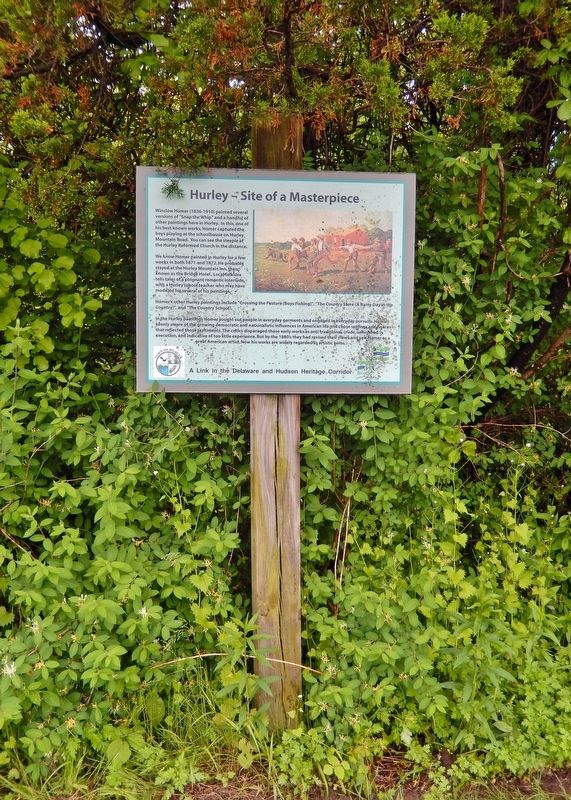
1. Hurley — Site of a Masterpiece Marker
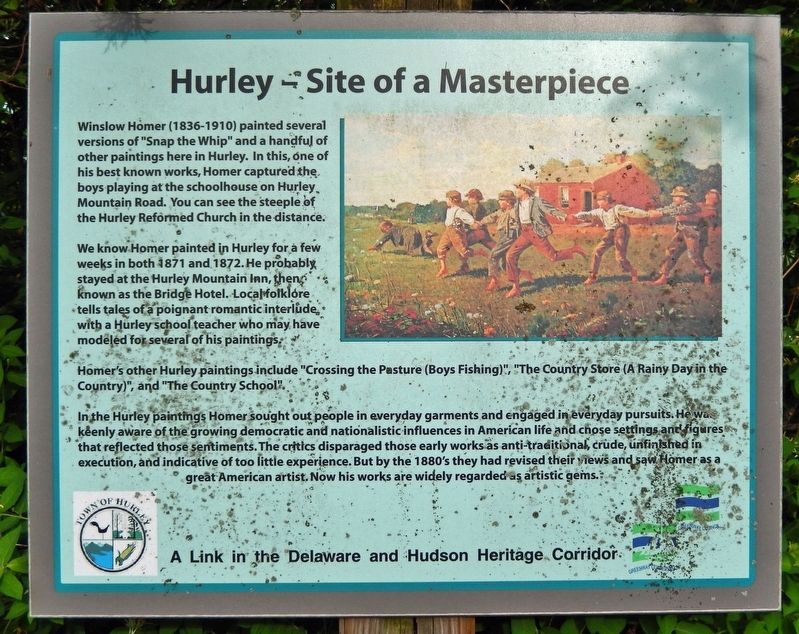
Winslow Homer (1836-1910) painted several versions of "Snap the Whip" and a handful of other paintings here in Hurley. In this, one of his best known works, Homer captured the boys playing at the schoolhouse on Hurley Mountain Road. You can see the steeple of the Hurley Reformed Church in the distance.
We know Homer painted in Hurley for a few weeks in both 1871 and 1872. He probably stayed at the Hurley Mountain Inn, then known as the Bridge Hotel. Local folklore tells tales of a poignant romantic interlude with a Hurley school teacher who may have modeled for several of his paintings.
Homer's other Hurley paintings include "Crossing the Pasture (Boys Fishing)", "The Country Store (A Rainy Day in the Country)", and "The Country School".
In the Hurley paintings Homer sought out people in everyday garments and engaged in everyday pursuits. He was keenly aware of the growing democratic and nationalistic influences in American life and chose settings and figures that reflected those sentiments. The critics disparaged those early works as anti-traditional, crude, unfinished in execution, and indicative of too little experience.
this page online
A Link in the Delaware and Hudson Heritage Corridor
Erected by Town of Hurley.
Topics. This historical marker is listed in this topic list: Arts, Letters, Music. A significant historical year for this entry is 1871.
Location. 41° 56.027′ N, 74° 3.259′ W. Marker is in Hurley, New York, in Ulster County. It is on U.S. 209 0.8 miles north of Wynkoop Road (County Road 29A), on the right when traveling north. The marker is located beside the Hurley O&W Rail Trail. Touch for map. Marker is in this post office area: Hurley NY 12443, United States of America. Touch for directions.

Regionally, this marker is in Upstate New York and in the Hudson Valley. It is also in the American Northeast, in the Mid-Atlantic, and on the Eastern Seaboard. Globally, it is in the North Atlantic Region, North America, the Western Hemisphere, the Western World, and the Anglosphere. Historically, it finds itself in what was once New Netherland and also one of the original Thirteen Colonies.
Other nearby markers. At
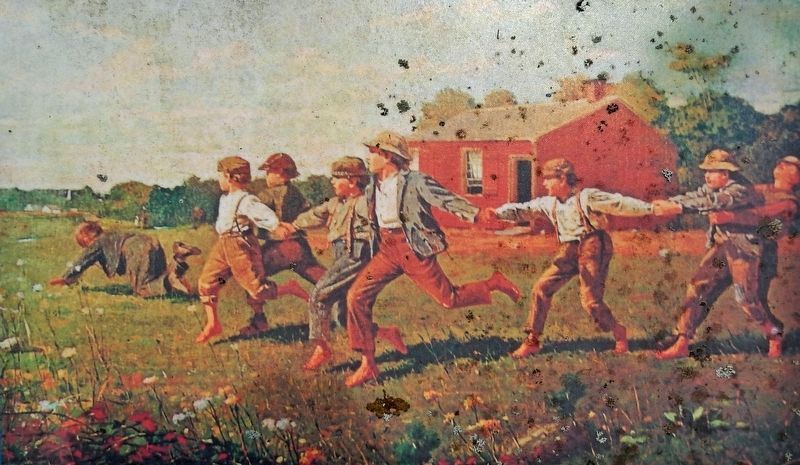
2. Marker detail: Snap the Whip by Winslow Homer
Also see . . .
1. Winslow Homer (Wikipedia). Excerpt:
Winslow Homer was an American landscape painter and illustrator, best known for his marine subjects. He is considered one of the foremost painters of 19th-century America and a preeminent figure in American art in general. Largely self-taught, Homer began his career working as a commercial illustrator. He subsequently took up oil painting and produced major studio works characterized by the weight and density he exploited from the medium. He also worked extensively in watercolor, creating a fluid and prolific oeuvre, primarily chronicling his working vacations.(Submitted on July 25, 2024, by Cosmos Mariner of Cape Canaveral, Florida.)
2. Winslow Homer (National Gallery of Art).
Photographed by Cosmos Mariner, May 15, 2024
3. Hurley — Site of a Masterpiece Marker
In 1859 he moved to New York City, where began his career as a painter. He visited the front during the Civil War and his first important paintings were of Civil War subjects. In 1867 he spent a year in France. At Gloucester, Massachusetts, in 1873 he began to paint in watercolor. In 1875 he submitted his last drawing to Harper's Weekly, ending his career as an illustrator. He traveled widely in the 1870s in New York State, to Virginia, and Massachusetts, and in 1881 he began a two-year stay in England, living in Cullercoats, near Newcastle.(Submitted on July 25, 2024, by Cosmos Mariner of Cape Canaveral, Florida.)
Returning to America in 1883, he settled at Prout's Neck, Maine, where he would live for the rest of his life. He continued to travel widely, to the Adirondacks, Canada, Bermuda, Florida, and the Caribbean, in all those places painting the watercolors upon which much of his later fame would be based.
Photographed by Cosmos Mariner, May 14, 2024
4. Hurley — Site of a Masterpiece Marker
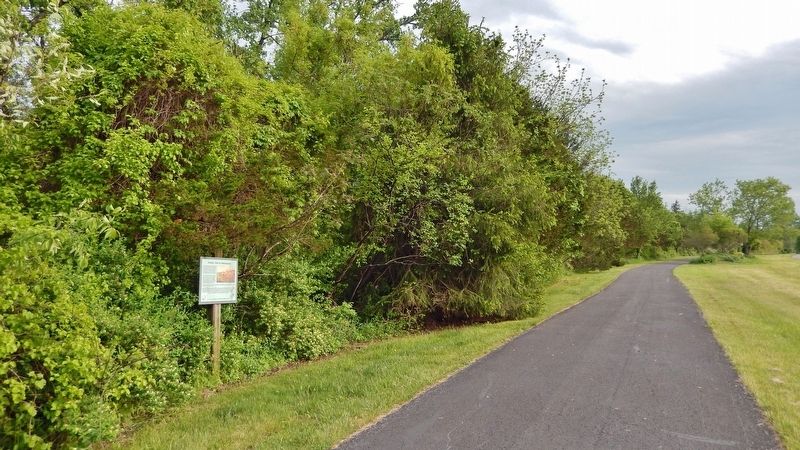
Looking south along the Hurley O&W Rail Trail.
Credits. This page was last revised on July 25, 2024. It was originally submitted on July 25, 2024, by Cosmos Mariner of Cape Canaveral, Florida. This page has been viewed 410 times since then and 56 times this year. Photos: 1, 2, 3, 4. submitted on July 25, 2024, by Cosmos Mariner of Cape Canaveral, Florida.
