Tybee Island in Chatham County, Georgia — The American South (South Atlantic)
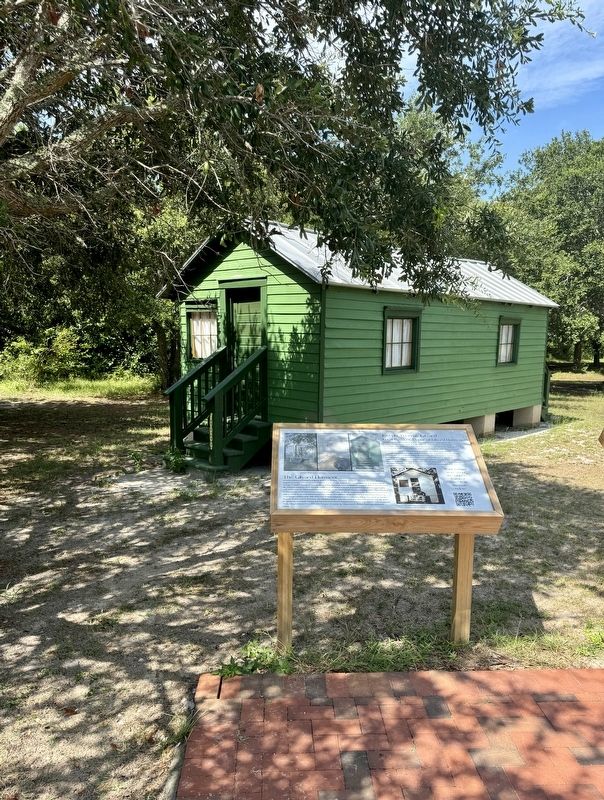
The Gilyard Hutment
Photographed by Brandon D Cross
1. The Gilyard Hutment Marker
this page online
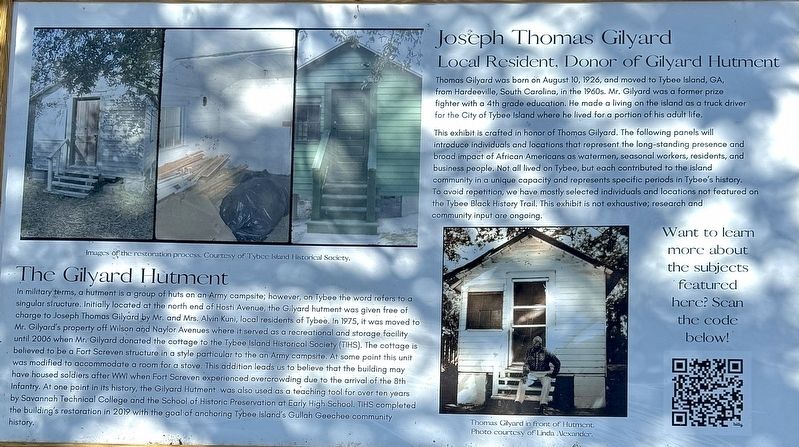
Joseph Thomas Gilyard
Local Resident. Donor of Gilyard Hutment
Thomas Gilyard was born on August 10, 1926, and moved to Tybee Island, GA, from Hardeeville, South Carolina, in the 1960s. Mr. Gilyard was a former prize fighter with a 4th grade education. He made a living on the island as a truck driver for the City of Tybee Island where he lived for a portion of his adult life.
This exhibit is crafted in honor of Thomas Gilyard. The following panels will introduce individuals and locations that represent the long-standing presence and broad impact of African Americans as watermen, seasonal workers, residents, and business people. Not all lived on Tybee, but each contributed to the island community in a unique capacity and represents specific periods in Tybee's history. To avoid repetition, we have mostly selected individuals and locations not featured on the Tybee Black History Trail. This exhibit is not exhaustive; research and community input are ongoing.
(captions)
Images of the restoration process. Courtesy of Tybee Island Historical Society.
Thomas Gilyard in front of Hutment Photo courtesy of Linda Alexander
Erected by Tybee
Photographed by Brandon D Cross
2. The Gilyard Hutment Marker
Topics. This historical marker is listed in this topic list: African Americans.
Location. 32° 1.312′ N, 80° 50.73′ W. Marker is on Tybee Island, Georgia, in Chatham County. It can be reached from the intersection of Meddin Drive and Tom Lynch Loop, on the right when traveling south. Located on the south side of the Lighthouse. Touch for map. Marker is at or near this postal address: 30 Meddin Drive, Tybee Island GA 31328, United States of America. Touch for directions.

Regionally, this marker is on the Coastal Plain, on the Georgia Coast and the Golden Isles, in Greater Savannah, and on the Sea Islands. It is also in the American South, specifically in the Deep South, and on the Eastern Seaboard. Globally, it is in the North Atlantic Region, North America, the Western Hemisphere, the Western World, and the Anglosphere. Historically, it finds itself in what was once New Spain, the territory of the Mississippian Culture, one of the original Thirteen Colonies, one of the Confederate States of America, and the Antebellum South.
Other nearby markers. At least 8 other markers are within walking distance of this marker: Albertha “Bertha” Lucas Tattnall and Edward “Bones” Tattnall/Henrietta Farabee (here, next to this marker); Louis Green and Joseph Sanders/John Curry (here, next to this marker); T.J. Carter/Jeff Williams (here, next to this marker); Annie Dickerson/James “Jim” Jones (here, next to this marker); Fogerty - Hosti Cottage (a few steps from this marker); Second Assistant Keeper's Cottage 1861 (within shouting distance of this marker); Fuel Storage Building 1890 (within shouting distance of this marker); First Assistant Keeper's Cottage 1885 (within shouting distance of this marker). Touch for a list and map of all markers in Tybee Island.
Also see . . .
1. Gylliard Cottage. (Submitted on July 25, 2024, by Brandon D Cross of Flagler Beach, Florida.)
2. Tybee Black History Trail Markers ‘We’re learning about the people who lived here’. (Submitted on July 25, 2024, by Brandon D Cross of Flagler Beach, Florida.)
Credits. This page was last revised on July 26, 2024. It was originally submitted on July 25, 2024, by Brandon D Cross of Flagler Beach, Florida. This page has been viewed 154 times since then and 24 times this year. Photos: 1, 2. submitted on July 25, 2024, by Brandon D Cross of Flagler Beach, Florida. • Bernard Fisher was the editor who published this page.
