
Casco Antiguo in Sevilla, Andalucía, Spain — Southwestern Europe (Iberian Peninsula)
Most Holy Virgin of Hope gold crown
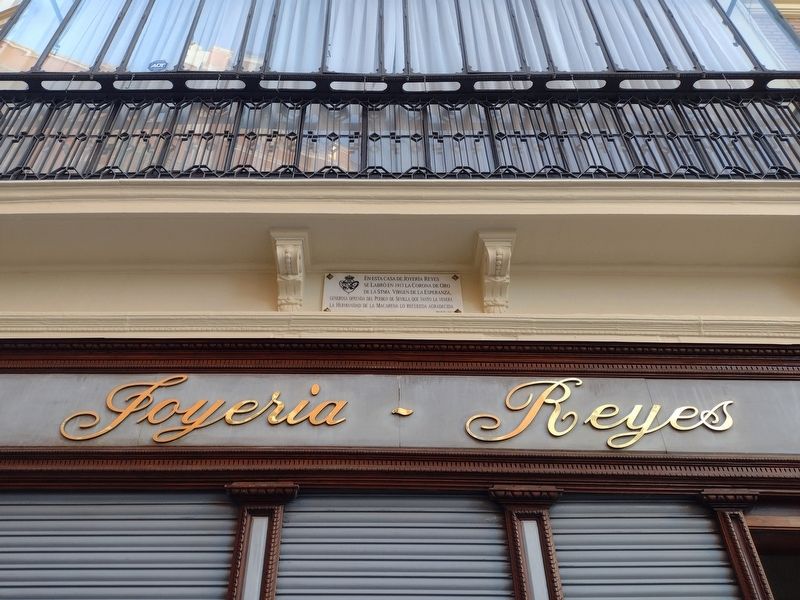
Photographed by Charles Berman, November 23, 2023
1. Most Holy Virgin of Hope gold crown Marker

Marzo 2013
In this Reyes jewellers’ house was worked in 1913 the gold crown of the Most Holy Virgin of Hope, generous offering of the people of Seville, who so venerate her. The Brotherhood of Macarena remembers it gratefully.
March 2013
Erected 2013.
Topics. This historical marker is listed in these topic lists: Arts, Letters, Music • Religion & Religious Structures. A significant historical month for this entry is March 2013.
Location. 37° 23.352′ N, 5° 59.603′ W. Marker is in Sevilla, Andalucía. It is in Casco Antiguo. It is on Calle Álvarez Quintero, on the right when traveling south. Touch for map. Marker is at or near this postal address: C Álvarez Quintero 14, Sevilla, Andalucía 41004, Spain. Touch for directions.

Regionally, it is in the North Atlantic Region, on the Atlantic Arc, in Europe, in the European Union, in Atlantic Europe, on the Iberian Peninsula,
this page online
Other nearby markers. At least 5 other markers are within walking distance of this marker: Don José Luís Luque Rodríguez-Almansa (approx. 0.4 kilometers away); Society of Jesus and Cervantes (approx. 0.4 kilometers away); Don Pablo de Olavide y Jáuregui (approx. 0.6 kilometers away); Seville Fair and Béquer (approx. 0.9 kilometers away); Maria Isabel de Orleans y Borbón (approx. one kilometer away).
Also see . . . Virgin of Hope of Macarena (Wikipedia).
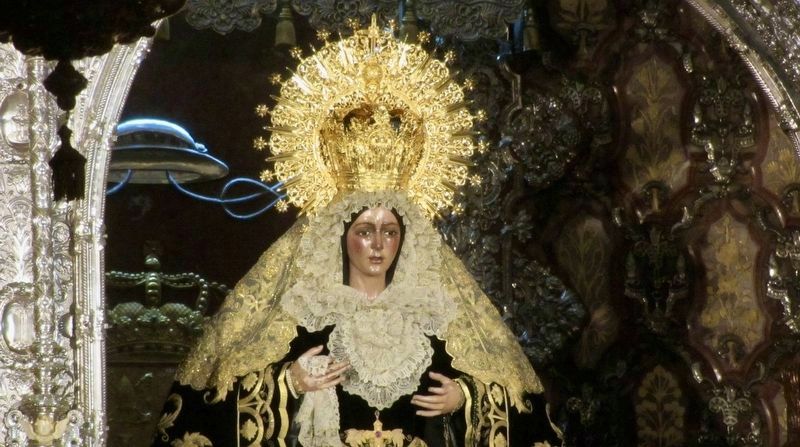
Overview: The Virgin of Hope of Macarena (Spanish: Virgen de la Esperanza Macarena), popularly known as the Virgin of Macarena or simply La Macarena, is a Roman Catholic title of the Blessed Virgin Mary associated with a pious 17th century wooden image of the Blessed Virgin venerated in the Basilica de la Macarena in Seville, Spain. The Marian title falls under a category of Our Lady of Sorrows commemorating the desolate grievance and piety of the Virgin Mary during Holy Week. The image is widely considered as a national(Submitted on July 29, 2024, by Charles Berman of Binghamton, New York.)treasure by the Spanish people, primarily because of its religious grandeur during Lenten celebrations.Photographed by HaguardduNord (via Wikimedia Commons under CC 4.0 license), November 11, 20172. Virgin of Macarena - with crown
Credits. This page was last revised on July 29, 2024. It was originally submitted on July 27, 2024, by Charles Berman of Binghamton, New York. This page has been viewed 119 times since then and 10 times this year. Photos: 1. submitted on July 27, 2024, by Charles Berman of Binghamton, New York. 2. submitted on July 29, 2024. • Andrew Ruppenstein was the editor who published this page.
