
Fricourt in Somme, Upper France, France — Western Europe
Fricourt
Les Batailles de la Somme
Photographed by J. Makali Bruton, June 10, 2024
1. Fricourt Marker

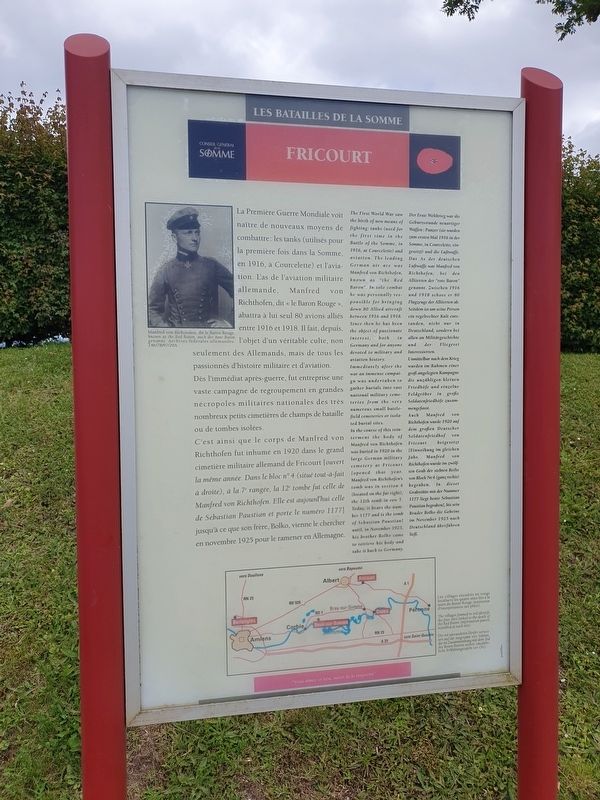
La Première Guerre Mondiale voit naître de nouveaux moyens de combattre: les tanks (utilisés pour la première fois dans la Somme, en 1916, à Courcelette) et l'aviation. L'as de l'aviation militaire allemande, Manfred Richthofen, dit « le Baron Rouge », abattra à lui seul 80 avions alliés von entre 1916 et 1918. Il fait, depuis, l'objet d'un véritable culte, non seulement des Allemands, mais de tous les passionnés d'histoire militaire et d'aviation.
Dès l'immédiat après-guerre, fut entreprise une vaste campagne de regroupement en grandes nécropoles militaires nationales des très nombreux petits cimetières de champs de bataille ou de tombes isolées.
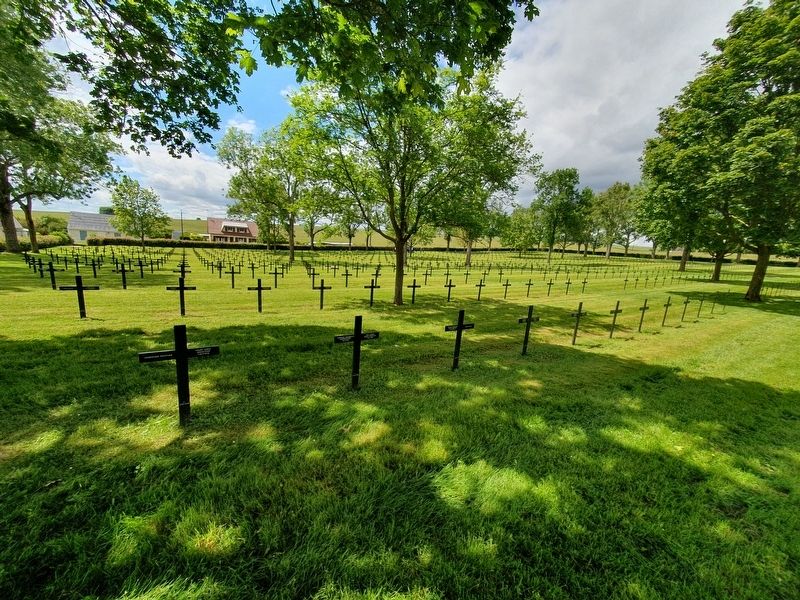
C'est ainsi que le corps de Manfred von Richthofen fut inhumé en 1920 dans le grand cimetière militaire allemand de Fricourt [ouvert la même année. Dans le bloc n° 4 (situé tout-à-fait à droite), à la 7' rangée, la 12' tombe fut celle de Manfred von Richthofen. Elle est aujourd'hui celle de Sebastian Paustian et porte le numéro 1177] jusqu'à ce que son frère, Bolko, vienne le chercher en novembre 1925 pour le ramener en Allemagne.
Manfred
this page online
Les villages encadrés en rouge localisent les quatre sites liés à la mort du Baron Rouge (panneaux d'interprétation sur place).
Fricourt
The First World War saw the birth of new means of fighting: tanks (used for the first time in the Battle of the Somme, in 1916, at Courcelette) and aviation. The leading German air ace was Manfred von Richthofen, Richthofen, known as "the Red Baron". In solo combat he was personally responsible for bringing down 80 Allied aircraft between 1916 and 1918. Since then he has been the object of passionate interest, both in Germany and for anyone devoted to military and aviation history.
Immediately after the war an immense campaign was undertaken to gather burials into vast national military cemeteries from the very numerous small battlefield cemeteries or isolated burial sites.
In the course of this reinterment the body of Manfred von Richthofen was buried in 1920 in the large German military cemetery at Fricourt [opened that year. Manfred von Richthofen’s tomb was in section 4 (located on the far right), the 12th tomb in row 7. Today it bears the number 1177 and is the tomb of Sebastian Paustian] until, in November 1925, his brother
Photographed by J. Makali Bruton, June 10, 2024
2. Fricourt Marker
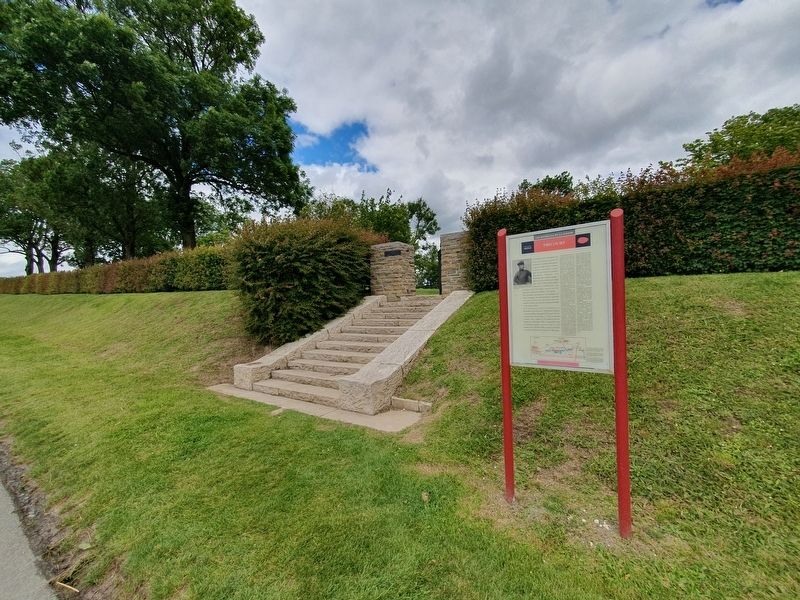
The villages framed in red identify the four sites linked to the death of the Red Baron (information panels installed at each site).
Fricourt
Der Erste Weltkrieg war die Geburtsstunde neuartiger Waffen: Panzer (sie wurden zum ersten Mal 1916 in der Somme, in Courcelette, eingesetzt) und die Luftwaffe. Das As der deutschen Luftwaffe war Manfred von Richthofen, bei den Alliierten der "rote Baron" genannt. Zwischen 1916 und 1918 schoss er 80 Flugzeuge der Alliierten ab. Seitdem ist um seine Person ein regelrechter Kult entstanden, nicht nur in Deutschland, sondern bei allen an Militärgeschichte und der Fliegerei interessierten.
Unmittelbar nach dem Krieg wurden im Rahmen einer groß angelegten Kampagne die unzähligen kleinen Friedhöfe und einzelne Feldgrober in große Soldatenfriedhöfe zusam mengefasst.
Auch Manfred von Richthofen wurde 1920 auf Von dem großen Deutscher Soldatenfriedhof Fricourt beigesetzt [Einweihung im gleichen Jahr. Manfred von Richthofen wurde im zwölften Grab der siebten Reihe von Block Nr.4 (ganz rechts) In dieser begraben. Grabstätte mit der Nummer 1177 liegt heute Sebastian Paustian begraben), bis sein Bruder Bolko die Gebeine im November 1925 nach Deutschland überführen ließ.
Die rot umrandeten Dörfer verweisen
Photographed by J. Makali Bruton, June 10, 2024
3. Fricourt Cemetery and former grave site of von Richthofen
The former grave site was the nearest grave on the left in this view.
Topics. This historical marker is listed in this topic list: War, World I. A significant historical month for this entry is November 1925.
Location. 50° 0.26′ N, 2° 42.866′ E. Marker is in Fricourt, Hauts-de-France (Upper France), in Somme. It is on Rue de Pozières (Route D147), on the right when traveling north. Touch for map. Marker is at or near this postal address: 21 Rue de Pozières, Fricourt, Hauts-de-France 80300, France. Touch for directions.

Regionally, it is in the North Atlantic Region, Europe, the European Union, Atlantic Europe, the Schengen Area, Western Europe, a coastal Mediterranean country, and the Western World. Historically, it finds itself in what was once a French colony and also the Roman Empire.
Other nearby markers. At least 8 other markers are within 2 kilometers of this marker, measured as the crow flies: Fricourt German Military Cemetery (a few steps from this marker); Fricourt New Military Cemetery (approx. 0.6 kilometers away); Fricourt 1914-1918 Memorial (approx. 0.8 kilometers away); Peake Wood Cemetery (approx. 1.6 kilometers away); 15th and 16th Royal Scots (approx. 1.7 kilometers away); An account by Pte. Billy Disbrey (approx. 1.7 kilometers away); The Sacrifice of All Nations (approx. 1.7 kilometers away); T'isnt worth it.... (approx. 1.7 kilometers away). Touch for a list and map of all markers in Fricourt.
Credits. This page was last revised on August 9, 2024. It was originally submitted on July 28, 2024, by J. Makali Bruton of Washington, District of Columbia. This page has been viewed 221 times since then and 21 times this year. Photos: 1, 2, 3. submitted on July 28, 2024, by J. Makali Bruton of Washington, District of Columbia.
