Notre Dame in St. Joseph County, Indiana — The American Midwest (Great Lakes)
Rockne, Texas
Photographed by Sean Flynn, July 27, 2024
1. Rockne, Texas Marker
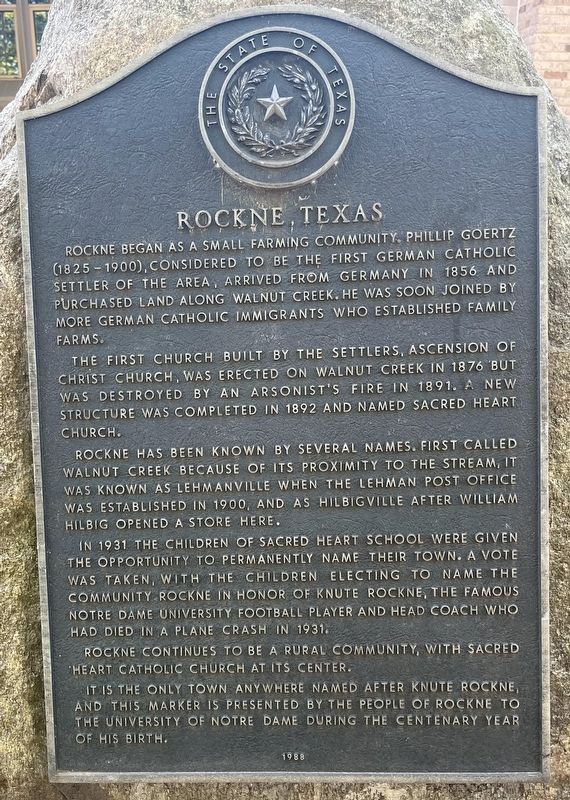
Rockne began as a small farming community. Phillip Goertz (1825-1900), considered to be the first German Catholic settler of the area, arrived from Germany in 1856 and purchased land along Walnut Creek. He was soon joined by more German Catholic immigrants who established family farms.
The first church built by the settlers, Ascension of Christ Church, was erected on Walnut Creek in 1876 but was destroyed by an arsonist's fire in 1891. A new structure was completed in 1892 and named Sacred Heart Church.
Rockne has been known by several names. First called Walnut Creek because of its proximity to the stream, it was known as Lehmanville when the Lehman Post Office was established in 1900, and a Hilbigville after William Hilbig opened a store here.
In 1931 the children of Sacred Heart
this page online
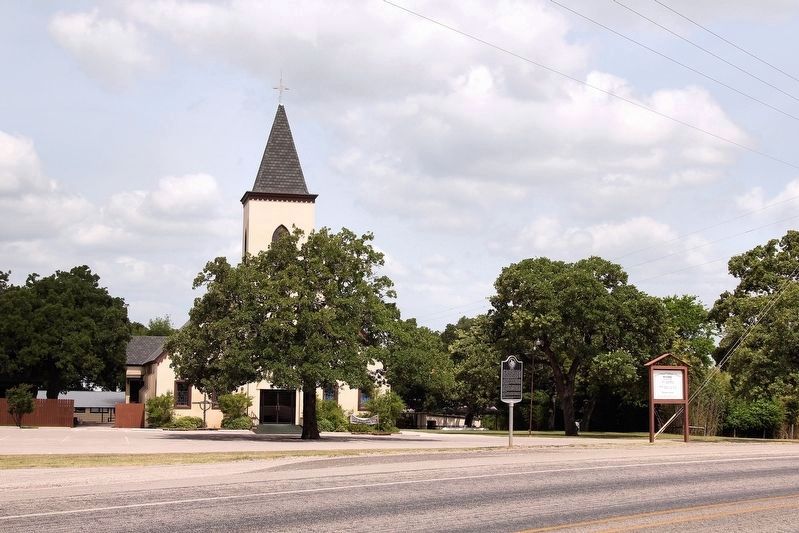
Rockne continues to be a rural community, with Sacred Heart Catholic Church at its center.
It is the only town anywhere named after Knute Rockne, and this marker is presented by the People of Rockne to the University of Notre Dame during the centenary year of his birth.
Erected 1988 by the people of Rockne, Texas.
Topics. This historical marker is listed in these topic lists: Education • Religion & Religious Structures • Settlements & Settlers • Sports. A significant historical year for this entry is 1888.
Location. 41° 42.011′ N, 86° 14.613′ W.
Photographed by Sean Flynn, July 27, 2024
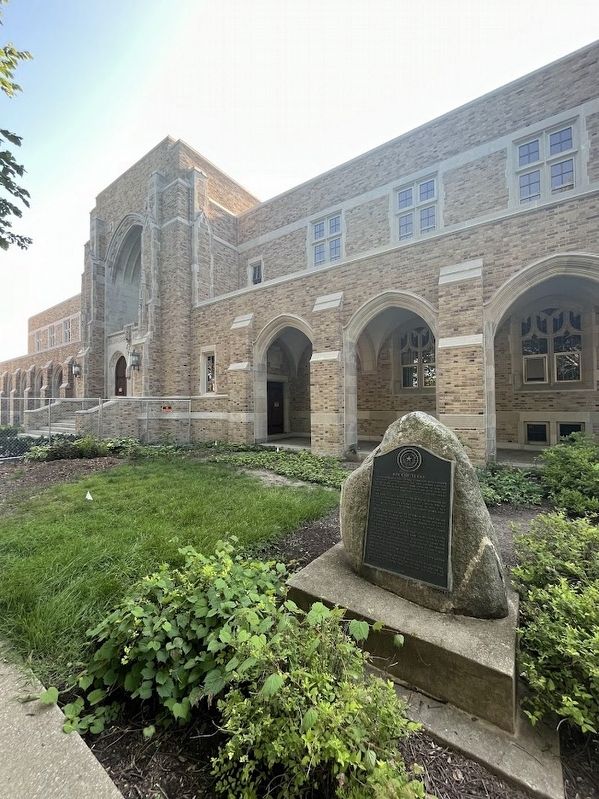
2. Rockne, Texas Marker and Rockne Memorial

Regionally, this marker is in Northern Indiana and in Greater South Bend. It is also in the American Midwest and in the Corn Belt. Globally, it is in North America, the Western Hemisphere, the Western World, and the Anglosphere. Historically, it finds itself in what was once the territory of the Mississippian Culture and also the Northwest Territory.
Other nearby markers. At
Photographed by Sean Flynn, July 27, 2024
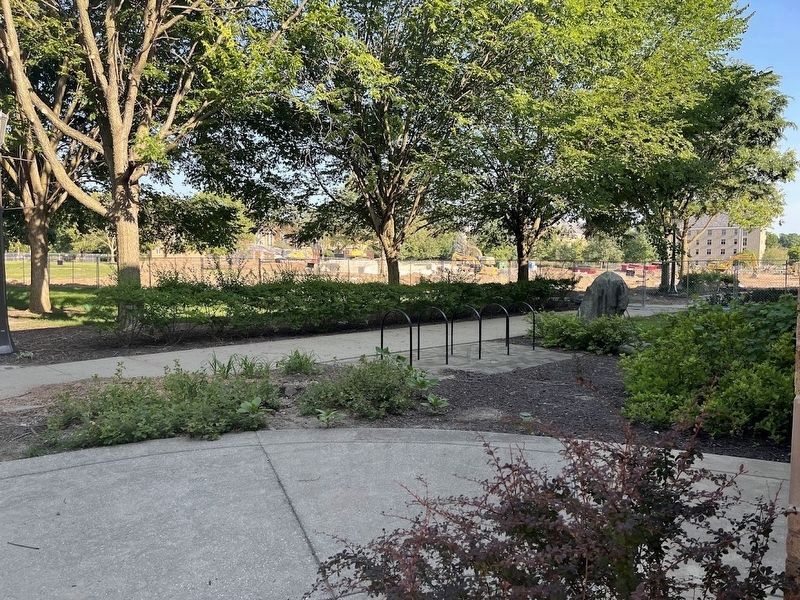
3. Rockne, Texas Marker Reverse
The area to the south and east of Rockne Memorial was under construction during the summer of 2024 as Notre Dame razed Pangborn and Fisher halls, to be replaced by two new residence halls.
More about this marker. A nearly identical marker can be found in Rockne, Texas, a small town 30 miles east of Austin and about 1,200 miles southwest of the University of Notre Dame in Indiana. That 2006 marker is officially titled "Rockne" and is marker #9223 from the Texas Historical
Library of Congress, Bain News Service photograph collection
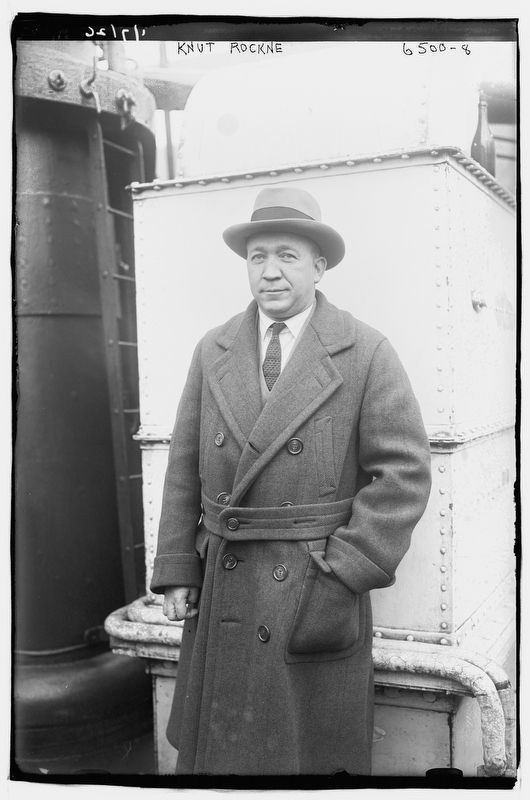
4. Knute Rockne (1888-1931)
The Notre Dame version dates to 1988; while it follows the typical style of Texas historical markers, it does not appear to have been officially issued by the Texas Historical Commission and is not on its official database. Additionally, instead of a Texas Historical Commission logo at the top, it has a seal of the state of Texas.
This marker on Notre Dame's campus sits in front of Rockne Memorial, a student recreation building erected in 1939 in honor of the school's famed football coach, who died in a plane crash in eastern
Photographed by Larry D. Moore, June 7, 2018
5. "Rockne" Marker in Rockne, Texas
A picture of the nearly identical marker in front of Sacred Heart Catholic Church in Rockne, Texas, about 1,200 miles southwest of the University of Notre Dame.
Related marker. Click here for another marker that is related to this marker. The nearly identical marker in Rockne, Texas
Also see . . .
1. Early History of Rockne, Texas. A history of Rockne, Texas, from its first German settlers in 1846 to its christening as Rockne, about 85 years later.
Excerpt: "In August of(Submitted on July 28, 2024, by Sean P. Flynn of Oak Park, Illinois.)1931, Fr. Francis Strobel proposed that Sacred Heart Parish community have an official name. School children were given the choice to vote on the names Knute Rockne or Joyce Kilmer. The boys voted for the football coach and the girls voted for the poet resulting in a tie. The next day Edith Goertz changed her vote giving the community its name, 'Rockne'."Photographed by Lou Donkle, May 21, 20246. Knute Rockne statue in lobby of the Knute Rockne Memorial Building

2. Rockne Memorial. A short history and description of Rockne Memorial, a recreation building on the campus of the University of Notre Dame. (Submitted on July 28, 2024, by Sean P. Flynn of Oak Park, Illinois.)
3. Welcome to Rockne, a Texas town named after the coaching icon. (Submitted on July 28, 2024, by Sean P. Flynn of Oak Park, Illinois.)
Credits. This page was last revised on August 26, 2024. It was originally submitted on July 28, 2024, by Sean P. Flynn of Oak Park, Illinois. This page has been viewed 401 times since then and 54 times this year. Photos: 1, 2, 3, 4. submitted on July 28, 2024, by Sean P. Flynn of Oak Park, Illinois. 5. submitted on June 7, 2018, by Larry D. Moore of Del Valle, Texas. 6. submitted on August 19, 2024, by Lou Donkle of Valparaiso, Indiana.
