White Sands in Doña Ana County, New Mexico — The American Mountains (Southwest)
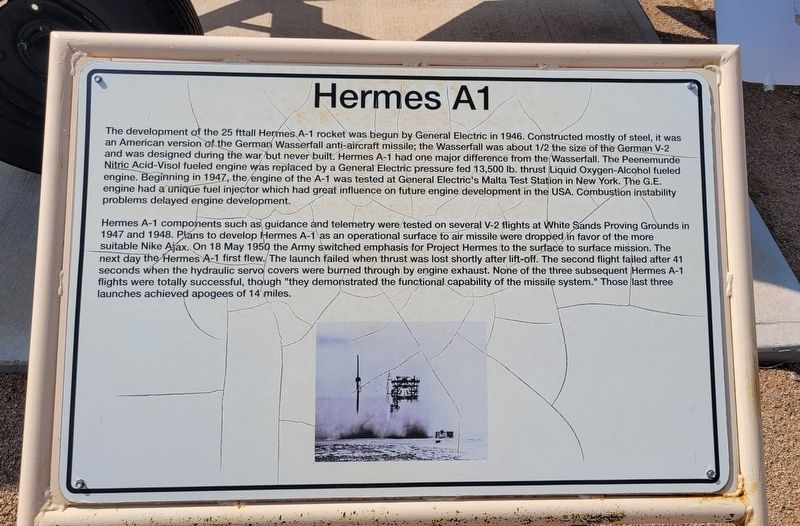
Hermes A1
Photographed by James Hulse, July 23, 2024
1. Hermes A1 Marker
Hermes A-1 components such as guidance and telemetry were tested on several V-2 flights at White Sands Proving Grounds in 1947 and 1948. Plans to develop Hermes A-1 as an operational surface to air missile were dropped in favor of the more suitable Nike Ajax. On 18 May 1950 the Army switched emphasis for Project Hermes to the surface to surface mission.
this page online
Erected by White Sands Missile Range Museum.
Topics. This historical marker is listed in this topic list: Air & Space. A significant historical date for this entry is May 18, 1950.
Location. 32° 23.128′ N, 106° 28.691′ W. Marker is in White Sands, New Mexico, in Doña Ana County. It is on Wsmr P Rt 1 (New Mexico Route 213) 4 miles south of U.S. 70. The marker and various missiles are located on the grounds of the White Sands Missile Range Museum. Touch for map. Marker is in this post office area: White Sands Missile Range NM 88002, United States of America. Touch for directions.

Regionally, this marker is in the Rio Grande Valley. It is also in the American Borderlands and in the Southwest. Globally, it is in North America,

Photographed by James Hulse, July 23, 2024
2. The Hermes A1 and Marker
Other nearby markers. At least 8 other markers are within walking distance of this marker: Fat Man Bomb Casing (here, next to this marker); IGOR (here, next to this marker); Tracking Telescopes at White Sands Missile Range (a few steps from this marker); Clyde Tombaugh (1906-1997) (a few steps from this marker); Cinetheodolite (a few steps from this marker); Anatomy of the Type IV (T-4) Tracking Telescope (a few steps from this marker); The Type IV (T-4) Tracking Telescope at Mule Peak (a few steps from this marker); Patriot Missile (a few steps from this marker). Touch for a list and map of all markers in White Sands.
More about this marker. The marker and museum are located on the White Sands Missile Range, an active U.S. military installation. The museum is open to the public, but appropriate identification is required for access.
Also see . . .
1. Hermes program. Wikipedia
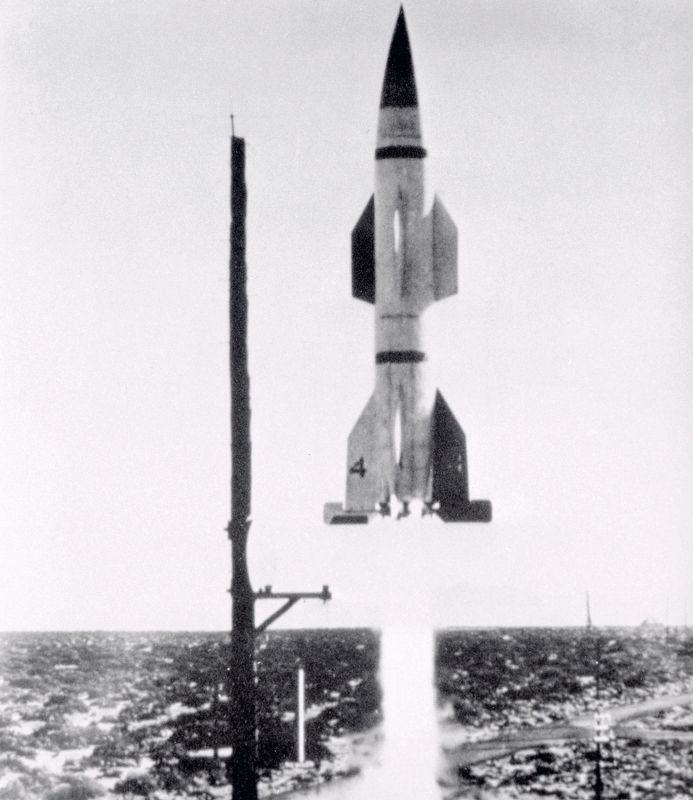
Project Hermes was a missile research program run by the Ordnance(Submitted on July 28, 2024, by James Hulse of Medina, Texas.)Corps of the United States Army from November 15, 1944, to December 31, 1954, in response to Germany's rocket attacks in Europe during World War II. The program was to determine the missile needs of army field forces. A research and development partnership between the Ordnance Corps and General Electric started November 20, 1944 and resulted in the "development of long-range missiles that could be used against both ground targets and high-altitude aircraft.Public Domain - NASA photo, May 1, 19503. Hermes A1 Test LaunchThe first Hermes A-1 test rocket was fired at White Sand Proving Ground (WSPG). Hermes was a modified V-2 German rocket, utilizing the German aerodynamic configuration; however, internally it was a completely new design. Although it did not result in an operational vehicle, the information that was gathered in the process contributed directly to the development of the Redstone rocket.
2. Welcome to the White Sands Missile Range Museum. White Sands Missile Range Museum (Submitted on July 28, 2024, by James Hulse of Medina, Texas.)
Credits. This page was last revised on July 28, 2024. It was originally submitted on July 28, 2024, by James Hulse of Medina, Texas. This page has been viewed 348 times since then and 49 times this year. Photos: 1, 2, 3. submitted on July 28, 2024, by James Hulse of Medina, Texas.
