
Thimister-Clermont in Liège, Wallonia, Belgium — Northwestern Europe
Clermont-sur-Berwinne
Photographed by Andrew Ruppenstein, July 13, 2024
1. Clermont-sur-Berwinne Marker

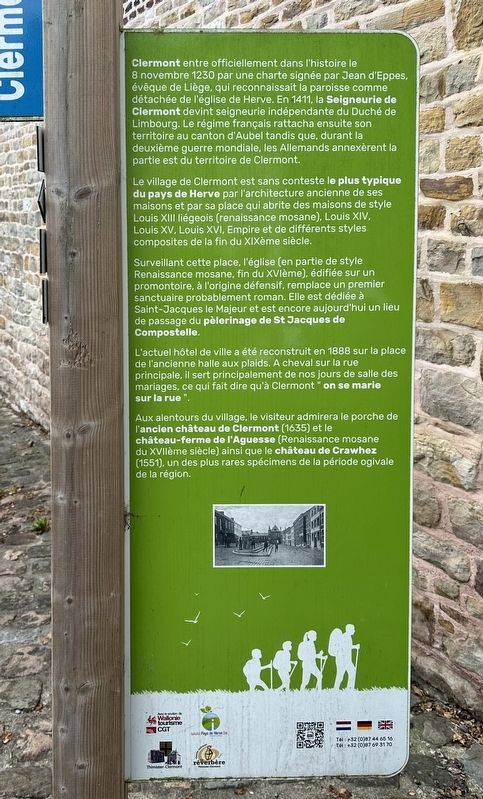
Le village de Clermont est sans conteste le plus typique du pays de Herve par l'architecture ancienne de ses maisons et par sa place qui abrite des maisons de style Louis XIII liégeois (renaissance mosane), Louis XIV, Louis XV, Louis XVI, Empire et de différents styles composites de la fin du XIXème siècle.
Surveillant cette place, l'église (en partie de style Renaissance mosane, fin du XVIème), édifiée sur un promontoire, à l'origine défensif, remplace un premier sanctuaire probablement roman. Elle est dédiée à Saint-Jacques le Majeur et est encore aujourd'hui un lieu de passage du pèlerinage de St Jacques de Compostelle.
L'actuel hôtel de ville a été reconstruit en 1888 sur la place de l'ancienne halle aux plaids. A cheval sur la rue principale, il sert principalement de nos jours de salle des mariages, ce qui fait dire qu'à Clermont “on se marie sur la rue”.
Aux alentours du village, le visiteur admirera le porche de l'ancien château de Clermont (1635) et le château-ferme de l'Aguesse (Renaissance mosane du XVIème siècle) ainsi que le château de Crawhez (1551), un des plus rares spécimens de la période ogivale de la région.
(English translation:)
Clermont officially entered history on November 8, 1230 by a charter signed by Jean d'Eppes, Bishop of Liège, who recognized the parish as detached from the church of Herve. In 1411, the Seigneurie de Clermont became an independent seigneurie of the Duchy of Limburg. The French regime then attached its territory to the canton of Aubel while, during the Second World War, the Germans annexed the eastern part of the territory of Clermont.
The village of Clermont is undoubtedly the most typical of the Herve region by the old architecture of its houses and by its square which shelters houses of the Liège Louis XIII style (Meuse Renaissance), Louis XIV, Louis XV, Louis XVI, Empire and different composite styles from the end of the 19th century.
Overlooking this square, the church (partly in the Meuse Renaissance style, end of the 16th century), built on a promontory, originally defensive, replaces a first sanctuary probably Romanesque. It is dedicated to Saint-Jacques le Majeur and is still today a place of passage for the pilgrimage of St Jacques de Compostelle.
The current town hall was rebuilt in 1888 on the square of the old halle aux plaids. Straddling the main street, it is mainly used today as a wedding hall, which is why it is said that in Clermont “you get married on the street”.
Around the village, visitors will admire the porch of the old castle of Clermont (1635) and the castle-farm of Aguesse (Meuse Renaissance of the 16th century) as well as the castle of Crawhez (1551), one of the rarest examples of the Gothic period in the region.
Topics.
this page online
Location. 50° 39.528′ N, 5° 53.004′ E. Marker is in Thimister-Clermont, Région Wallonne (Wallonia), in Liège. It is on Rue du Bac, on the right when traveling south. Touch for map. Marker is at or near this postal address: Rue du Bac 6, Thimister-Clermont, Région Wallonne 4890, Belgium. Touch for directions.

Regionally, it is in Europe, the European Union, Atlantic Europe, the Benelux Low Countries, the Schengen Area, Western Europe, and the Western World. Historically, it finds itself in what was once the Roman Empire and specifically also the Holy Roman Empire.
Other nearby markers. At least 8 other markers are within 11 kilometers of this marker, measured as the crow flies: Patrimoine Funéraire / Funerary Heritage (within shouting distance of this marker); Le Paysage du Pays de Herve / The Landscape of the Pays de Herve (within shouting distance of this marker); Pirenne House / La Maison Pirenne / Het Huis Pirenne / Das Haus Pirenne (within shouting distance of this marker); Clermont WWI and WWII Memorial
Photographed by Andrew Ruppenstein, July 13, 2024
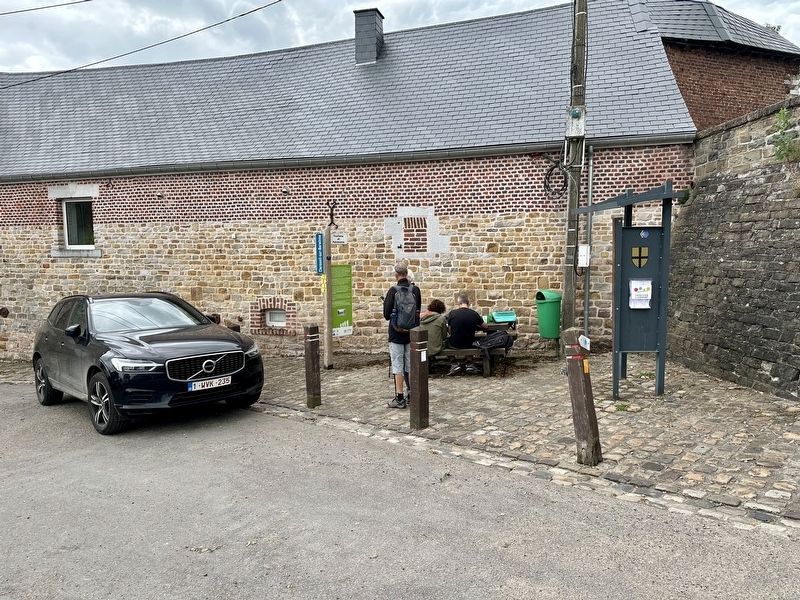
2. Clermont-sur-Berwinne Marker - wide view
Credits. This page was last revised on July 29, 2024. It was originally submitted on July 29, 2024, by Andrew Ruppenstein of Lamorinda, California. This page has been viewed 235 times since then and 44 times this year. Photos: 1, 2. submitted on July 29, 2024, by Andrew Ruppenstein of Lamorinda, California.
