White Sands in Doña Ana County, New Mexico — The American Mountains (Southwest)
Pershing
Photographed by James Hulse, July 23, 2024
1. Pershing Marker
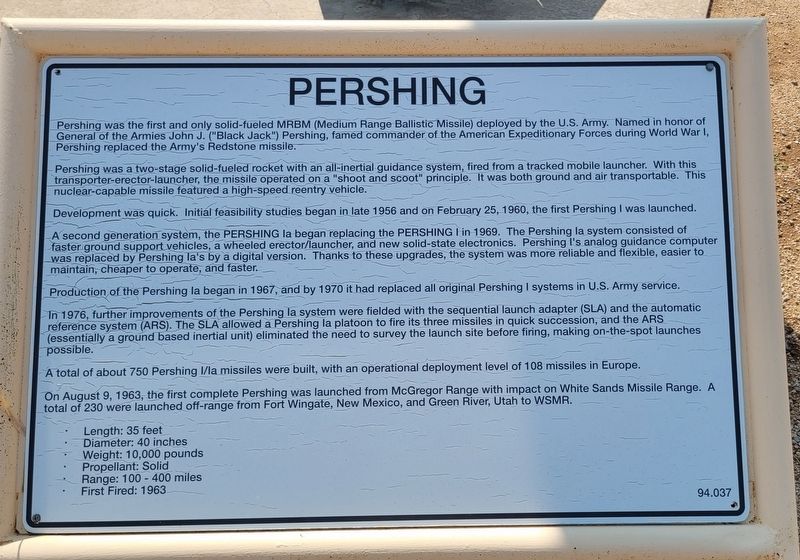
Pershing was a two-stage solid-fueled rocket with an all-inertial guidance system, fired from a tracked mobile launcher. With this transporter-erector-launcher, the missile operated on a "shoot and scoot" principle. It was both ground and air transportable. This nuclear-capable missile featured a high-speed reentry vehicle.
Development was quick. Initial feasibility studies began in late 1956 and on February 25, 1960, the first Pershing I was launched
A second generation system, the PERSHING 1a began replacing the PERSHING I in 1969. The Pershing 1a system consisted of faster ground support vehicles, a wheeled erector/launcher, and new solid-state electronics. Pershing I's analog guidance computer was replaced by Pershing 1a's by a digital version. Thanks to these upgrades, the system was more reliable and flexible,
this page online
Production of the Pershing 1a began in 1967, and by 1970 it had replaced all original Pershing I systems in U.S. Army service.
In 1976, further improvements of the Pershing 1a system were fielded with the sequential launch adapter (SLA) and the automatic reference system (ARS). The SLA allowed a Pershing 1a platoon to fire its three missiles in quick succession, and the ARS (essentially a ground based inertial unit) eliminated the need to survey the launch site before firing, making on-the-spot launches possible.
A total of about 750 Pershing I/1a missiles were built, with an operational deployment level of 108 missiles in Europe.
On August 9, 1963, the first complete Pershing was launched from McGregor Range with impact on White Sands Missile Range. A total of 230 were launched off-range from Fort Wingate, New Mexico, and Green River, Utah to WSMR.
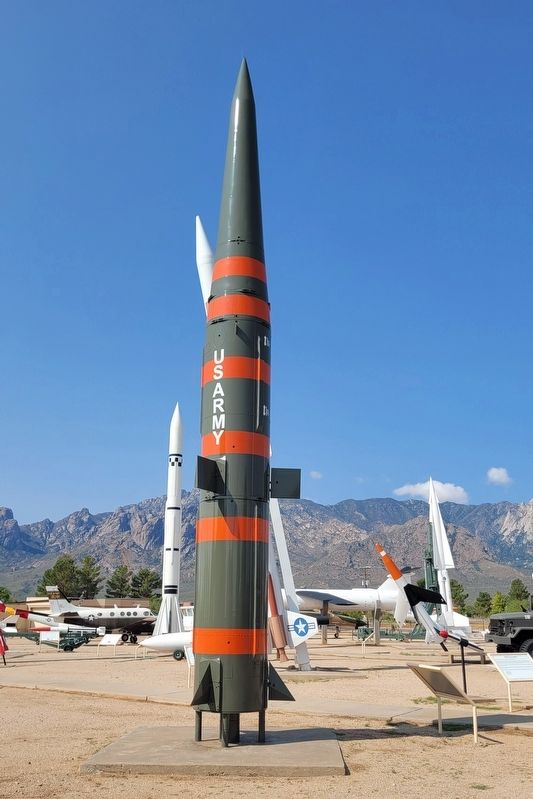
Length: 35 feet
Diameter: 40 inches
Weight: 10,000 pounds
Propellant: Solid
Range: 100- 400 miles
First Fired: 1963
Erected by White Sands Missile Range Museum. (Marker Number 94.037.)
Topics. This historical
Photographed by James Hulse, July 23, 2024
2. Pershing missile
Location. 32° 23.173′ N, 106° 28.703′ W. Marker is in White Sands, New Mexico, in Doña Ana County. It is on Wsmr P Rt 1 (New Mexico Route 213) 4 miles south of U.S. 70. The marker and various missiles are located on the grounds of the White Sands Missile Range Museum. Touch for map. Marker is in this post office area: White Sands Missile Range NM 88002, United States of America. Touch for directions.

Regionally, this marker is in the Rio Grande Valley. It is also in the American Borderlands and in the Southwest. Globally, it is in North America, the Western Hemisphere, the Western World, and the Anglosphere. Historically, it finds itself in what was once New Spain, the Gadsden Purchase, and the Republic of Texas.
Other nearby markers. At least 8 other markers are within walking distance of this marker: MK 39 5-inch Gun (here, next to this marker); US Navy Standard Missile 2 Block II (a few steps from this marker); Athena (a few steps from this marker); HIBEX (a few steps from this marker); MK 5 Guided Missile Launcher (a few steps from this marker); MGM-18 Lacrosse (a few steps from this marker); Balloon Launched Decelerator Test Vehicle (within shouting distance of this marker); GAR-1 Falcon (within shouting distance of this marker). Touch for a list and map of all markers in White Sands.
More about this marker. The marker and museum are located on the White Sands Missile Range, an active U.S. military installation. The museum is open to the public, but appropriate identification is required for access.
Also see . . .
1. Welcome to the White Sands Missile Range Museum. White Sands Missile Range Museum (Submitted on July 30, 2024, by James Hulse of Medina, Texas.)
2. MGM-31 Pershing.

Public Domain - US Army - Warren C. Weaver, February 16, 1966
3. Pershing 1a launch
Pershing missile ARTY/ORD round
32 roars skyward, T-time 0815 hours
at Hueco Range, Ft. Bliss, Texas. Launch
crew from "A" Btry, 2nd F. of 79th Bn.
Pershing missile in foreground is in
countdown simultaneously. Missile
in foreground assembled by "C" Btry,
2nd of 79th Bn. After several minutes
flight, it impacted on White Sands
Missile Range, New Mexico.
The MGM-31A Pershing was the missile used in the Pershing 1 and Pershing 1a field artillery missile systems.[a] It was a solid-fueled two-stage theater ballistic missile designed and built by Martin Marietta to replace the PGM-11 Redstone missile as the primary nuclear-capable theater-level weapon of the United States Army and replaced the MGM-1 Matador cruise missiles operated by the German Air Force. Pershing later replaced the European-based MGM-13 Mace cruise missiles deployed by the United States Air Force and the German Air Force. Development began in 1958, with the first test missile fired in 1960, the Pershing 1 system deployed in 1963 and the improved Pershing 1a deployed in 1969. The U.S. Army replaced the Pershing 1a with the Pershing II Weapon System in 1983 while the German Air Force retained Pershing 1a until all Pershings were eliminated in 1991. The U.S. Army Missile Command (MICOM) managed the development and improvements while the Field Artillery Branch deployed the systems and developed tactical doctrine.(Submitted on July 30, 2024, by James Hulse of Medina, Texas.)
Credits. This page was last revised on July 30, 2024. It was originally submitted on July 29, 2024, by James Hulse of Medina, Texas. This page has been viewed 503 times since then and 62 times this year. Photos: 1, 2, 3. submitted on July 30, 2024, by James Hulse of Medina, Texas.
