White Sands in Doña Ana County, New Mexico — The American Mountains (Southwest)
HIBEX

Photographed by James Hulse, July 23, 2024
1. HIBEX Marker
Accelerating at 400g, HIBEX achieved Mach 8 velocities within 2 seconds of launch. Then-new laser gyros were used in the guidance and control section, because conventional mechanical ones were too slow for the required reaction time and acceleration. HIBEX was conceived in 1962, shortly after the Nike X program was initiated. Its flight test program began in February 1965 at White Sands Missile Range, and the last of 10 launches occurred in January 1966. The majority of the tests were from underground cells, with HIBEX ignited within the silo. The final HIBEX firing was made above ground.
Length: 16 ft. (4.9 m)
Diameter: 3.6 ft. (1.1m)
Weight: 2600 lb. (1180 kg.
Speed: 8400 feet per second (2560
this page online
Erected by White Sands Missile Range Museum. (Marker Number 94.044.)
Topics. This historical marker is listed in this topic list: Air & Space. A significant historical month for this entry is January 1966.
Location. 32° 23.163′ N, 106° 28.702′ W. Marker is in White Sands, New Mexico, in Doña Ana County. It is on Wsmr P Rt 1 (New Mexico Route 213) 4 miles south of U.S. 70. The marker and various missiles are located on the grounds of the White Sands Missile Range Museum. Touch for map. Marker is in this post office area: White Sands Missile Range NM 88002, United States of America. Touch for directions.

Regionally, this marker is in the Rio Grande Valley. It is also in the American Borderlands and in the Southwest. Globally, it is in North America, the Western Hemisphere, the Western World, and the Anglosphere. Historically, it finds itself in what was once New Spain, the Gadsden Purchase, and the Republic of Texas.
Other nearby markers. At least 8 other markers are within walking distance of this marker: Athena (a few steps from this marker); GAR-1 Falcon (a few steps from this marker); US Navy Standard Missile 2 Block II
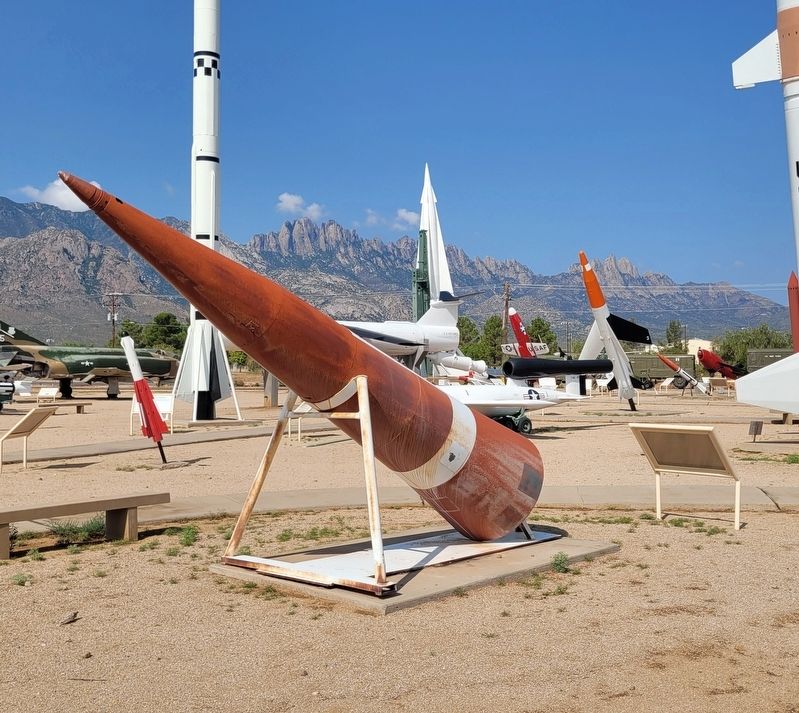
Photographed by James Hulse, July 23, 2024
2. The HIBEX Missile and Marker
More about this marker. The marker and museum are located on the White Sands Missile Range, an active U.S. military installation. The museum is open to the public, but appropriate identification is required for access.
Also see . . .
1. Welcome to the White Sands Missile Range Museum. White Sands Missile Range Museum (Submitted on July 30, 2024, by James Hulse of Medina, Texas.)
2. Sprint (missile). Wikipedia
The Sprint was a two-stage, solid-fuel anti-ballistic missile (ABM), armed with a W66 enhanced-radiation thermonuclear warhead used by the United States Army during 1975–76. It was designed to intercept incoming reentry vehicles (RV) after they had descended below an altitude of about 60 kilometres (37 mi), where the thickening air stripped away any decoys or radar reflectors and exposed the RV to observation by radar. As the RV would be traveling at about 5 miles per second (8,047 m/s; 26,400 ft/s; Mach 24), Sprint needed to have phenomenal performance to achieve an interception in the few seconds before the RV reached its target.(Submitted on July 30, 2024, by James Hulse of Medina, Texas.)
Credits. This page was last revised on August 1, 2024. It was originally submitted on July 30, 2024, by James Hulse of Medina, Texas. This page has been viewed 605 times since then and 128 times this year. Photos: 1, 2. submitted on July 30, 2024, by James Hulse of Medina, Texas.
