Bowling Green in Wood County, Ohio — The American Midwest (Great Lakes)
Commerce & Finance In Old Bowling Green
Photographed by Craig Doda, July 21, 2024
1. Commerce & Finance In Old Bowling Green Marker
Southwest Block
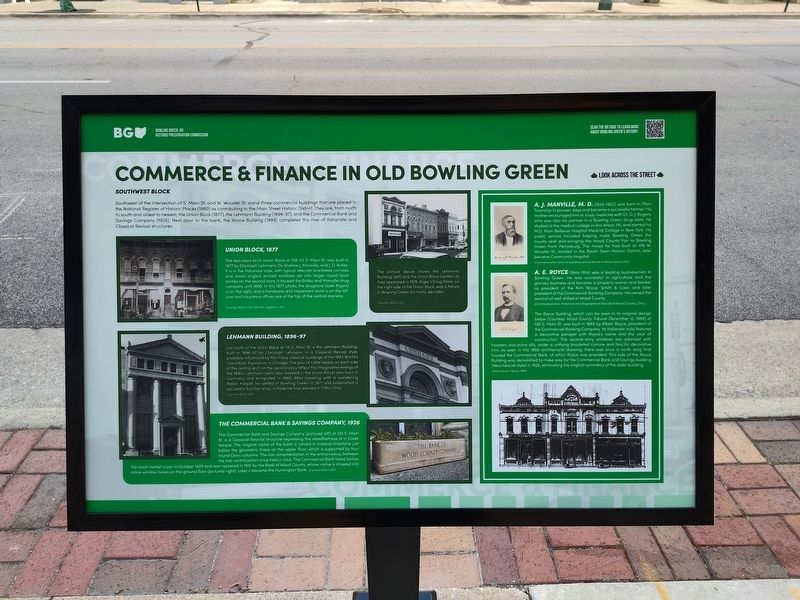
Southwest of the intersection of S. Main St. and W. Wooster St. stand three commercial buildings that are placed in the National Register of Historic Places (1980) as contributing to the Main Street Historic District. They are, from north to south and oldest to newest, the Union Block (1877), the Lehmann Building (1896-97), and the Commercial Bank and Savings Company (1926). Next door to the bank, the Royce Building (1889) completes this row of Italianate and Classical Revival structures.
Union Block, 1877
The two-story brick Union Block at 108-112 S. Main St. was built in 1877 by Christoph Lehmann, Dr. Andrew J. Manville, and J. D. Bolles. It is in the Italianate style, with typical delicate bracketed cornices and seven angled arched windows set into larger round brick arches on the second story. It housed the Bolles and Manville drug company until 1896. In this 1877 photo, the drugstore (later Kigers) is on the right, and a hardware and implement store is on the left. Law and insurance offices are at the top of the central stairway.
Lehmann Building, 1896-97
Just south of the Union Block at 116
this page online
The picture above shows the Lehmann Building (left) and the Union Block (center) as they appeared in 1976. Kiger's Drug Store, on the right side of the Union Block, was a fixture in Bowling Green for many decades.
The Commercial Bank & Savings Company, 1926
The Commercial Bank and Savings Company (pictured left) at 130 S. Main St. is a Classical Revivial structure expressing the steadfastness of a Greek temple. The original name of the bank is carved in Indiana limestone just below the geometric frieze on the upper floor, which is supported by four
Photographed by Craig Doda, July 21, 2024
2. Commerce & Finance In Old Bowling Green Marker
A. J. Manville, M. D. (1834-1902) was born in Plain Township in pioneer days and became a successful farmer. His mother encouraged him to study medicine with Dr. G. J. Rogers, who was also his partner in a Bowling Green drug store. He studied at the medical college in Ann Arbor, MI, and earned his M.D. from Bellevue Hospital Medical College in New York. His public service included helping make Bowling Green the county seat and bringing the Wood County Fair to Bowling Green from Perrysburg. The house he had built at 416 W. Wooster St., located in the Boom Town Historic District, later became Community Hospital.
A. E. Royce (1844-1914) was a leading businessman in Bowling Green. He was successful in agriculture and the grocery business and became a property owner and banker as president of the firm Royce, Smith & Coon and later president of the Commercial Banking Company. He owned the second oil well drilled in Wood County.
The Royce Building, which can be seen in its original design below (Courtesy Wood County Tribune December 12, 1989) at 136 S. Main St. was built in 1889 by Albert Royce, president of the Commercial Banking Company. Its Italianate style features a decorative parapet with Royce's name and the year of construction. The second-story windows are adorned with headers and stone sills, under a unifying bracketed cornice and fanciful decorative trim. As seen in this 1889 architectural drawing, there was once a north wing that housed the Commercial Bank, of which Royce was president. This side of the Royce Building was demolished to make way for the Commercial Bank and Savings building (Neoclassical style) in 1926, eliminating the original symmetry of the older building.
Topics. This historical marker is listed in this topic list: Industry & Commerce. A significant historical month for this entry is October 1929.
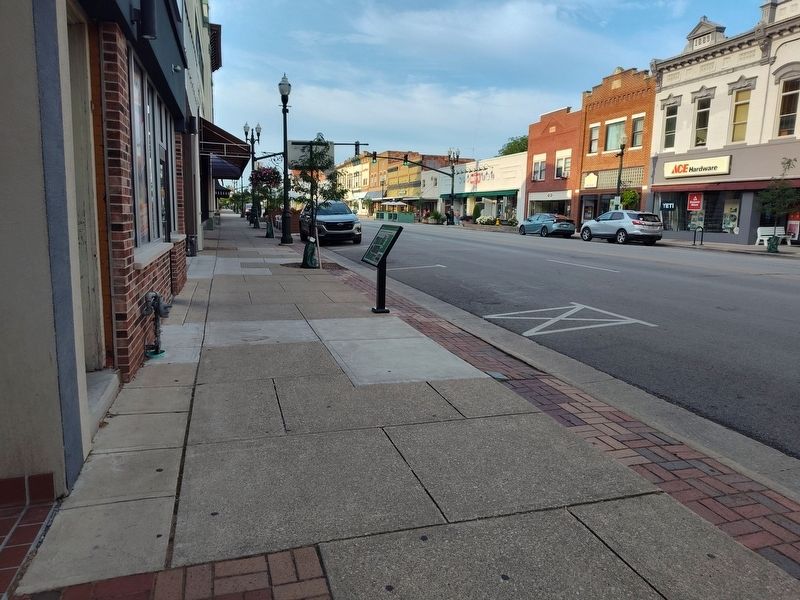
Location. 41° 22.463′ N, 83° 39.019′ W. Marker is in Bowling Green, Ohio, in Wood County. It is on South Main Street just south of East Wooster Street, on the right when traveling north. Touch for map. Marker is at or near this postal address: 127 S Main St, Bowling Green OH 43402, United States of America. Touch for directions.

Regionally, this marker is in Ohio’s Black Swamp, in the Till Plains, and in the Toledo Metropolitan Area. It is also in the American Midwest and in the Corn Belt. Globally, it is in North America, on the Great Lakes, in the Western Hemisphere, in the Western World, and in the Anglosphere. Historically, it finds itself in what was once the Haudenosaunee (Iroquois) Confederacy, the territory of the Mississippian Culture, and the Northwest Territory.
Other nearby markers. At least 8 other markers are within walking distance of this marker: The Four Corners (within shouting distance of this marker); The Changing Face of South Main (within shouting distance of this marker); Bowling Green's Interurban & Rail Line (within shouting distance of this marker); The Main Street Historic District (within shouting distance of this marker); Historic Main Street (within shouting distance of this marker); Exchange Bank (within shouting distance of this marker); The Great Black Swamp (about 300 feet away, measured in a direct line); Wiley Post No. 46 (about 400 feet away). Touch for a list and map of all markers in Bowling Green.
Credits. This page was last revised on July 31, 2024. It was originally submitted on July 30, 2024, by Craig Doda of Napoleon, Ohio. This page has been viewed 302 times since then and 60 times this year. Photos: 1, 2. submitted on July 30, 2024, by Craig Doda of Napoleon, Ohio. • Devry Becker Jones was the editor who published this page.
