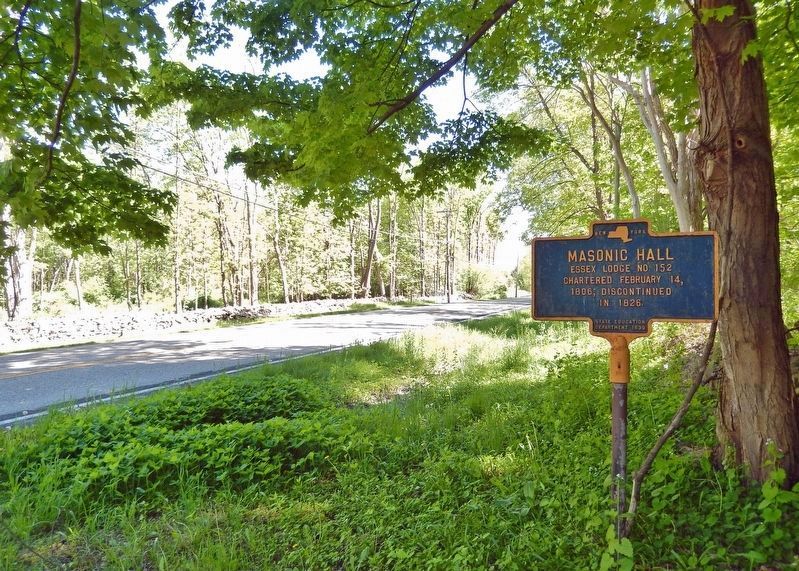
Masonic Hall
Essex Lodge No. 152

Erected 1939 by State Education Department.
Topics and series. This historical marker is listed in these topic lists: Architecture • Fraternal or Sororal Organizations • Notable Buildings. In addition, it is included in the National Register of Historic Places (NRHP) series list. A significant historical date for this entry is February 14, 1806.
Location. 44° 20.6′ N, 73° 21.717′ W. Marker is in Willsboro, New York, in Essex County. It is on Essex Road (New York State Route 22) just south of Creative Way, on the right when traveling south. The marker is located near the front/east gate of the subject Masonic Hall building. Touch for map. Marker is at or near this postal address: 3269 Essex Road, Willsboro NY 12996, United States of America. Touch for directions.

Regionally, this marker is in Upstate New York, in the Adirondacks & North Country, and in the Champlain Valley. It is also in the American Northeast and in the Mid-Atlantic. Globally, it is in North America, the Great North Woods, the Western Hemisphere, the Western World, and the Anglosphere. Historically,
this page online
Other nearby markers. At least 8 other markers are within 3 miles of this marker, measured as the crow flies: Lakeview Cemetery (approx. 0.6 miles away); Memorial Cemetery (approx. one mile away); Site of Willsborough Blockhouse (approx. 1.7 miles away); Willsborough Block House (approx. 1.7 miles away); Willsboro (approx. 1.9 miles away); a different marker also named Willsboro (approx. 1.9 miles away); Bouquet River (approx. 2 miles away); World Wars Memorial (approx. 2.4 miles away). Touch for a list and map of all markers in Willsboro.
Regarding Masonic Hall. National Register of Historic Places #89000465, as Abraham Aiken House.
From the National Register Nomination:
The nominated property encompasses four acres currently associated with the Aiken home. The Aiken property originally encompassed three-hundred acres until the mid-twentieth century when it was parceled off. The nominated property includes the 1807 Aiken house (contributing) and two contributing outbuildings: a c. 1807 horse barn and ac. 1840 tenants' cottage and five contributing stone-lined wells.Photographed by Cosmos Mariner, May 18, 20242. Masonic Hall MarkerLooking south along Essex Road (New York State Route 22). The Masonic Hall is about 50 meters west/right of this marker.The Aiken house sits back on a broad lawn, surrounded by majestic old maples. In the summer, the house is virtually hidden from the main road by these trees. With the leaves gone, however, the house looks out across fields and Lake Champlain to the Green Mountains of Vermont to the east.
The attic story, which once housed a local Masonic Lodge, is remarkably intact with original built-in wall benches along the eaves walls and a partition at the north end with original six paneled door and Federal period architrave. This partition may have separated the head of the Masons from the rest of the group before meetings.
The Abraham Aiken House is architecturally significant as a distinguished early example of Federal style brick residential design in Essex County. Constructed in 1807 by Abraham Aiken, a Quaker from Pawling Dutchess County, the large symmetrical five bay, two-story residence with attached two-story brick ell exhibits high-style decorative design characteristics unusual in early nineteenth century dwellings of the Champlain-Adirondack regions. The Aiken house
reflects the transfer of style and aesthetic preferences from New England to the northern frontier via Lake Champlain during the Federal period.Photographed by Cosmos Mariner, May 18, 20243. Masonic Hall (east/front elevation)From the National Register Nomination: The Abraham Aiken House is a large, rectangular, gable roofed structure which is oriented to the cardinal points (north, south, east and west). The house measures 45 by 30 feet across its front and side elevations, respectively, and is two and one-half stories in height. The front facade of the house is symmetrical, divided into five bays on first and second story levels, with a central entrance at ground level and central Palladian window at the second story level.The residence was also the location of one of the earliest Masonic Lodges in the region, which met in the attic story of the large brick house from 1807 to 1826.

Also see . . . Abraham Aiken House (Wikipedia). (Submitted on July 30, 2024, by Cosmos Mariner of Cape Canaveral, Florida.)

From the National Register Nomination: The main entry on the building's east facade is finely detailed and, with the delicate Palladian window above, constitutes the architectural focal point of the house. The entrance is composed of a six-panel door framed by moveable four over-four sidelights and a large elliptical fanlight with leaded tracery. The glass in the fanlight and in the Palladian window above is original blue-tinted cylinder glass. This arrangement replaced an earlier entry portico, whose outline can still be seen on the brick wall to either side of the main entry.

placed on the
National Register
of Historic Places
by the United States
Department of the Interior

Credits. This page was last revised on July 30, 2024. It was originally submitted on July 30, 2024, by Cosmos Mariner of Cape Canaveral, Florida. This page has been viewed 387 times since then and 107 times this year. Photos: 1, 2, 3, 4, 5, 6. submitted on July 30, 2024, by Cosmos Mariner of Cape Canaveral, Florida.
