Willsboro in Essex County, New York — The American Northeast (Mid-Atlantic)
Willsboro

Photographed by Cosmos Mariner, May 18, 2024
1. Willsboro Marker
Erected 1939 by State Education Department.
Topics. This historical marker is listed in these topic lists: Political Subdivisions • Settlements & Settlers. A significant historical year for this entry is 1765.
Location. 44° 21.687′ N, 73° 23.478′ W. Marker is in Willsboro, New York, in Essex County. It is on Main Street (New York State Route 22) 0.2 miles south of South Library Street, on the right when traveling south. The marker is located beside the sidewalk, directly in front of the Willsboro Visitor Center. Touch for map. Marker is at or near this postal address: 3743 Main Street, Willsboro NY 12996, United States of America. Touch for directions.

Regionally, this marker is in Upstate New York, in the Adirondacks & North Country, and in the Champlain Valley. It is also in the American Northeast and in the Mid-Atlantic. Globally, it is in North America, the Great North Woods, the Western Hemisphere, the Western World, and the Anglosphere. Historically, it finds itself in what was once the Viceroyalty
this page online
Other nearby markers. At least 8 other markers are within 4 miles of this marker, measured as the crow flies: A different marker also named Willsboro (a few steps from this marker); Bouquet River (approx. 0.2 miles away); Memorial Cemetery (approx. one mile away); Masonic Hall (approx. 1.9 miles away); Lakeview Cemetery (approx. 2½ miles away); Site of Willsborough Blockhouse (approx. 3½ miles away); Willsborough Block House (approx. 3.6 miles away); World Wars Memorial (approx. 4.1 miles away). Touch for a list and map of all markers in Willsboro.
Related markers. Click here for a list of markers that are related to this marker.
Also see . . .
1. Willsboro, New York (Wikipedia). Excerpt:
The region was first settled by Europeans in 1765 by William Gilliland. Originally called "Milltown" by its founder (for the sawmill he located on the falls of the Bouquet River, located in the center of the town), it was renamed "Willsborough" (subsequently shortened to "Willsboro") shortly after the Revolutionary War, in honor of the founder.(Submitted on July 30, 2024, by Cosmos Mariner of Cape Canaveral, Florida.)
2. A Brief History of William Gilliland (By Katie Shepard).
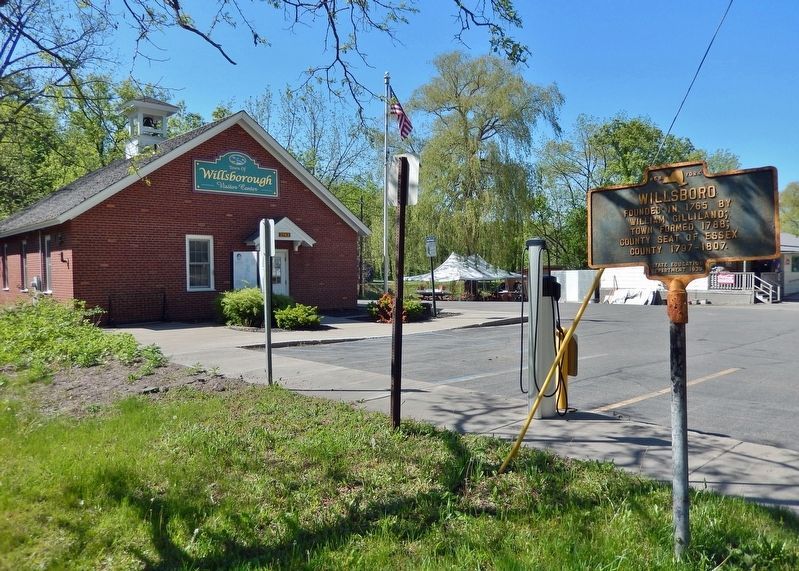
Photographed by Cosmos Mariner, May 18, 2024
2. Willsboro Marker
Looking northwest from Main Street; the Willsboro Visitor Center is in the left background.
Born and raised in County Armagh, Ireland, William Gilliland came to America in about 1754 as a young man. Prior to the French and Indian War there was minimal European settlement in the North Country, but after British victory many soldiers were rewarded with land grants to repay their military service and to help ensure Britain’s control of the frontier. Gilliland took advantage of these newly released grants and began purchasing them from interested sellers. By 1764, he was able to gain land bounties from several veterans, ultimately securing title to upwards of 50,000 acres of land. The land extended between present day Crown Point and Cumberland Head. Gilliland created settlements that would become present-day Willsboro and Essex among others. He named the settlements after his family, “Willsboro” after himself, “Elizabeth” (now Essex) after his wife, and “Janesboro,” “Charlottesboro,” and “Bessboro” were named for his daughters.(Submitted on July 30, 2024, by Cosmos Mariner of Cape Canaveral, Florida.)
3. Essex County, New York (Wikipedia). Excerpt:
When counties were established in the state of New York in 1683, the present Essex County was part of Albany County. This was an enormous county, including the northern part of New York state as well as all of the present state of Vermont and, in theory, extending westward to the Pacific Ocean. This county was reduced in size on July 3, 1766, by the creation of Cumberland County, and further on March 16, 1770, by the creation of Gloucester County, both containing territory now in Vermont. On March 12, 1772, what was left of Albany County was split into three parts, one remaining under the name Albany County. One of the other pieces, Charlotte County, contained the eastern portion. In 1784, the name "Charlotte County" was changed to Washington County. In 1788, Clinton County was split off from Washington County. Essex County was split from Clinton County in 1799.(Submitted on July 30, 2024, by Cosmos Mariner of Cape Canaveral, Florida.)
Credits. This page was last revised on July 30, 2024. It was originally submitted on July 30, 2024, by Cosmos Mariner of Cape Canaveral, Florida. This page has been viewed 306 times since then and 46 times this year. Photos: 1, 2. submitted on July 30, 2024, by Cosmos Mariner of Cape Canaveral, Florida.
