Essex in Essex County, New York — The American Northeast (Mid-Atlantic)
Essex Village Historic District
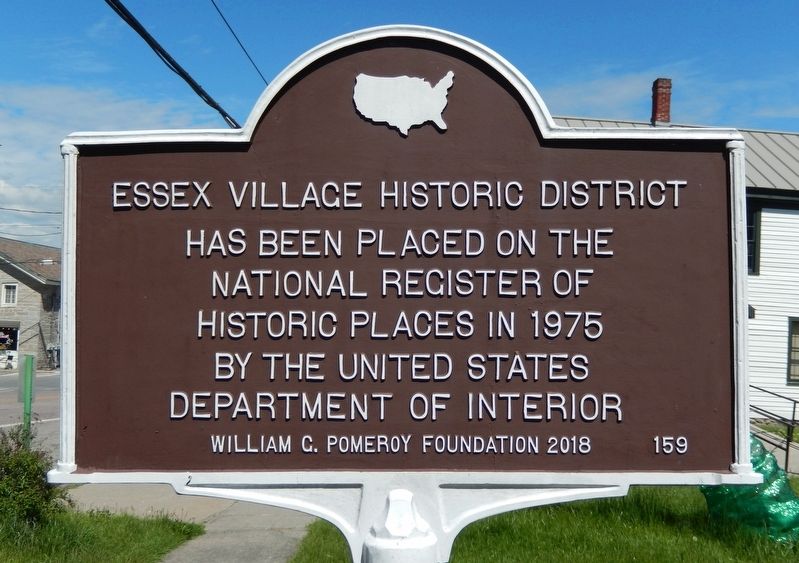
Photographed by Cosmos Mariner, May 18, 2024
1. Essex Village Historic District Marker
Has been placed on the National Register of Historic Places in 1975 by the United States Department of Interior
Erected 2018 by William G. Pomeroy Foundation. (Marker Number 159.)
Topics and series. This historical marker is listed in this topic list: Architecture. In addition, it is included in the National Register of Historic Places (NRHP), and the William G. Pomeroy Foundation series lists.
Location. 44° 18.581′ N, 73° 21.129′ W. Marker is in Essex, New York, in Essex County. It is on Empire State Trail (New York State Route 22) just west of Main Street (Lake Shore Road), on the left when traveling west. The marker is located beside the sidewalk, on the west side of the Essex Town Hall. Touch for map. Marker is at or near this postal address: 2313 Lake Shore Road, Essex NY 12936, United States of America. Touch for directions.

Regionally, this marker is in Upstate New York, in the Adirondacks & North Country, and in the Champlain Valley. It is also in the American Northeast and in the Mid-Atlantic. Globally, it is in North America, the Great North Woods,
this page online
Other nearby markers. At least 8 other markers are within 4 miles of this marker, measured as the crow flies: World Wars Memorial (within shouting distance of this marker); Site of Willsborough Blockhouse (approx. 0.7 miles away); Willsborough Block House (approx. 0.7 miles away); Lakeview Cemetery (approx. 1.8 miles away); Masonic Hall (approx. 2.4 miles away); Split Rock (approx. 2½ miles away); Memorial Cemetery (approx. 3.3 miles away); Holmes Creek Bridge (approx. 3.8 miles away in Vermont). Touch for a list and map of all markers in Essex.
Regarding Essex Village Historic District. National Register of Historic Places #75001187.
From the National Register Nomination:
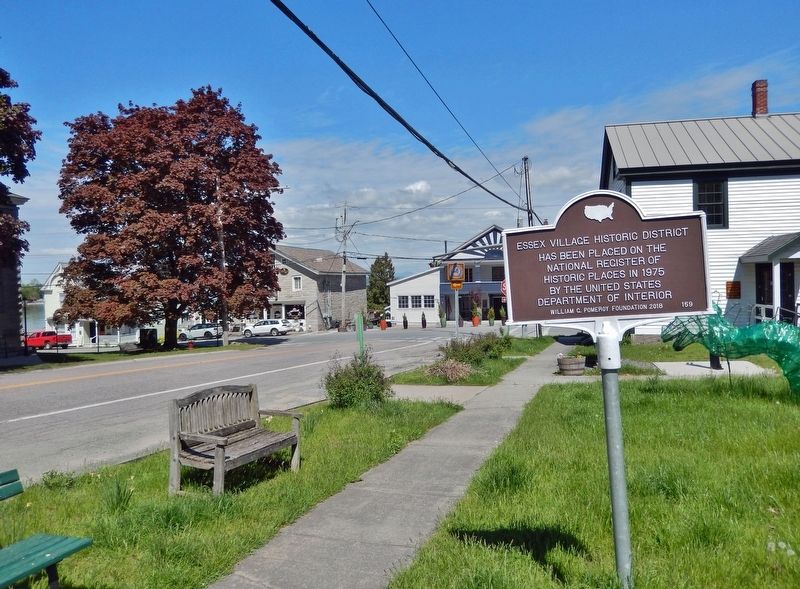
The district contains approximately 150 structures which predate the 20th century. Of the structures in the district, there are only 15 which were constructed after 1900. Of these, only 3 were built after 1910; four or five structures are of the l8th century;the rest are all 19th century. Of these, only 7 were constructed after 1860. The predominant building materials were clapboarded wood frame, brick, and native stone. No structure exceeds 2½ stories, thus taking the fullest advantage of the natural beauty of a location between wooded ridge and a rocky and irregular lake shore.Photographed by Cosmos Mariner, May 18, 20242. Essex Village Historic District MarkerLooking east along Empire State Trail Trail (New York State Route 22); Main Street (Lake Shore Road) crosses in the background. Essex Town Hall is partially visible in the right background.
The unique quality of Essex Village lies in the fact that its structures — residential, commercial, and ecclesiastic — were almost entirely built before the Civil War, and have remained substantially unaltered, with the exception of an occasional Victorian porch or bay window.In the 1820's, Essex was "the busiest port on Lake Champlain". Through it funneled the timber, iron, cattle, and hides of the western shore of the Champlain Valley. Its inns (and there are two surviving of a documented five) swarmed with drovers, lumbermen and "lakers".
Ironically, the 20th century sees Essex as a village preserved by its very loss of economic importance from the attrition which has befallen busier places. While its industry has vanished, its charm and the great beauty of the Champlain Valley have given it a vacation population
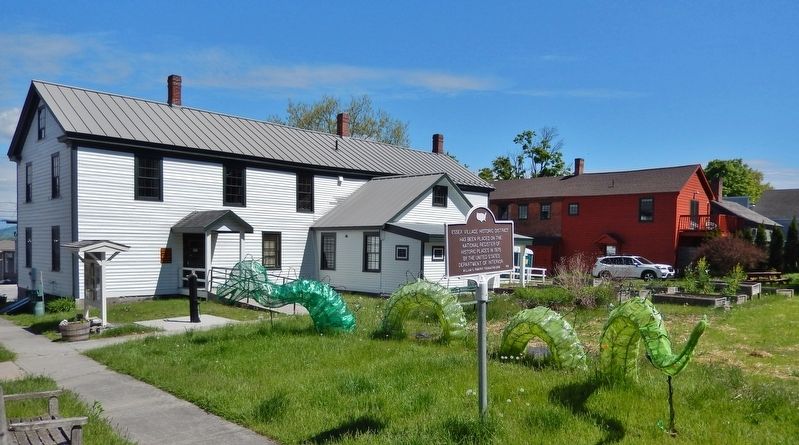
upon which the economy of the area principally depends.Photographed by Cosmos Mariner, May 18, 20243. Essex Village Historic District MarkerLooking southeast from Empire State Trail Trail (New York State Route 22); Essex Town Hall is in the left background.
Also see . . .
1. Essex Village Historic District (William G. Pomeroy Foundation). (Submitted on July 30, 2024, by Cosmos Mariner of Cape Canaveral, Florida.)
2. Essex Village Historic District (Wikipedia). Excerpt:
The district contains 150 contributing buildings. It encompasses the historic core of the hamlet of Essex and primarily contains early-19th-century buildings. The predominant building materials are clapboarded wood frame, brick, and stone. The oldest documented structure is Dower House, built prior to 1793. Other notable buildings include Wright's Inn (1798), Essex Free Library (1818), and "Hickory Hill" (1822), "Rosslyn" (ca. 1830), the "Old Brick Schoolhouse" (1830), and "Greystone" (1853).(Submitted on July 30, 2024, by Cosmos Mariner of Cape Canaveral, Florida.)
3. Essex Village Historic District (livingplaces.com). Excerpt:
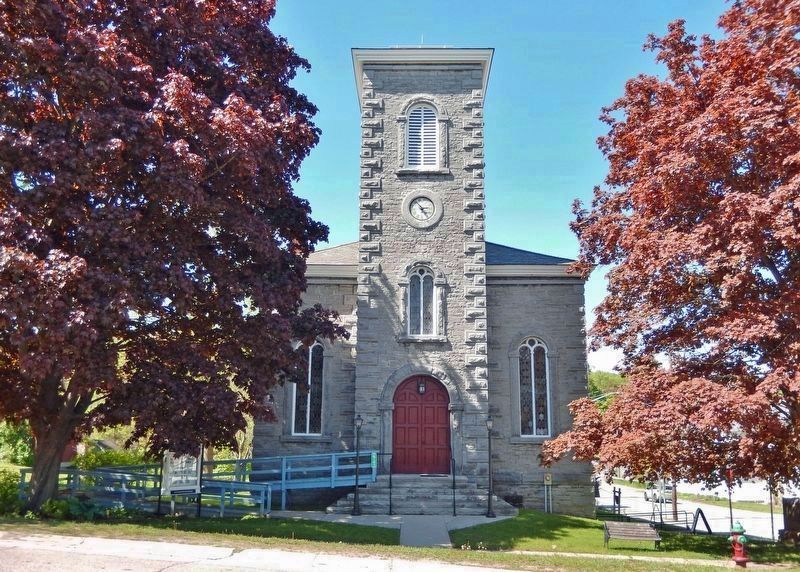
The Essex Village Historic District is located on the eastern boundary of Essex County, on the western shore of Lake Champlain. Essex Village is nearly unique in that, established in the 1780's, it reached its(Submitted on July 31, 2024, by Cosmos Mariner of Cape Canaveral, Florida.)maturity in less than 60 years, thus containing buildings of only three closely-related architectural periods: Federal, Greek Revival, and early Victorian. These styles are displayed, virtually unaltered, in their residential, commercial, and ecclesiastical forms. Visually, both in layout and architecture, Essex has retained the character of an early 19th century village, a character determined by its geographical and historical position.Photographed by Cosmos Mariner, May 18, 20244. Essex Community ChurchContributing property, Essex Village Historic District. (located north across NY State Route 22 from the marker)
From the National Register Nomination: The Federated Church (formerly Presbyterian) on the corner of Route 22 was built of native limestone in 1853. Its interior represents a remarkable survival of the Federal style into later periods.
4. Essex Community Church History. Excerpt:
By 1853 The Presbyterians of Essex had already built an imposing stone structure, now known as Essex Community Church, at the main intersection of the hamlet at Main Street and Route 22. Eventually, this church became the home of the Federated Church of Essex. The church, designed in a rusticated Italianate style by architect T. S. Whitby, is constructed of grey stone quarried at nearby Willsboro Point, and built for a total cost of $10,000. The clock in the church’s tower, which serves as timekeeper for the town, was installed in 1911 with donations from Justice James S. Harlan and Maude Noble Harlan in honor of Maude’s mother, Adeline Noble. It was Adeline who had established the town’s first library, Essex Free Library, at Greystone Cottage.(Submitted on July 31, 2024, by Cosmos Mariner of Cape Canaveral, Florida.)
Credits. This page was last revised on July 31, 2024. It was originally submitted on July 30, 2024, by Cosmos Mariner of Cape Canaveral, Florida. This page has been viewed 299 times since then and 41 times this year. Photos: 1, 2. submitted on July 30, 2024, by Cosmos Mariner of Cape Canaveral, Florida. 3, 4. submitted on July 31, 2024, by Cosmos Mariner of Cape Canaveral, Florida.
