White Sands in Doña Ana County, New Mexico — The American Mountains (Southwest)
Hound Dog
Photographed by James Hulse, July 23, 2024
1. Hound Dog Marker
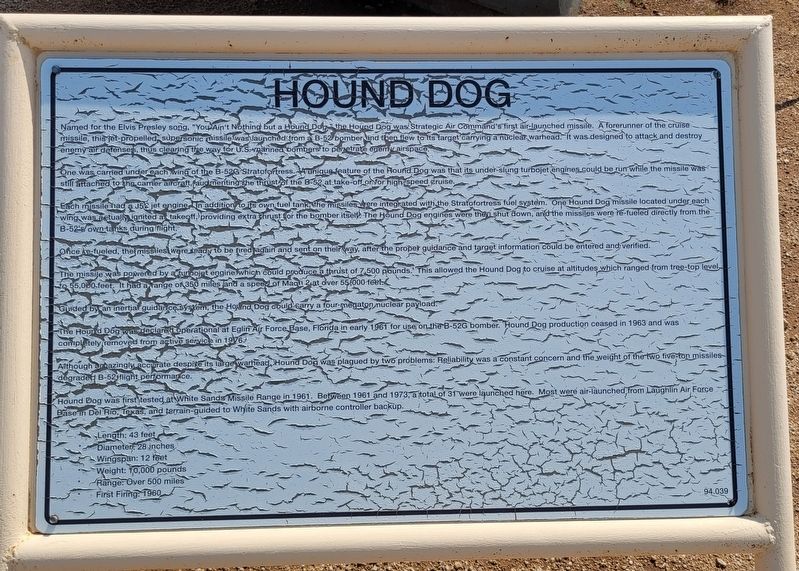
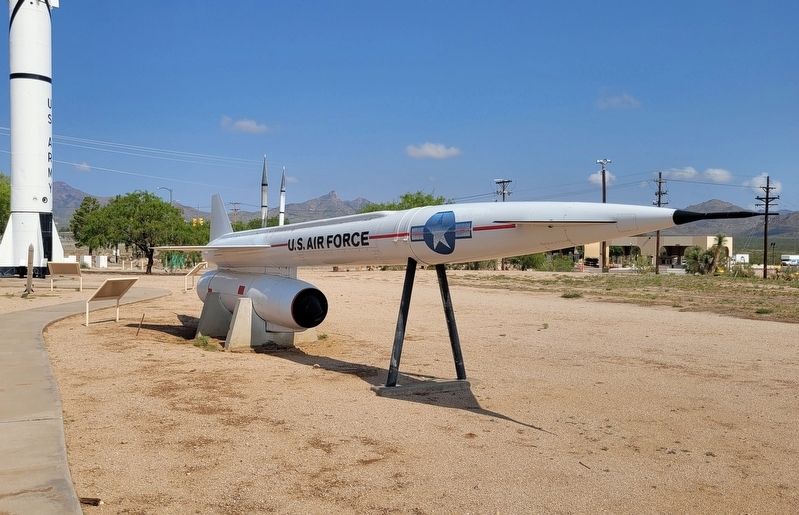
One was carried under each wing of the B-52G Stratofortress. A unique feature of the Hound Dog was that its under-slung turbojet engines could be run while the the missile was still attached to the carrier aircraft, auolmenting the thrust of the B-52 at take-off or for high-speed cruise.
Each missile had a J52 jet engine. In addition to its own fuel tank, the missiles were integrated with the Stratofortress fuel system. One Hound Dog missile located under each wing was actually ignited as takeoff, providing extra thrust for the bomber itself. The Hound Dog engines were then shut down, and the missiles were re-fueled directly from the B-52's own-tanks during flight.
Once re-fueled, the
this page online
The missile was powered by a turbojet engine which could produce, a thrust of 7,500 pounds. This allowed the Hound Dog to cruise at altitudes which ranged from tree-top level to 55,000 feet. It had a range of 350 miles and a speed of Mach 2 at over 55,000 feet.
Guided by an inertial guidance system, the Hound Dog could carry a four-megaton nuclear payload.
The Hound Dog was declared operational at Eglin Air Force Base, Florida in early 1961 for use on the B-52G bomber. Hound Dog production ceased in 1963 and was completely removed from active service in 1976.
Although amazingly accurate despite its large warhead, Hound Dog was plagued by two problems: Reliability was a constant concern and the weight of the two five-ton missiles degraded B-52 flight performance.
Hound Dog was first tested at White Sands Missile Range in 1961. Between 1961 and 1973, a total of 31 were launched here. Most were air-launched from Laughlin Air Force Base in Del Rio, Texas, and terrain-guided to White
Photographed by James Hulse, July 23, 2024
2. Hound Dog Marker
Length: 43 feet
Diameter: 28 inches
Wingspan: 12 feet
Weight: 10,000 pounds
Range: Over 500 miles
First Firing: 1960
Erected by White Sands Missile Range Museum.
Topics and series. This historical marker is listed in this topic list: Air & Space. In addition, it is included in the Elvis Presley series list. A significant historical year for this entry is 1961.
Location. 32° 23.174′ N, 106° 28.731′ W. Marker is in White Sands, New Mexico, in Doña Ana County. It is on New Mexico Route 213 4 miles south of U.S. 70. The marker and various missiles are located on the grounds of the White Sands Missile Range Museum. Touch for map. Marker is in this post office area: White Sands Missile Range NM 88002, United States of America. Touch for directions.

Regionally, this marker is in the Rio Grande Valley. It is also in the American Borderlands and in the Southwest. Globally, it is in North America, the Western Hemisphere, the Western World, and the Anglosphere. Historically, it finds itself in what was once New Spain, the Gadsden Purchase, and the Republic of Texas.
Other nearby markers. At

Public Domain - US AirForce, circa 1960/70s
3. Boeing B-52F takeoff with AGM-28 Hound Dog missiles
More about this marker. The marker and museum are located on the White Sands Missile Range, an active U.S. military installation. The museum is open to the public, but appropriate identification is required for access.
Also see . . .
1. Welcome to the White Sands Missile Range Museum. White Sands Missile Range Museum (Submitted on July 31, 2024, by James Hulse of Medina, Texas.)
2. AGM-28 Hound Dog. Wikipedia
The North American Aviation AGM-28 Hound Dog was a supersonic, turbojet-propelled, nuclear armed, air-launched cruise missile developed in 1959 for the United States Air Force. It was primarily designed to be capable of attacking Soviet ground-based air defense sites prior to a potential air attack by B-52 Stratofortress long range bombers during the Cold War. The Hound Dog was first given the designation B-77, then redesignated GAM-77, and finally AGM-28. It was conceived as a temporary standoff missile for the B-52, to be used until the GAM-87 Skybolt air-launched ballistic missile was available. Instead, the Skybolt was cancelled within a few years and the Hound Dog continued to be deployed for a total of 15 years until its replacement by newer missiles, including the AGM-69 SRAM and then the AGM-86 ALCM.(Submitted on August 1, 2024, by James Hulse of Medina, Texas.)
Credits. This page was last revised on August 1, 2024. It was originally submitted on July 31, 2024, by James Hulse of Medina, Texas. This page has been viewed 195 times since then and 25 times this year. Photos: 1, 2, 3. submitted on August 1, 2024, by James Hulse of Medina, Texas.
