Ovillers-la-Boisselle in Somme, Upper France, France — Western Europe
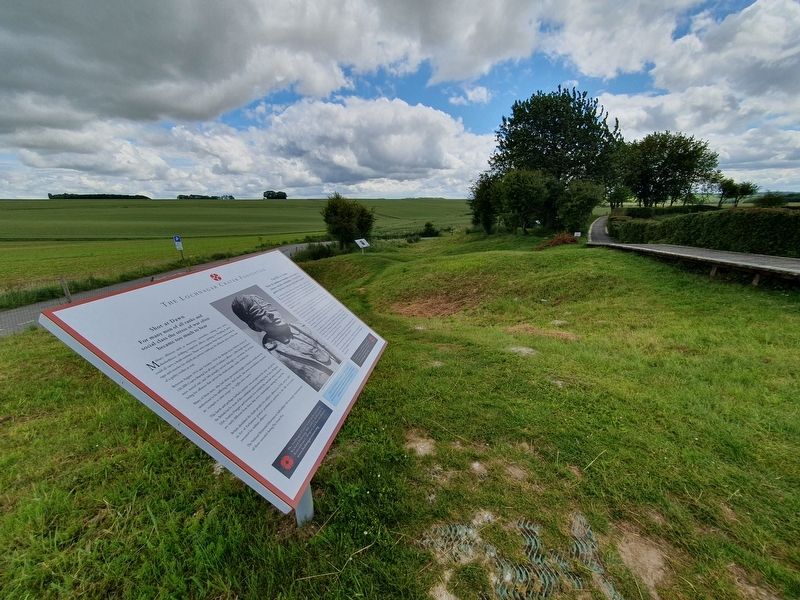
Shot at Dawn

Photographed by J. Makali Bruton, June 10, 2024
1. Shot at Dawn Marker

For many men of all ranks and social class the stress of war often became too much to bear
Military offences such as desertion, cowardice, casting away arms, striking a superior officer, quitting or sleeping at post, could all carry a death sentence. These were separate from those crimes such as rape and murder for which any person could pay the ultimate price in the case of a guilty verdict at trial.
Between August 1914 and October 1918 the British Army held in excess of 230,000 Courts Martial for all types of military offence. 3,080 death sentences were meted out, and 346 actually carried through to execution, 40 of these being for offences that carried the death penalty under civilian law.
Many of these men, who had often previously fought so bravely would now be understood to be suffering from 'shell shock', but were nevertheless executed, an 'example to other troops', to 'stiffen their resolve’.
This harsh and perhaps barbaric practice was accepted at the time, not just by the British but by most of the combatant nations including Italy, France, Belgium, USA, Austria-Hungary and Germany. It is
this page online
Britain abolished the death penalty for military offences in 1930, and in 2007 an Act of Parliament granted posthumous pardons to the 306 servicemen executed for military offences.
The National Memorial Arboretum in Staffordshire UK movingly commemorates all those executed during The Great War.
The Lochnagar Crater is privately owned by Richard Dunning MBE and is dedicated to Remembrance, Respect and Reconciliation.
www.lochnagarcrater.org
'The Lochnagar Promise For Peace'
“In Remembrance of all those who have suffered in conflict, and those who are suffering still may we live our lives today with more Compassion and Kindness. Understanding and Forgiveness Reconciliation and Unity. Let us now, in their honour, wage Peace.”
The Trustees are grateful for the generous bequest which enabled the refurbishment of these Visitor Information Panels.
www.lochnagarcrater.org
Fusillés à l'aube
Pour de nombreux hommes, tous rangs et classes sociales confondus, le stress de la guerre devient souvent trop lourd
Photographed by J. Makali Bruton, June 10, 2024
2. Shot at Dawn Marker
Les infractions militaires, telles que la désertion, la licheté, l'abandon de ses armes, la désobéissance, frapper un officier supérieur, quitter son poste on dormir à son poste, peuvent toutes entrainer une condamnation à mort. Celles-ci sont distinguées de crimes tels que le viol et le meurtre, pour lesquels toute personne pouvait être condamnée à la peine capitale dans le cas d'un verdict de culpabilité lors du proces.
D'août 1914 à octobre 1918, l'Armée Britannique tient plus de 230 000 cours martiales pour tous types d'infractions militaires. 3 080 condamnations à morts sont prononcées, dont 346 appliquées, 40 d'entre elles pour des délits condamnées à la peine de mort dans le droit civil.
Beaucoup de ces hommes, qui avaient jusqu'alors combattus avec courage et seraient aujourd'hui considérés comme souffrant de syndrome de stress past traumatique », sont néanmoins exécutés, soit pour l'exemple », soit pour renforcer la détermination des troupes ».
Cette pratique sévère, et peut-être barbare, est répandue à l'époque, non seulement chez les Britanniques, mais aussi chez la plupart des nations combattantes, y compris l'Italie, la France, la Belgique, les Etats-Unis, l'Autriche-Hongrie et l'Allemagne. I est bien sûr évident que les pratiques d'aujourd'hui sont très differentes de celles qui étaient d'usage pendant la Grande Guerre.
La Grande Bretagne abolit la peine de mort pour les infractions militaires en 1930 et en 2007, une loi est promulguée pour accorder le pardon à titre posthume aux 306 militaires exécutés pour des infractions militaires.
Tous ceux qui furent exécutés lors de la Grande Guerre sont commémoris de manière très poignante au National Memorial Arboretum dans le Staffordshire, au Royaume Uni.
Erected by Lochnagar Crater Foundation.
Topics. This historical marker is listed in this topic list: War, World I. A significant historical month for this entry is August 1914.
Location. 50° 0.947′ N, 2° 41.876′ E. Marker is in Ovillers-la-Boisselle, Hauts-de-France (Upper France), in Somme. It is on Route de la Grande Mine south of Route D20, on the right when traveling south. Touch for map. Marker is at or near this postal address: 6 Rte de la Grande Mine, Ovillers-la-Boisselle, Hauts-de-France 80300, France. Touch for directions.

Regionally, it is in the North Atlantic Region, Europe, the European Union, Atlantic Europe, the Schengen Area, Western Europe, a coastal Mediterranean country, and the Western World. Historically, it finds itself in what was once a French colony and also the Roman Empire.
Other nearby markers. At least 8 other markers are within walking distance of this marker: Vera Brittain (a few steps from this marker); The Unseen Scars of War... (a few steps from this marker); The Last Letter of Pte. John Scollen (within shouting distance of this marker); T'isnt worth it.... (within shouting distance of this marker); The Lochnagar Crater of La Boisselle (within shouting distance of this marker); Pilgrimage: Tom Easton's visits to his friends at Bécourt (within shouting distance of this marker); 15th and 16th Royal Scots (within shouting distance of this marker); An account by Pte. Billy Disbrey (within shouting distance of this marker). Touch for a list and map of all markers in Ovillers-la-Boisselle.
Credits. This page was last revised on July 31, 2024. It was originally submitted on July 31, 2024, by J. Makali Bruton of Washington, District of Columbia. This page has been viewed 128 times since then and 11 times this year. Photos: 1, 2. submitted on July 31, 2024, by J. Makali Bruton of Washington, District of Columbia.
