White Sands in Doña Ana County, New Mexico — The American Mountains (Southwest)
Beechcraft MQM-61 Cardinal Target Drone

Photographed by James Hulse, July 23, 2024
1. Beechcraft MQM-61 Cardinal Target Drone Marker
Erected by White Sands Missile Range Museum.
Topics. This historical marker is listed in this topic list: Air & Space. A significant historical year for this entry is 1955.
Location. 32° 23.168′ N, 106° 28.738′ W.
this page online

Regionally, this marker is in the Rio Grande Valley. It is also in the American Borderlands and in the Southwest. Globally, it is in North America, the Western Hemisphere, the Western World, and the Anglosphere. Historically, it finds itself in what was once New Spain, the Gadsden Purchase, and the Republic of Texas.
Other nearby markers. At least 8 other markers are within walking distance of this marker: XQ-4 Drone (here, next to this marker); Firebee (here, next to this marker); Shavetail (a few steps from this marker); Little John (a few steps from this marker); XM-21 (a few steps from this marker); Hound Dog (a few steps from this marker); Pogo and Pogo-HI (a few steps from this marker); PGM-11 Redstone Tactical Version (a few steps from this marker). Touch for a list and map

Photographed by James Hulse, July 23, 2024
2. Beechcraft MQM-61 Cardinal Target Drone Marker
More about this marker. The marker and museum are located on the White Sands Missile Range, an active U.S. military installation. The museum is open to the public, but appropriate identification is required for access.
Also see . . .
1. Welcome to the White Sands Missile Range Museum. White Sands Missile Range Museum (Submitted on July 31, 2024, by James Hulse of Medina, Texas.)
2. Beechcraft MQM-61 Cardinal. Wikipedia
The MQM-61 Cardinal was a target drone designed and built by Beechcraft.(Submitted on August 1, 2024, by James Hulse of Medina, Texas.)
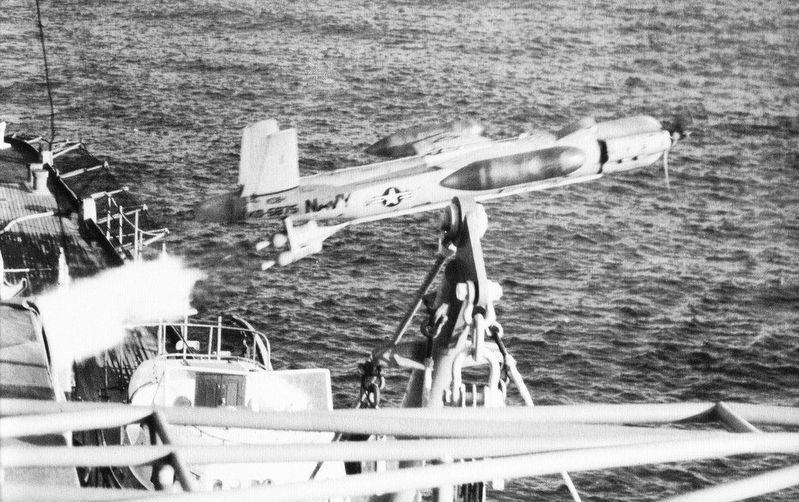
Public Domain - US Navy, circa 1962
3. USS Boston (CAG-1) launches KDB-1 drone
A Beechcraft KDB-1 Cardinal target drone is launched from the U.S. Navy guided missile cruiser USS Boston (CAG-1).
Credits. This page was last revised on August 1, 2024. It was originally submitted on July 31, 2024, by James Hulse of Medina, Texas. This page has been viewed 411 times since then and 82 times this year. Photos: 1, 2, 3. submitted on August 1, 2024, by James Hulse of Medina, Texas.
