Beek, Limburg, Netherlands — Northwestern Europe
Nooit Echt Bevrijd
⎯⎯⎯
Never Genuinely Liberated
⎯⎯⎯
Nie Wirklich Befreit
| — | Liberation Route Europe | — |
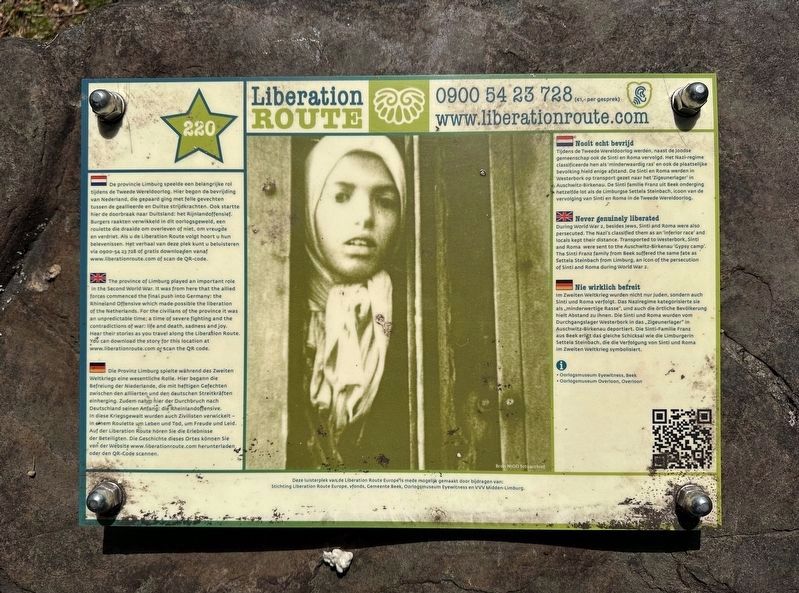
Photographed by Andrew Ruppenstein, July 14, 2024
1. Nooit Echt Bevrijd / Never Genuinely Liberated / Nie Wirklich Befreit Marker
Although not noted on the marker, the girl depicted in the picture has been identified as Settela Steinbach. She was one of the Sinti arrested in the razzia of May 14, 1944, sent to Westerbork, and then deported to Auschwitz where she was murdered on July 31, 1944 at the age of 9.

Tijdens de Tweede Wereldoorlog werden, naast de Joodse gemeenschap ook de Sinti en Roma vervolgd. Het Nazi-regime classificeerde hen als 'minderwaardig ras' en ook de plaatselijke bevolking hield enige afstand. De Sinti en Roma werden in Westerbork op transport gezet naar het 'Zigeunerlager' in Auschwitz-Birkenau. De Sinti familie Franz uit Beek onderging - hetzelfde lot als de Limburgse Settela Steinbach, icoon van de vervolging van Sinti en Roma in de Tweede Wereldoorlog.
De provincie Limburg speelde een belangrijke rol tijdens de Tweede Wereldoorlog. Hier begon de bevrijding van Nederland, die gepaard ging met felle gevechten tussen de geallieerde en Duitse strijdkrachten. Ook startte hier de doorbraak naar Duitsland: het Rijnlandoffensief. Burgers raakten verwikkeld in dit oorlogsgeweld, een roulette die draaide om overleven of niet, om vreugde en verdriet. Als u de Liberation Route volgt hoort u hun belevenissen. Het verhaal van deze plek kunt u beluisteren via 0900-54 23 728 of gratis downloaden vanaf www.liberationroute.com of scan de QR-code.
🇬🇧
this page online
During World War 2, besides Jews, Sinti and Roma were also persecuted. The Nazi's classified them as an 'inferior race' and locals kept their distance. Transported to Westerbork, Sinti and Roma were sent to the Auschwitz-Birkenau 'Gypsy camp'. The Sinti Franz family from Beek suffered the same fate as Settela Steinbach from Limburg, an icon of the persecution of Sinti and Roma during World War 2.
The province of Limburg played an important role in the Second World War. It was from here that the allied forces commenced the final push into Germany: the Rhineland Offensive which made possible the liberation of the Netherlands. For the civilians of the province it was an unpredictable time; a time of severe fighting and the contradictions of war: life and death, sadness and joy. Hear their stories as you travel along the Liberation Route. You can download the story for this location at www.liberationroute.com or scan the QR code.
🇩🇪
Im Zweiten Weltkrieg wurden nicht nur Juden, sondern auch Sinti und Roma verfolgt. Das Naziregime kategorisierte sie als
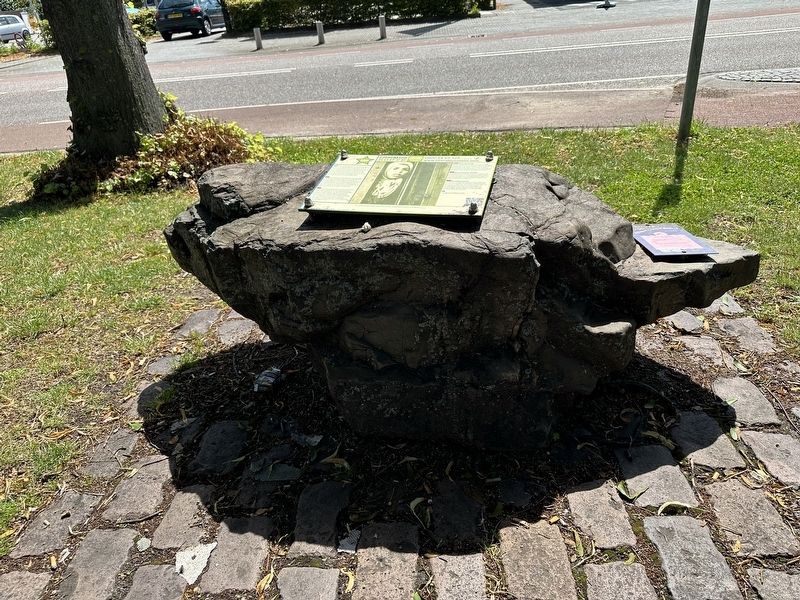
Photographed by Andrew Ruppenstein, July 14, 2024
2. Nooit Echt Bevrijd / Never Genuinely Liberated / Nie Wirklich Befreit Marker
Die Provinz Limburg spielte während des Zweiten Weltkriegs eine wesentliche Rolle. Hier begann die Befreiung der Niederlande, die mit heftigen Gefechten zwischen den alliierten und den deutschen Streitkräften einherging. Zudem nahm hier der Durchbruch nach Deutschland seinen Anfang: die Rheinlandoffensive. In diese Kriegsgewalt wurden auch Zivilisten verwickelt- in einem Roulette um Leben und Tod, um Freude und Leid. Auf der Liberation Route hören Sie die Erlebnisse der Beteiligten. Die Geschichte dieses Ortes können Sie von der Website www.liberationroute.com herunterladen oder den QR-Code scannen.
Erected 2015 by Stichting Liberation Route, Eyewitness te Beek. (Marker Number 220.)
Topics and series. This historical marker is listed in this
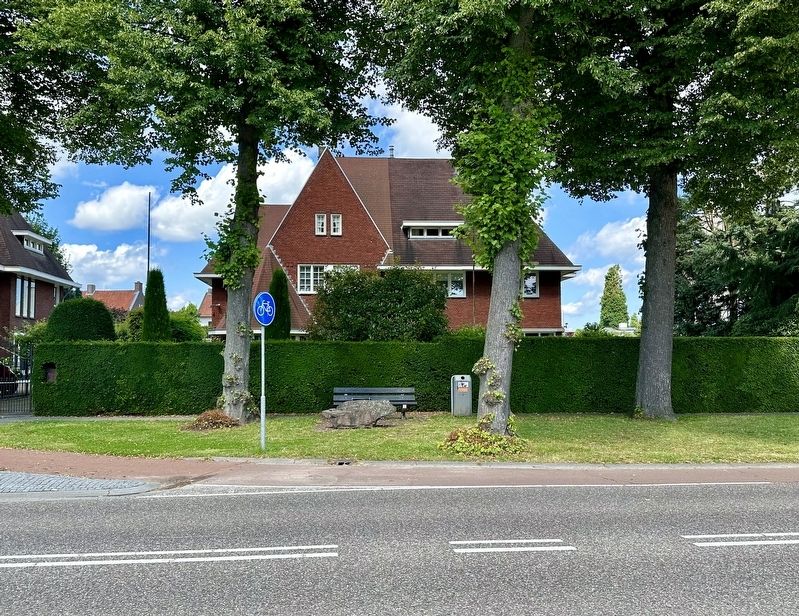
Photographed by Andrew Ruppenstein, July 14, 2024
3. Nooit Echt Bevrijd / Never Genuinely Liberated / Nie Wirklich Befreit Marker - wide view
Location. 50° 56.309′ N, 5° 47.514′ E. Marker is in Beek, Limburg. It is at the intersection of Maastrichterlaan and Kloostersteeg, on the left when traveling north on Maastrichterlaan. Touch for map. Marker is at or near this postal address: Maastrichterlaan 33, Beek, Limburg 6191 AK, Netherlands. Touch for directions.

Regionally, it is in Europe, the European Union, Atlantic Europe, the Benelux Low Countries, the Schengen Area, Western Europe, and the Western World. Historically, it finds itself in what was once the Roman Empire and specifically also the Holy Roman Empire.
Other nearby markers. At least 8 other markers are within walking distance of this marker: German Deserter Saves the Life of a Persecuted “Gypsy” (within shouting distance of this marker); Beek Synagogue (about 210 meters away, measured in a direct line); Joods Monument Beek / Beek Holocaust Memorial (approx. 0.3 kilometers away); Hervormde Pastorie / Reformed Parsonage (approx. 0.3 kilometers away); Voormalige Bakkerij / Former Bakery (approx. 0.3 kilometers away); Hell on Wheels (approx. 0.4 kilometers away); Restaurant “De Lindeboom” (approx. 0.4 kilometers away); Sinti Monument (approx. half a kilometer away). Touch for a list and map of all markers in Beek.
Related markers. Click here for a list of markers that are related to this marker.
Also see . . .
1. Never Genuinely Liberated (Liberation Route Europe).
Excerpt: In the first years of the war the Dutch government particularly discriminated against the Sinti and Roma, commonly known by the derogatory term “gypsies”. They were preconceived to be antisocial or criminal by large parts of the population. The Nazis also discriminated against them and classified the Roma and Sinti as a subhuman race that needed to be exterminated.(Submitted on August 1, 2024.)
Reichsführer SS Heinrich Himmler therefore issued the Auschwitz Erlass in December 1942, ordering all Gypsies to be taken to a special section of the Auschwitz-Birkenau extermination camp, the Zigeunerlager.
Throughout the Netherlands, during the night of the 16th of May, raids took place on the Roma and Sinti. On the 19th of May, nine members of the Franz Sinti family from Beek were transported along with 236 other the Roma and Sinti from Westerbork to Auschwitz. Among them was Settela Steinbach, a young girl born in Buchten near Sittard.
Of this group, 31 people survived the horrors of the camps. Three of the survivors were members of the Franz family. But genuine liberation was not for them. They had to live with the realisation their family had been massacred. And the pre-war discrimination against people living in caravans hadn’t suddenly gone away.
2. Settela Steinbach (Wikipedia).
Overview: Anna Maria (Settela) Steinbach (23 December 1934, Buchten – 31 July 1944) was a Dutch girl who was gassed in Nazi Germany's Auschwitz-Birkenau extermination camp. Initially identified as a Dutch Jew, her personal identity and association with the Sinti group of the Romani people were discovered in 1994.(Submitted on August 1, 2024.)
Credits. This page was last revised on July 4, 2026. It was originally submitted on August 1, 2024, by Andrew Ruppenstein of Lamorinda, California. This page has been viewed 166 times since then and 13 times this year. Photos: 1, 2, 3. submitted on August 1, 2024, by Andrew Ruppenstein of Lamorinda, California.
