
Bowling Green in Wood County, Ohio — The American Midwest (Great Lakes)
The Changing Face of South Main
Photographed by Craig Doda, July 21, 2024
1. The Changing Face of South Main Marker
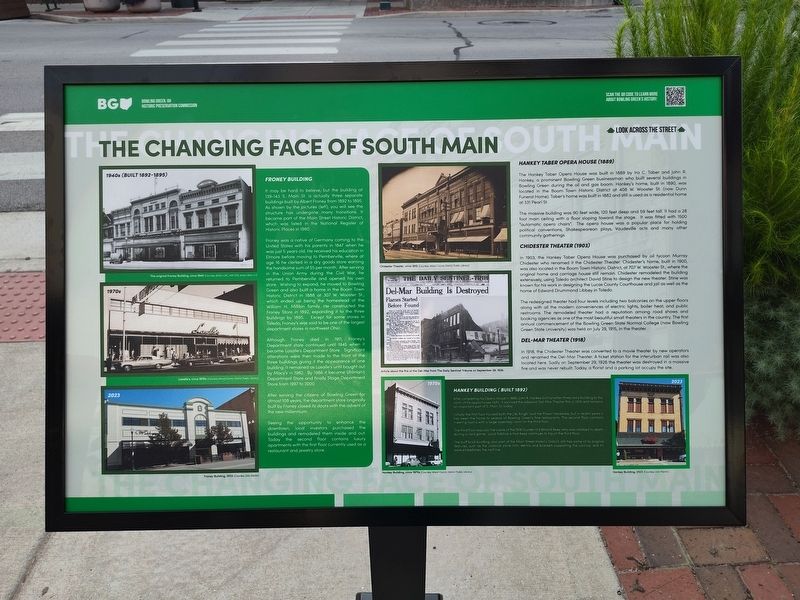
Froney Building
It may be hard to believe, but the building at 139-143 S. Main St. is actually three separate buildings built by Albert Froney from 1892 to 1895. As shown by the pictures (left), you will see the structure has undergone many transitions. It became part of the Main Street Historic District, which was listed in the National Register of Historic Places in 1980.
Froney was a native of Germany coming to the United States with his parents in 1847 when he was just 5 years old. He received his education in Elmore before moving to Pemberville, where at age 16 he clerked in a dry goods store earning the handsome sum of $5 per month. After serving in the Union Army during the Civil War, he returned to Pemberville and opened his own store. Wishing to expand, he moved to Bowling Green and also built a home in the Boom Town Historic District in 1888 at 307 W. Wooster St., which ended up being the homestead of the William H. Millikin family. He constructed the Froney Store in 1892, expanding it to the three buildings by 1895. Except for some stores in Toledo, Froney's was said to be one of the largest department stores
this page online
Although Froney died in 1911, Froney's Department store continued until 1945 when it became Lasalle's Department Store. Significant alterations were then made to the front of the three buildings giving it the appearance of one building. It remained as Lasalle's until bought out by Macy's in 1982. By 1986 it became Uhlman's Department Store and finally Stage Department Store from 1997 to 2000.
After serving the citizens of Bowling Green for almost 108 years, the department store originally built by Froney closed its doors with the advent of the new millennium.
Seeing the opportunity to enhance the downtown, local investors purchased the buildings and remodeled them inside and out. Today the second floor contains luxury apartments with the first floor currently used as a restaurant and jewelry store.
Hankey Taber Opera House (1889)
The Hankey Taber Opera House was built in 1889 by Ira C. Taber and John R. Hankey, a prominent Bowling Green businessman who built several buildings in. Bowling Green during the oil and gas boom. Hankey's home, built in 1890, was located in the Boom Town Historic District at 408 W. Wooster
Photographed by Craig Doda, July 21, 2024
2. The Changing Face of South Main Marker
The massive building was 90 feet wide, 120 feet deep and 59 feet tall. It had a 28 foot main ceiling with a floor sloping toward the stage. It was fitted with 1500 "automatic opera chairs". The opera house was a popular place for holding political conventions, Shakespearean plays, Vaudeville acts and many other community gatherings.
Chidester Theater (1903)
In 1903, the Hankey Taber Opera House was purchased by oil tycoon Murray Chidester who renamed it the Chidester Theater. Chidester's home, built in 1900, was also located in the Boom Town Historic District, at 707 W. Wooster St., where the original home and carriage house still remain. Chidester remodeled the building extensively, using Toledo architect David Stine to design the new theater. Stine was known for his work in designing the Lucas County Courthouse and jail as well as the home of Edward Drummond Libbey in Toledo.
The redesigned theater had four levels including two balconies on the upper floors along with all the modern conveniences of electric lights, boiler heat, and public restrooms. The remodeled theater had a reputation among road shows and booking agencies as one of the most beautiful small theaters in the country. The first annual commencement of the Bowling Green State Normal College (now Bowling Green State University) was held on July 29, 1915, in the theater.
Del-Mar Theater (1918)
In 1918, the Chidester Theater was converted to a movie theater by new operators and renamed the Del-Mar Theater. A ticket station for the interurban rail was also located here. Sadly on September 29, 1926 the theater was destroyed in a massive fire and was never rebuilt. Today, a florist and a parking lot occupy the site.
Hankey Building (Built 1892)
After completing his Opera House in 1886, John R. Honkey built another three story building to the north of his opera house (left). It survived the adjacent Del-Mar Theater fire in 1926 and remains. an important part of S. Main St. today.
Initially the first floor housed both the JW. Knight and the Prieur Hardware, but in recent years it has been the home to several of Bowling Green's fine restaurants. The second floor contains. meeting rooms with a large assembly room on the third floor.
The third floor was also the scene of the 1918 murder of Edmund Keep who was stabbed to death during a card game. Local folklore is that Keep continues to haunt the third floor.
The buff brick building, also part of the Main Street Historic District, still has some of its original features, such as the classical stone trim, dentils and brackets supporting the cornice, and fin work embellishes the roof line.
Topics. This historical marker is listed in these topic lists: Architecture • Arts, Letters, Music • Entertainment • Industry & Commerce. A significant historical date for this entry is July 29, 1915.
Location. 41° 22.437′ N, 83° 39.021′ W. Marker is in Bowling Green, Ohio, in Wood County. It is on South Main Street 0.1 miles south of East Wooster Street, on the right when traveling north. Touch for map. Marker is at or near this postal address: 145 S Main St, Bowling Green OH 43402, United States of America. Touch for directions.

Regionally, this marker is in Ohio’s Black Swamp, in the Till Plains, and in the Toledo Metropolitan Area. It is also in the American Midwest and in the Corn Belt. Globally, it is in North America, on the Great Lakes, in the Western Hemisphere, in the Western World, and in the Anglosphere. Historically, it finds itself in what was once the Haudenosaunee (Iroquois) Confederacy, the territory of the Mississippian Culture, and the Northwest Territory.
Other nearby markers. At least 8 other markers are within walking distance of this marker: Historic Main Street (a few steps from this marker); The Main Street Historic District (a few steps from this marker); The Great Black Swamp (within shouting distance of this marker); Commerce & Finance In Old Bowling Green (within shouting distance of this marker); The Four Corners (about 300 feet away, measured in a direct line); Bowling Green's Interurban & Rail Line (about 300 feet away); Exchange Bank (about 400 feet away); Wiley Post No. 46 (about 400 feet away). Touch for a list and map of all markers in Bowling Green.
Credits. This page was last revised on August 1, 2024. It was originally submitted on August 1, 2024, by Craig Doda of Napoleon, Ohio. This page has been viewed 167 times since then and 22 times this year. Photos: 1, 2. submitted on August 1, 2024, by Craig Doda of Napoleon, Ohio. • Devry Becker Jones was the editor who published this page.
