Bowling Green in Wood County, Ohio — The American Midwest (Great Lakes)
Entertainment For The Decades

Photographed by Craig Doda, July 21, 2024
1. Entertainment For The Decades Marker
All buildings on the northwest block of N. Main St. and described here are part of the Main Street Historic District, placed in the National Register of Historic Places on November 28, 1980.
Through the decades, residents have found entertainment on N. Main St. From Vaudeville acts to silent movies, theatrical plays to the "Talkies", first-run movies with synchronized high-fidelity sound to opera performances, this block has been home to it all. Before television, the internet, and social media, residents congregated most evenings downtown for social encounters, parades and fun-filled events. A performer even attempted to fly a hot air balloon over the block of buildings but was unsuccessful after the balloon caught on fire and landed unceremoniously. Now BGSU students enjoy the pubs and taverns with their friends for late night escapes from studies.
The Cla-Zel Theater
, 129 N. Main St., was built in 1926 and designed in the Classical Revival style by local architect Jack Rainey (who lived to age 106). In the era of silent films, the Cla-Zel was built by S.P. Stewart and Son for $150,000. The fire-proof building housed
this page online
Rogers Drugs, 135 N. Main St., is now a tavern. Many residents fondly remember the former lunch counter and soda fountain where lunches were served to people for decades. Doctor Rogers sold his interest in the business to Mr. Charles Rogers in February of 1870. In 1891 his sons, George and Clayton, took over upon his death. The drug store remained open into the 1980s.
Exchange Bank, on the northwest corner of the "Four Corners" is the Exchange Bank Building, 101 N. Main St. (built 1871), which
Photographed by Craig Doda, July 21, 2024
2. Entertainment For The Decades Marker
For entertainment, the Bigelow Family Band was a Bowling Green favorite. The family band would play weekly at the Four Corners. John (on bass drum) and his eight children participated in the group: Bigelow worked at his fathers lumber mill (which stood where St.- Aloysius Church stands today) and he worked with the carpenters there to build a wooden band stand for performances. His son Jack Bigelow and family owned and operated a music store on E. Wooster St. until 1980 Jack formed the All-Girl Band, featuring his five sisters and first wife, in 1921. They toured the Vaudeville Circuit and state fairs. They played at the Wood County Fairgrounds for 25 years.
Mercer Block, 157-163 N. Main St., is now known as the Masonic Temple. The Renaissance Revival Beaux Arts building was built in 1903. In the National Register of Historic Places it was described as the "last of the oil and gas buildings in this district." The original mansard-like roof featured elaborate ornamentation over the three central arched windows on the fourth floor, now removed. Upon completion, a furniture store as well as medical physicians and surgeons, dental, and optical professionals had office suites at the Mercer block. After 85 years of furniture and interior-decorating entities, photo shops occupied 157 N. Main St. for many years. Attorneys inhabited offices on the second floor of 161 N. Main St. Restaurants, beauty shops, and the Chamber of Commerce and related entities were located on the ground level at 163 N. Main St. Since 1920, the historic upper three floors have been known as the Masonic Lodge. The original wood accents, tin ceiling, and lighting fixtures are still maintained as they were in 1920. Five Masonic organizations share the space and continue the centuries-old traditions of the Masons.
Mckenzie-Kabig Block, 175-203 N. Main St. (1892), features carved name blocks at the top of the Romanesque double storefront plan. Actually, the Kabig block reads Kabic, possibly due to a mistake by the stonecutter. Frank Kabig had his butcher shop there. By 1919, the second floor housed the newly renamed Wood County Public Library with over 3,000 volumes of books donated through efforts of the Shakespeare Round Table and staffed by volunteers from the club. This "labor of love and sacrifice" through the century grew into the Wood County District Public Library located on the next block north. The building also served as an interurban station, as well as a bakery, grocery, dry cleaner, department store, and pastry shop. Today it is the home of Pisanello's Pizza, BG's first pizza parlor, owned and operated since 1964 by the Liss family. This building is the last building to the north on the west side of N. Main St., marking the northern edge of the Main Street District Historic District. 2023 (Courtesy Dick Martin)
Topics. This historical marker is listed in these topic lists: Architecture • Arts, Letters, Music • Entertainment • Industry & Commerce. A significant historical month for this entry is February 1930.
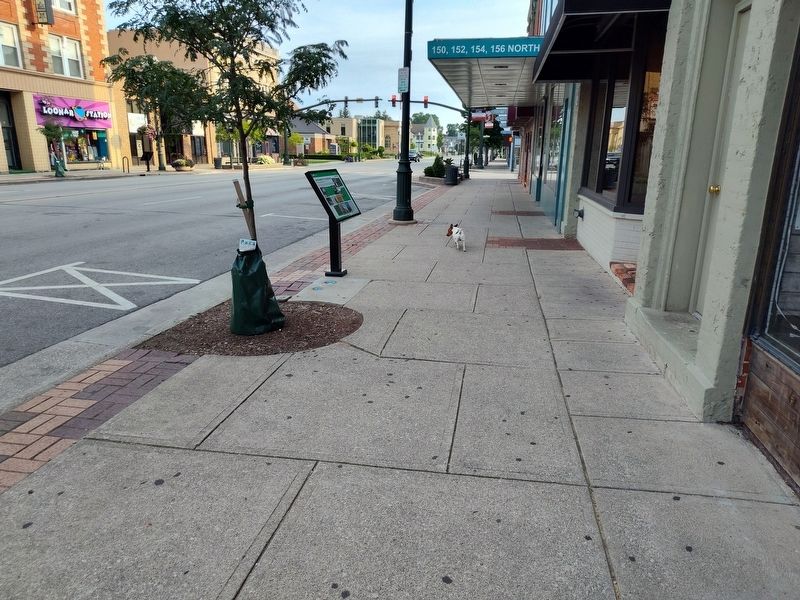
Location. 41° 22.54′ N, 83° 39.033′ W. Marker is in Bowling Green, Ohio, in Wood County. It is on North Main Street 0.1 miles north of West Wooster Street, on the right when traveling south. Touch for map. Marker is at or near this postal address: 149 N Main St, Bowling Green OH 43402, United States of America. Touch for directions.

Regionally, this marker is in the Black Swamp, in the Till Plains, and in the Toledo Metropolitan Area. It is also in the American Midwest and in the Corn Belt. Globally, it is in North America, on the Great Lakes, in the Western Hemisphere, in the Western World, and in the Anglosphere. Historically, it finds itself in what was once the Haudenosaunee (Iroquois) Confederacy, the territory of the Mississippian Culture, and the Northwest Territory.
Other nearby markers. At least 8 other markers are within walking distance of this marker: The Changing Faces of North Main Street (within shouting distance of this marker); Exchange Bank (within shouting distance of this marker); Bowling Green's Interurban & Rail Line (about 300 feet away, measured in a direct line); The Four Corners (about 300 feet away); Serving The Citizens of Bowling Green (about 400 feet away); Wiley Post No. 46 (about 400 feet away); Commerce & Finance In Old Bowling Green (about 500 feet away); A Legacy of Public Service (about 500 feet away). Touch for a list and map of all markers in Bowling Green.
Credits. This page was last revised on August 1, 2024. It was originally submitted on August 1, 2024, by Craig Doda of Napoleon, Ohio. This page has been viewed 205 times since then and 36 times this year. Photos: 1, 2. submitted on August 1, 2024, by Craig Doda of Napoleon, Ohio. • Devry Becker Jones was the editor who published this page.
