Ovillers-la-Boisselle in Somme, Upper France, France — Western Europe
The Unseen Scars of War...
Photographed by J. Makali Bruton, June 10, 2024
1. The Unseen Scars of War... Marker

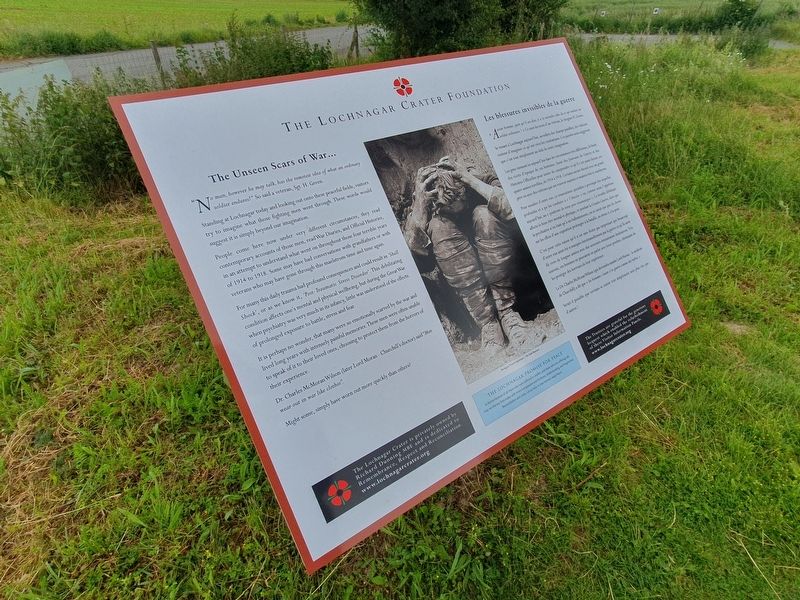
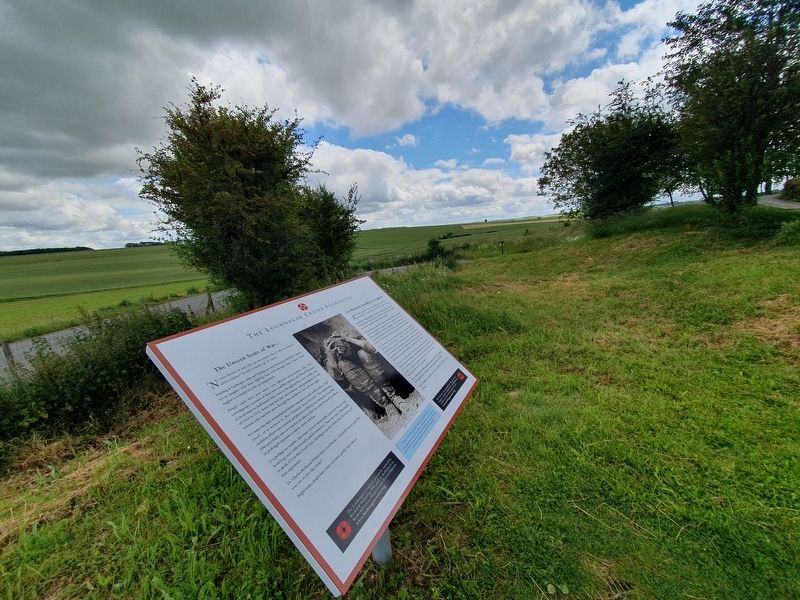
“No man, however he may talk, has the remotest idea of what an ordinary soldier endures!" So said a veteran, Sgt. H. Green.
Standing at Lochnagar today and looking out onto these peaceful fields, visitors try to imagine what those fighting men went through. These words would suggest it is simply beyond our imagination.
People come here now under very different circumstances, they read contemporary accounts of those men, read War Diaries, and Official Histories, in an attempt to understand what went on throughout those four terrible years of 1914 to 1918. Some may have had conversations with grandfathers or with veterans who may have gone through this maelstrom time and time again.
For many this daily trauma had profound consequences and could result in 'Shell Shock', or as we know it, 'Post-Traumatic Stress Disorder'. This debilitating condition affects one's mental and physical wellbeing, but during the Great War when psychiatry was very much in its infancy, little was understood of the effects of prolonged exposure to battle, stress and fear.
It is perhaps no wonder, that many
this page online
Dr. Charles McMoran Wilson (later Lord Moran - Churchill's doctor) said "Men wear out in war like clothes".
Might some, simply have worn out more quickly than others?
The Lochnagar Crater is privately owned by Richard Dunning MBE and is dedicated to Remembrance, Respect and Reconciliation.
www.lochnagarcrater.org
'The Lochnagar Promise For Peace'
“In Remembrance of all those who have suffered in conflict, and those who are suffering still may we live our lives today with more Compassion and Kindness. Understanding and Forgiveness Reconciliation and Unity. Let us now, in their honour, wage Peace.”
The Trustees are grateful for the generous bequest which enabled the refurbishment of these Visitor Information Panels.
www.lochnagarcrater.org
Les blessures invisibles de la guerre
Aucun homme, quoi qu'il en dise, n'a la moindre idée de ce qu'endure un A soldat ordinaire !» Ce sont les mots d'un vétéran,
Photographed by J. Makali Bruton, June 10, 2024
2. The Unseen Scars of War... Marker
Se tenant à Lochnagar aujourd'hui, au milieu des champs paisibles, les visiteurs tentent d'imaginer ce qu'ont vécu les combattants. Ces paroles nous suggèrent que c'est tout simplement au-delà de notre imagination.
Les gens viennent ici aujourd'hui dans des circonstances très differentes, ils lisent des récits d'époque de ces hommes, lisent des Journaux de Guerre et des Histoires Officielles pour tenter de comprendre ce qu'il s'est passé durant ces quatre années terribles, de 1914 à 1918. Certains auront discuté avec un grand- père ou avec des vétérans qui ont traversé maintes et maintes fois ce maelstrom.
Pour nombre d'entre eux, ce traumatisme quotidien a provoqué des séquelles profondes et a pu les conduire à « l'oburite » ou, comme nous l'appelons syndrome de stress post-traumatique ». Ce trouble debilitant aujourd'hui, au « affecte le bien-être mental et physique, or pendant la Grande Guerre, alors que la psychiatrie n'en était qu'à ses balbutiements, on ne savait que peu de choses sur les effets d'une exposition prolongée à la bataille, au stress et à la peur.
C'est pour cette raison qu'il n'est sans doute pas surprenant que beaucoup d'entre eux aient été si marqués émotionnellement par la guerre et qu'ils aient dû vivre de longues années avec des souvenirs intensément douloureux. Très souvent, ces hommes ne pouvaient en parler avec leurs proches, choisissant de les protéger des horreurs de leur expérience.
Le Dr. Charles McMoran Wilson (qui deviendra ensuite Lord Moran - le médecin de Churchill) a dit que les hommes s'usent à la guerre comme des habits.
Serait-il possible que certains se soient tout simplement usés plus vite que d'autres ?
Erected by The Lochnagar Crater Foundation.
Topics. This historical marker is listed in this topic list: War, World I. A significant historical year for this entry is 1914.
Location. 50° 0.939′ N, 2° 41.887′ E. Marker is in Ovillers-la-Boisselle, Hauts-de-France (Upper France), in Somme. It is on Route de la Grande Mine south of Route D20, on the right when traveling south. Touch for map. Marker is at or near this postal address: 3 Rte de la Grande Mine, Ovillers-la-Boisselle, Hauts-de-France 80300, France. Touch for directions.

Regionally, it is in the North Atlantic Region, Europe, the European Union, Atlantic Europe, the Schengen Area, Western Europe, a coastal Mediterranean country, and the Western World. Historically, it finds itself in what was once a French colony and also the Roman Empire.
Other nearby markers. At least 8 other markers are within walking distance of this marker: Shot at Dawn (a few steps from this marker); T'isnt worth it.... (within shouting distance of this marker); Vera Brittain (within shouting distance of this marker); 15th and 16th Royal Scots (within shouting distance of this marker); The Last Letter of Pte. John Scollen (within shouting distance of this marker); An account by Pte. Billy Disbrey (within shouting distance of this marker); The Lochnagar Crater of La Boisselle (within shouting distance of this marker); Pilgrimage: Tom Easton's visits to his friends at Bécourt (within shouting distance of this marker). Touch for a list and map of all markers in Ovillers-la-Boisselle.
Credits. This page was last revised on August 1, 2024. It was originally submitted on August 1, 2024, by J. Makali Bruton of Washington, District of Columbia. This page has been viewed 131 times since then and 16 times this year. Photos: 1, 2. submitted on August 1, 2024, by J. Makali Bruton of Washington, District of Columbia.
