Savalou, Collines Department, Benin — West Africa
Ahossou Soha, 1er Roi de Savalou
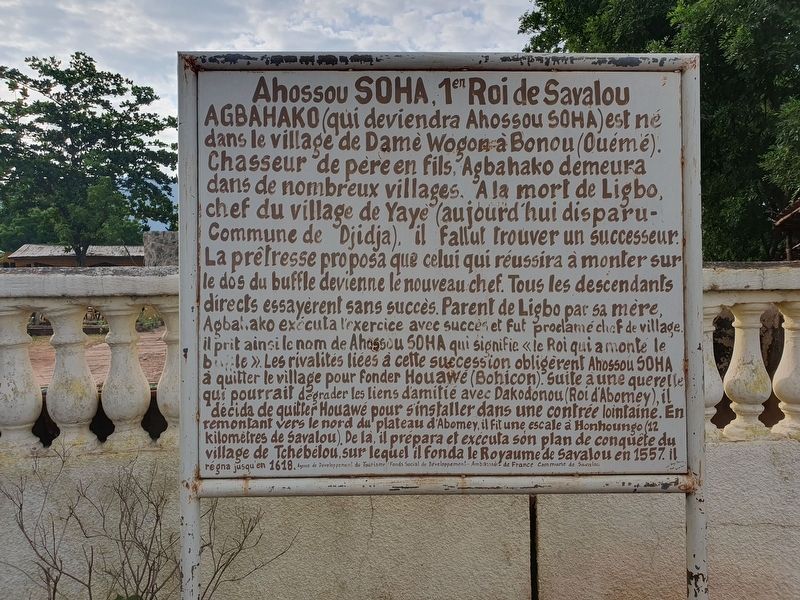
Photographed by J. Makali Bruton, July 24, 2024
1. Ahossou Soha, 1er Roi de Savalou Marker

Agbahako (qui deviendra Ahossou Soha) est né dans le village de Dame Wogon à Bonou (Ouémé). Chasseur de pere en fils, Agbahako demeura dans de nombreux villages. A la mort de Ligbo, chef du village de Yaye (aujourd'hui disparu-Commune de Djidja), il fallut trouver un successeur. La pretresse proposa que celui qui réussira à monter sur le dos du buffle devienne le nouveau chef. Tous les descendants directs essayerent sans succès. Parent de Ligbo par sa mère, Agbahako executa l'exercice avec succès et fut proclamé chef de village. Il prit ainsi le nom de Ahassou Soha qui signifie « le Roi qui a monte le buffle ». Les rivalités liées à cette succession obligerent Ahossou Soha à quitter le village pour fonder Houawe (Bohicon). Suite a une querelle qui pourrait degrader les liens d’amitié avec Dakodonou (Roi d'Abomey), il decida de quitter Houawé pour s’installer dans une contrée lointaine. En remontant vers le nord du plateau d'Abomey, il fit une escale à Honhoungo (12 kilometres de Savalou). De la, il prépara et executa són plan de conquête du village de Tchebelou, sur lequel il fonda
this page online
Agence de Developpement du Turisme, Fonds Social de Developpement - Ambassade de France, Commune de Savalou
Ahossou Soha, First King of Savalou
Agbahako (who would become Ahossou Soha) was born in the village of Dame Wogon in Bonou (Ouémé). As a hunter, like his father, Agbahako lived in many villages. When Ligbo died, chief of the village of Yaye (now disappeared - Commune of Djidja), it was necessary to find a successor. The priestess proposed that whoever managed to ride on the buffalo's back should become the new leader. All the direct descendants tried without success. A relative of Ligbo through his mother, Agbahako successfully performed the exercise and was proclaimed village chief. He took the name Ahassou Soha, which means "the King who rode the buffalo". The rivalries linked to this succession forced Ahossou Soha to leave the village to found Houawe (Bohicon). Following a quarrel that could degrade the bonds of friendship with Dakodonou (King of Abomey), he decided to leave Houawé to settle in a distant country. On his way up to the north of the Abomey
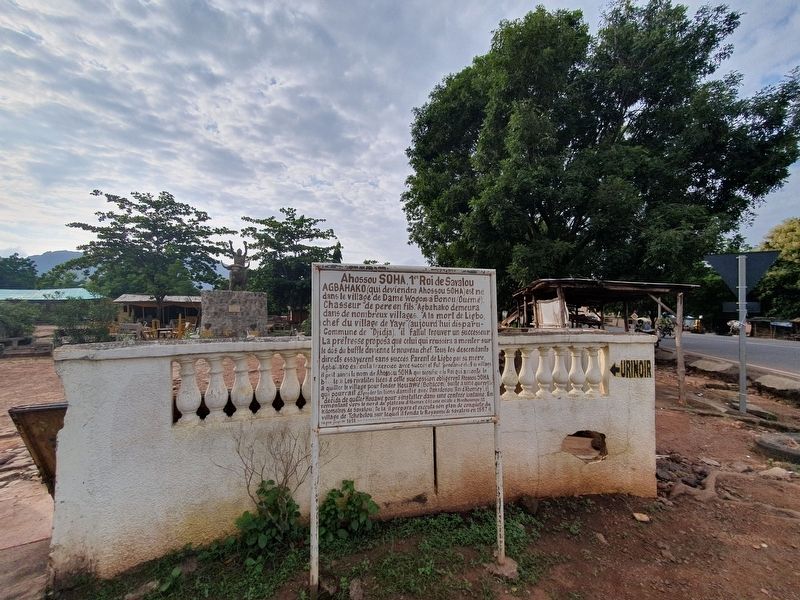
Photographed by J. Makali Bruton, July 24, 2024
2. Ahossou Soha, 1er Roi de Savalou Marker
Tourism Development Agency, Social Development Fund - Embassy of France, Municipality of Savalou
Topics. This historical marker is listed in these topic lists: Animals • Settlements & Settlers. A significant historical year for this entry is 1557.
Location. 7° 55.499′ N, 1° 59.524′ E. Marker is in Savalou, Collines Department. It is on Route RNIE3, on the right when traveling south. The marker is at the Soha Roundabout (Carrefour). Touch for map. Touch for directions.

Regionally, it is in Africa, Sub-Saharan Africa, and specifically West Africa. Historically, it finds itself in what was once a French colony.
Other nearby markers. At least one other marker is within walking distance of this marker: A different marker also named Ahossou Soha (within shouting distance of this marker).
Credits. This page was last revised on August 2, 2024. It was originally submitted on August 1, 2024, by J. Makali Bruton of Washington, District of Columbia. This page has been viewed 380 times since then and 96 times this year. Photos: 1, 2. submitted on August 1, 2024, by J. Makali Bruton of Washington, District of Columbia.
