White Sands in Doña Ana County, New Mexico — The American Mountains (Southwest)
Nike Hercules

Photographed by James Hulse, July 23, 2024
1. Nike Hercules Marker
Developed as a replacement for Nike Ajax, Nike Hercules was essentially an Ajax with four of each component: a cluster of four solid-fuel rocket boosters to accelerate the missile, and four liquid-propellant engines to carry the warhead to its target. Eventually the liquid propellant was changed to a solid fuel for the engine.
Hercules was designed to use the supporting components of the Nike Ajax system, although the increased capability of Hercules necessitated some additions to ground equipment. A High-Powered Acquisition Radar (HIPAR) was installed to track targets at greater range. Alternate Battery Radars (ABARS) were installed as backup units. And a Target Ranging Radar (TRR) was added to counter enemy radar jamming attempts.
Hercules development began in the early 1950s, when the Army became concerned that Nike Ajax was incapable of stopping a massed Soviet air attack.
this page online
Nike Hercules testing began in 1955 at White Sands Proving Ground. On September 30, 1955, tragedy struck. A liquid-fueled engine undergoing static test exploded with such force that the protective bunker collapsed. Five people were injured and one was killed, the only missile-testing death in the history of White Sands Missile Range.
Because of this incident, fuel for Nike Hercules' engine was changed from liquid to solid propellant.
At White Sands Missile Range, Nike Hercules achieved many firsts: first intercept of a drone on October 31, 1956, first test using the new solid propellant sustainer engine on March 13, 1957, direct hit on a Corporal missile on June 3, 1960, and finally intercept of its own kind - another Hercules - in late 1960.
The first production Nike
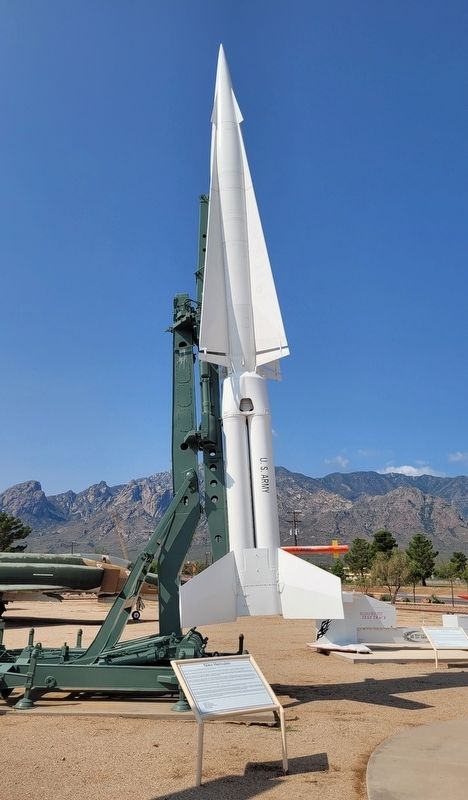
Photographed by James Hulse, July 23, 2024
2. The Nike Hercules and Marker
During the Cold War, the Army established 145 Nike Hercules sites in the continental U.S., protecting metropolitan areas and Strategic Air Command (SAC) bomber bases. They remained strategically deployed in the continental U.S. until 1974, although Nike Hercules continued to see service abroad into the early 1990s. Originally, the Army planned to replace Hercules with Patriot, but this plan was not implemented.
More than 25,000 Nike Hercules missiles were manufactured during its long history. At White Sands Missile Range, 680 Nike Hercules missiles were fired, more than any other missile ever tested here.
Length: 41 feet
Diameter: 31.5 inches
Weight: 10,000 pounds
Range: Greater than 75 miles
Altitude: 30 miles
First Firing: 1955
Erected by White Sands Missile Range Museum.
Topics. This historical marker is listed in this topic list: Air & Space. A significant historical date for this entry is March 13, 1957.
Location. 32° 23.155′ N, 106° 28.729′ W. Marker is in White Sands, New Mexico, in Doña Ana County. It is on Wsmr P Rt 1 (New Mexico Route 213) 4 miles south of U.S. 70. The marker and various missiles are located on the grounds of the White Sands Missile Range Museum. Touch for map. Marker is in this post office area: White Sands Missile Range NM 88002, United States of America. Touch for directions.

Regionally, this marker is in the Rio Grande Valley. It is also in the American
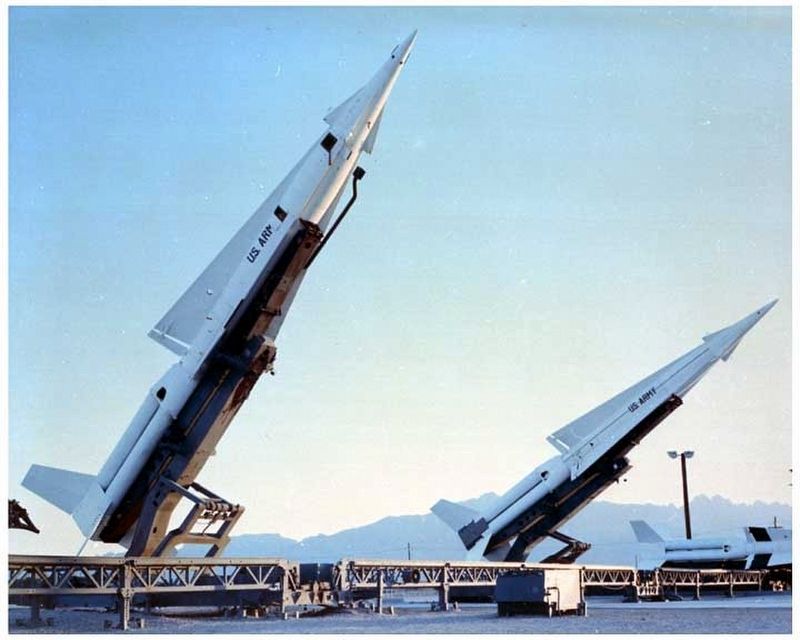
Public Domain - US Army - Redstone Arsenal Historical Information, circa 1970s
3. MIM-14 Nike-Hercules
Other nearby markers. At least 8 other markers are within walking distance of this marker: Sidewinder (here, next to this marker); Improved Hawk Rocket Test Sled (here, next to this marker); Hawk (a few steps from this marker); Crossbow (a few steps from this marker); Mace (a few steps from this marker); MQM-42 Redhead/Roadrunner Target Drone (a few steps from this marker); Little John (a few steps from this marker); QH-50 DASH (a few steps from this marker). Touch for a list and map of all markers in White Sands.
More about this marker. The marker and museum are located on the White Sands Missile Range, an active U.S. military installation. The museum is open to the public, but appropriate identification is required for access.
Also see . . .
1. Welcome to the White Sands Missile Range Museum. White Sands Missile Range Museum (Submitted on August 2, 2024, by James Hulse of Medina, Texas.)
2. Nike Hercules.
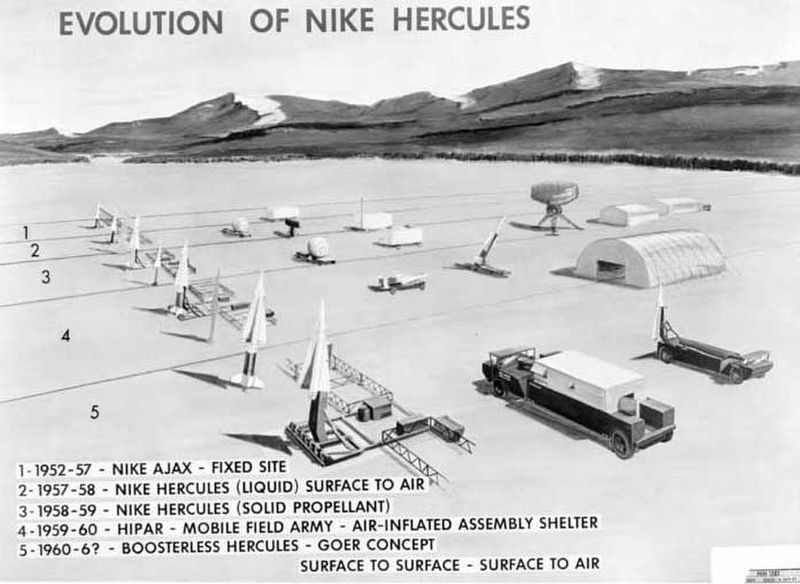
Public Domain - US Army Rocket and Guided Missile Agency, June 14, 1961
4. Evolution of Nike Hercules
This illustration, from a US Army booklet, shows the evolution of the Nike Ajax and Hercules missiles, and their associated support equipment. In the background is the original Nike I (later known as Ajax) is shown with the LOPAR radar (rectangular) and the associated tracking radars (spherical). In "slice 2", the slightly enlarged Hercules is shown, before its conversion to solid fuel. The missile grows dramatically in slice 3, when it moved to solid fuel and began to be deployed alongside Ajax, along with larger tracking radars and the much more powerful HIPAR radar. Slice 4 shows the Army's first attempts at a semi-mobile system, using truck-mounted reloaders and inflatable structures for the control equipment. Ajax is shown being phased out. Finally in slice 5, experiments with fully mobile systems based on the GOER vehicle and optionally removing the booster cluster for short- and medium-range engagements are shown. Neither of the mobile options would be deployed operationally, that role being filled by the MIM-23 Hawk.
The Nike Hercules, initially designated SAM-A-25 and later MIM-14, was a surface-to-air missile (SAM) used by U.S. and NATO armed forces for medium- and high-altitude long-range air defense. It was normally armed with the W31 nuclear warhead, but could also be fitted with a conventional warhead for export use. Its warhead also allowed it to be used in a secondary surface-to-surface role, and the system also demonstrated its ability to hit other short-range missiles in flight.(Submitted on August 3, 2024, by James Hulse of Medina, Texas.)
Credits. This page was last revised on August 3, 2024. It was originally submitted on August 2, 2024, by James Hulse of Medina, Texas. This page has been viewed 464 times since then and 142 times this year. Photos: 1, 2, 3, 4. submitted on August 3, 2024, by James Hulse of Medina, Texas.
