White Sands in Doña Ana County, New Mexico — The American Mountains (Southwest)
Sidewinder
Photographed by James Hulse, July 23, 2024
1. Sidewinder Marker
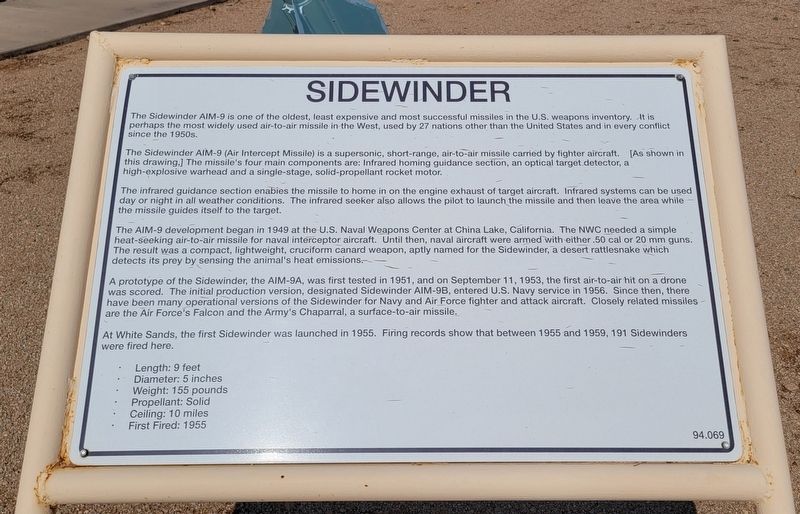
The Sidewinder AIM-9 (Air Intercept Missile) is a supersonic, short-range, air-to-air missile carried by fighter aircraft. [As shown in this drawing,] The missile's four main components are: Infrared homing guidance section, an optical target detector, a high-explosive warhead and a single-stage, solid-propellant rocket motor.
The infrared guidance section enabies the missile to home in on the engine exhaust of target aircraft. Infrared systems can be used day or night in all weather conditions. The infrared seeker also allows the pilot to launch the missile and then leave the area while the missile guides itself to the target.
The AIM-9 development began in 1949 at the U.S. Naval Weapons Center at China Lake, California. The NWC needed a simple heat-seeking air-to-air missile for naval interceptor aircraft. Until then, naval aircraft were armed
this page online
A prototype of the Sidewinder, the AIM-9A, was first tested in 1951, and on September 11, 1953, the first air-to-air hit on a drone was scored. The initial production version, designated Sidewinder AIM-9B, entered U.S. Navy service in 1956. Since then, there have been many operational versions of the Sidewinder for Navy and Air Force fighter and attack aircraft. Closely related missiles are the Air Force's Falcon and the Army's Chaparral, a surface-to-air missile.
At White Sands, the first Sidewinder was launched in 1955. Firing records show that between 1955 and 1959, 191 Sidewinders were fired here.
Length: 9 feet
Diameter: 5 inches
Weight: 155 pounds
Propellant: Solid
Ceiling: 10 miles
First Fired: 1955
Erected by White Sands Missile Range Museum. (Marker Number 94.069.)
Topics. This historical marker is listed in this topic list: Air & Space. A significant historical date for this entry is September 11, 1953.
Location. 32° 23.157′ N,
Photographed by James Hulse, July 23, 2024
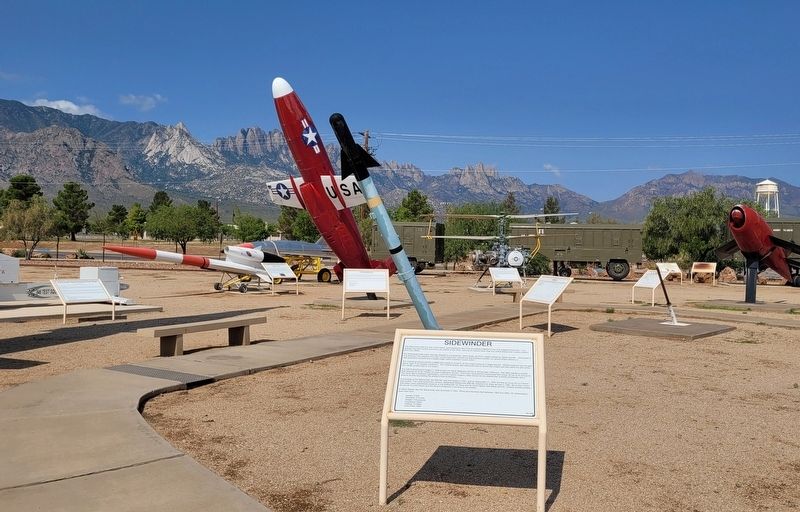
2. The Sidewinder and Marker

Regionally, this marker is in the Rio Grande Valley. It is also in the American Borderlands and in the Southwest. Globally, it is in North America, the Western Hemisphere, the Western World, and the Anglosphere. Historically, it finds itself in what was once New Spain, the Gadsden Purchase, and the Republic of Texas.
Other nearby markers. At least 8 other markers are within walking distance of this marker: Nike Hercules (here, next to this marker); Mace (a few steps from this marker); Hawk (a few steps from this marker); Little John (a few steps from this marker); Improved Hawk Rocket Test Sled (a few steps from this marker); Crossbow (a few steps from this marker); XM-21 (a few steps from this marker); QH-50 DASH (a few steps
Public Domain - U.S. Navy Naval Museum of Armament and Technology, circa 1952
3. Early Test of Sidewinder
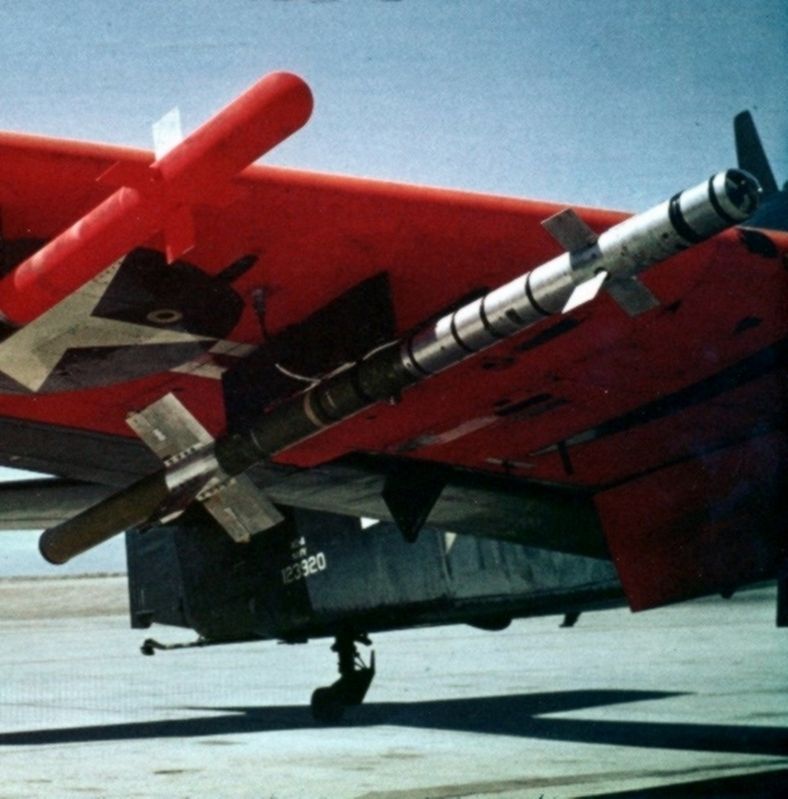
The "Heat-Homing Rocket" at Naval Ordnance Test Station Inyokern, in 1952. The developmental Sidewinders is mounted for a test flight on a Douglas AD-4 Skyraider (BuNo 123920).
More about this marker. The marker and museum are located on the White Sands Missile Range, an active U.S. military installation. The museum is open to the public, but appropriate identification is required for access.
Also see . . .
1. Welcome to the White Sands Missile Range Museum. White Sands Missile Range Museum (Submitted on August 2, 2024, by James Hulse of Medina, Texas.)
2. AIM-9 Sidewinder. Wikipedia
The AIM-9 Sidewinder ("AIM" for "Air Intercept Missile") is a short-range air-to-air missile. Entering service with the United States Navy in 1956 and the Air Force in 1964, the AIM-9 is one of the oldest, cheapest, and most successful air-to-air missiles. Its latest variants remain standard equipment in most Western-aligned air forces. The Soviet K-13 (AA-2 "Atoll"), a reverse-engineered copy of the AIM-9B, was also widely adopted.(Submitted on August 3, 2024, by James Hulse of Medina, Texas.)
Credits. This page was last revised on August 3, 2024. It was originally submitted on August 2, 2024, by James Hulse of Medina, Texas. This page has been viewed 220 times since then and 52 times this year. Photos: 1, 2, 3. submitted on August 3, 2024, by James Hulse of Medina, Texas.
