Visé in Liège, Wallonia, Belgium — Northwestern Europe
L’Eglise Saint-Martin de Vise
⎯⎯⎯
Church of Saint Martin of Vise
Photographed by Andrew Ruppenstein, July 13, 2024
1. L’Eglise Saint-Martin de Vise / Church of Saint Martin of Vise Marker

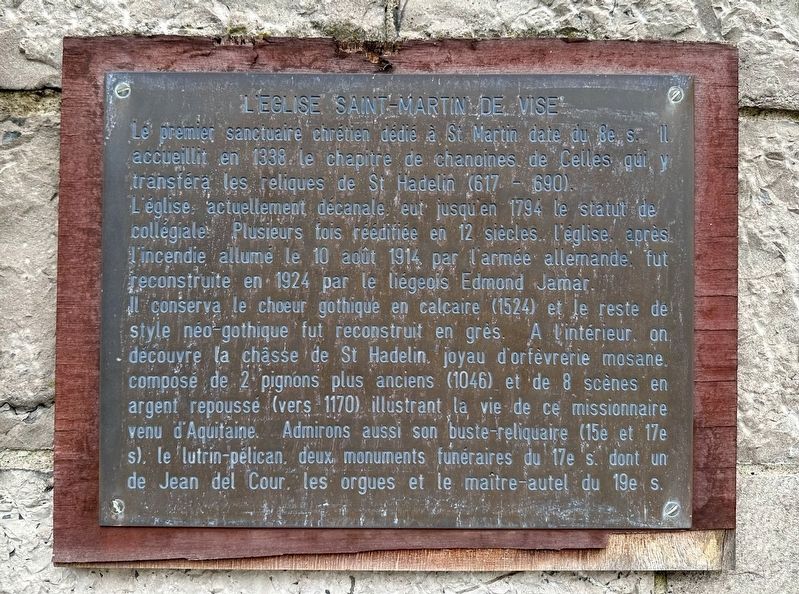
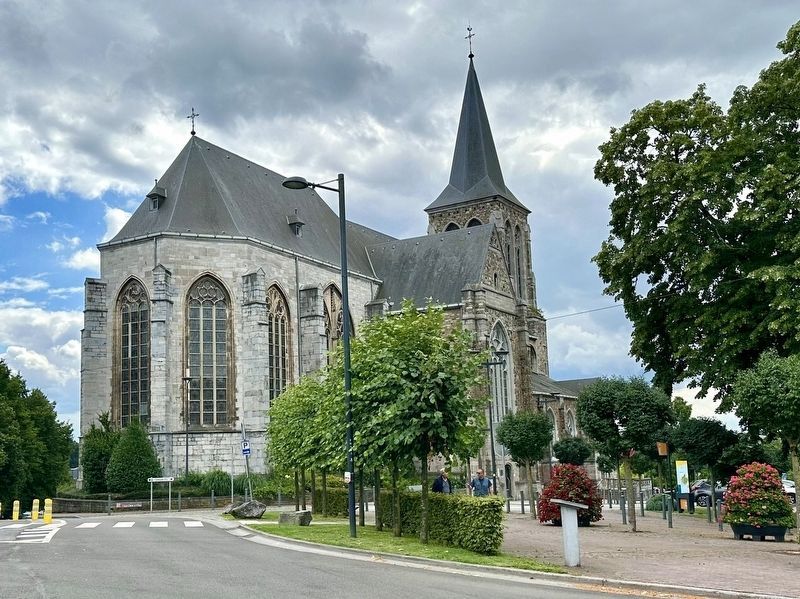
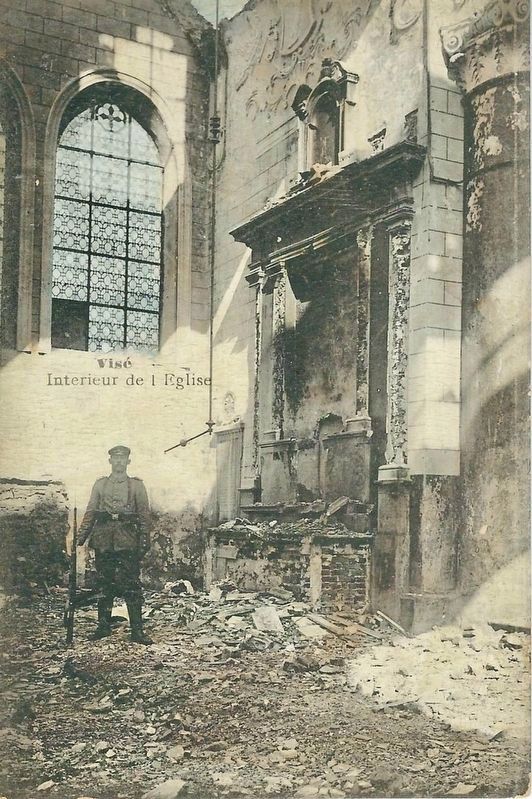
L'église, actuellement décanale, eut jusqu'en 1794 le statut de collégiale. Plusieurs fois réédifiée en 12 siècles, l'eglise, après l'incendie allumé le 10 août 1914 par l'armée allemande, fut reconstruite en 1924 par le liégeois Edmond Jamar.
Il conserva le choeur gothique en calcaire (1524) et le reste de style néo-gothique fut reconstruit en grès. A intérieur, on decouvre la chasse de St Hadelin, joyau d'orfèvrerie mosane, composé de 2 pignons plus anciens (1046) et de 8 scènes en argent repoussé (vers 1170) illustrant la vie de ce missionnaire venu d'Aquitaine. Admirons aussi son buste-reliquaire (15e et 17e s), le lutrin-pelican, deux monuments funéraires du 17e s. dont un de Jean del Cour, les orgues et le maître-autel du 19e s.
(English translation:)
The first Christian sanctuary dedicated to St Martin dates from the 8th century. In 1338, it welcomed the chapter of canons of Celles, who transferred the relics of St
this page online
Topics. This historical marker is listed in this topic list: Religion & Religious Structures. A significant historical date for this entry is August 10, 1914.
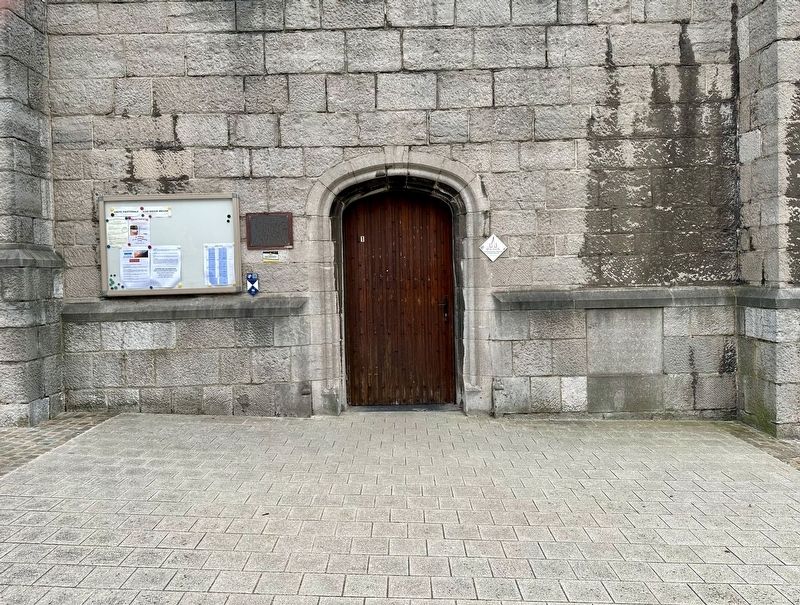
Location. 50° 43.994′ N, 5° 41.757′ E. Marker is in Visé, Région Wallonne (Wallonia), in Liège. It is on Place de la Collégiale, on the right when traveling east. The marker is on the north side of the church
Photographed by Andrew Ruppenstein, July 13, 2024
2. L’Eglise Saint-Martin de Vise / Church of Saint Martin of Vise Marker - wide view

Regionally, it is in Europe, the European Union, Atlantic Europe, the Benelux Low Countries, the Schengen Area, Western Europe, and the Western World. Historically, it finds itself in what was once the Roman Empire and specifically also the Holy Roman Empire.
Other nearby markers. At least 8 other markers are within 5 kilometers of this marker, measured as the crow flies: US Army 30th Infantry Division Liberation Memorial (a few steps from this marker); Statue Equestre d’un Arbaletrier / Equestrian Statue of a Crossbowman (within shouting distance of this marker); L’Incendie de Visé - Panneau 3 / The Burning of Visé - Panel 3 (approx. 0.2 kilometers away); John Knottenbelt (approx. 4.1 kilometers away in Netherlands); Leonard J. Hoffman Memorial (approx. 4.1 kilometers away in Netherlands); Leonard J. Hoffman (approx. 4.1 kilometers away in Netherlands); Mesch Liberation Monument (approx. 4.1 kilometers away in Netherlands); Het Eerste Bevrijde Cafe / The First Liberated Cafe
Photographed by Andrew Ruppenstein, July 13, 2024
3. L’Eglise Saint-Martin de Vise / Church of Saint Martin of Vise - view from NE
circa 1915
4. Church interior
Subsequent to the burning of the church by the German Army on August 10, 1914. A nearby historical marker notes: “Under the pretext that the tower of the church served as a landmark for Fort Pontnisse, the German sappers (military engineers) set fire to the tower of the sanctuary Monday 10 August 1914.”
Credits. This page was last revised on August 2, 2024. It was originally submitted on August 2, 2024, by Andrew Ruppenstein of Lamorinda, California. This page has been viewed 230 times since then and 84 times this year. Photos: 1, 2, 3, 4. submitted on August 2, 2024, by Andrew Ruppenstein of Lamorinda, California.
