White Sands in Doña Ana County, New Mexico — The American Mountains (Southwest)
MGM-3 Little John
Photographed by James Hulse, July 23, 2024
1. MGM-3 Little John Marker
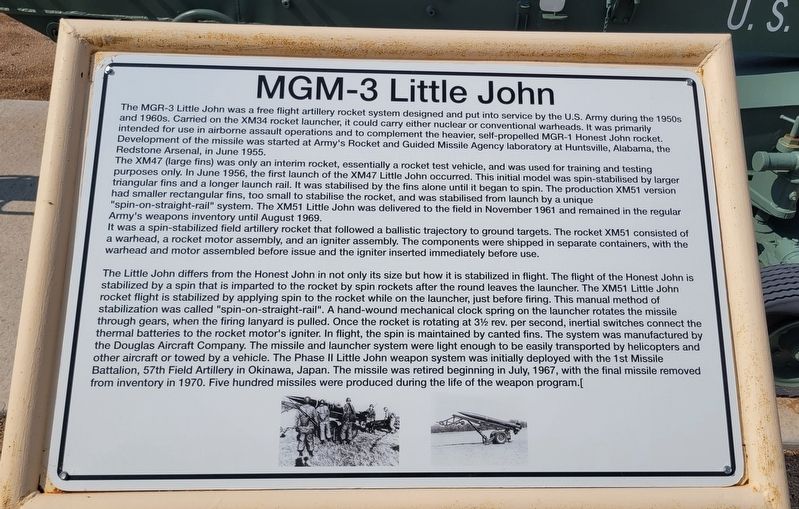
The XM47 (large fins) was only an interim rocket, essentially a rocket test vehicle, and was used for training and testing purposes only. In June 1956, the first launch of the XM47 Little John occurred. This initial model was spin-stabilised by larger triangular fins and a longer launch rail. It was stabilised by the fins alone until it began to spin. The production XM51 version had smaller rectangular fins, too small to stabilise the rocket, and was stabilised from launch by a unique "spin-on-straight-rail" system. The XM51 Little John was delivered to the field in November 1961 and remained in the regular
this page online
It was a spin-stabilized field artillery rocket that followed a ballistic trajectory to ground targets. The rocket XM51 consisted of a warhead, a rocket motor assembly, and an igniter assembly. The components were shipped in separate containers, with the warhead and motor assembled before issue and the igniter inserted immediately before use.
The Little John differs from the Honest John in not only its size but how it is stabilized in flight. The flight of the Honest John is stabilized by a spin that is imparted to the rocket by spin rockets after the round leaves the launcher. The XM51 Little John rocket flight is stabilized by applying spin to the rocket while on the launcher, just before firing. This manual method of stabilization was called "spin-on-straight-rail". A hand-wound mechanical clock spring on the launcher rotates the missile through gears, when the firing lanyard is pulled. Once the rocket is rotating at 31½ rev. per second, inertial switches connect the thermal batteries to the rocket motor's igniter. In flight, the spin is maintained by canted fins. The system was manufactured
Photographed by James Hulse, July 23, 2024
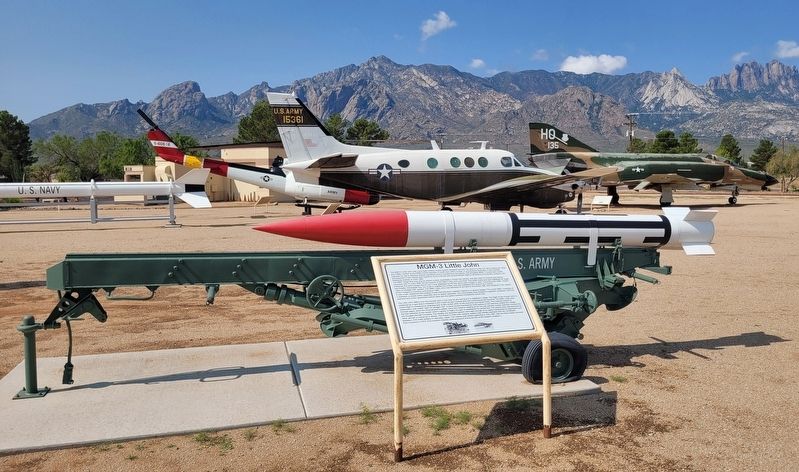
2. The MGM-3 Little John and Marker
Erected by White Sands Missile Range Museum.
Topics. This historical marker is listed in this topic list: Air & Space. A significant historical month for this entry is June 1955.
Location. 32° 23.153′ N, 106° 28.709′ W. Marker is in White Sands, New Mexico, in Doña Ana County. It is on Wsmr P Rt 1 (New Mexico Route 213) 4 miles south of U.S. 70. The marker and various missiles are located on the grounds of the White Sands Missile Range Museum. Touch for map. Marker is in this post office area: White Sands Missile Range NM 88002, United States of America. Touch for directions.

Regionally, this marker is in the Rio Grande Valley. It is also in the American Borderlands
Public Domain - US Army - Redstone Arsenal Historical Information, circa 1959
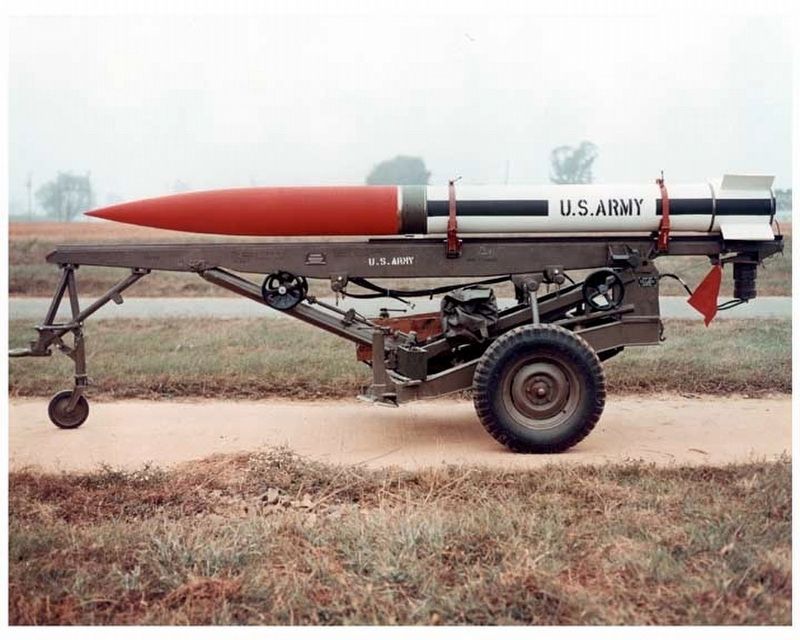
3. MGR-3 Little John (XM51)
Other nearby markers. At least 8 other markers are within walking distance of this marker: MGM-5 Corporal Missile (here, next to this marker); Honest John (here, next to this marker); GAR-1 Falcon (a few steps from this marker); VC-6A Plane (a few steps from this marker); HIBEX (a few steps from this marker); Mace (a few steps from this marker); Nike Ajax (a few steps from this marker); Loki-Dart (a few steps from this marker). Touch for a list and map of all markers in White Sands.
More about this marker. The marker and museum are located on the White Sands Missile Range, an active U.S. military installation. The museum is open to the public, but appropriate identification is required for access.
Also see . . .
1. Welcome to the White Sands Missile Range Museum. White Sands Missile Range Museum (Submitted on August 2, 2024, by James Hulse of Medina, Texas.)
2. MGR-3 Little John. Wikipedia
Carried on the XM34 rocket launcher, it could carry either nuclear or conventional warheads. It was primarily intended for use in airborne assault operations and to complement the heavier, self-propelled MGR-1 Honest John rocket. Development of the rocket was started at Army's Rocket and Guided Missile Agency laboratory at Huntsville, Alabama, the Redstone Arsenal, in June 1955.(Submitted on August 3, 2024, by James Hulse of Medina, Texas.)
Credits. This page was last revised on August 3, 2024. It was originally submitted on August 2, 2024, by James Hulse of Medina, Texas. This page has been viewed 300 times since then and 78 times this year. Photos: 1, 2, 3. submitted on August 3, 2024, by James Hulse of Medina, Texas.
