White Sands in Doña Ana County, New Mexico — The American Mountains (Southwest)
Loki-Dart
Photographed by James Hulse, July 23, 2024
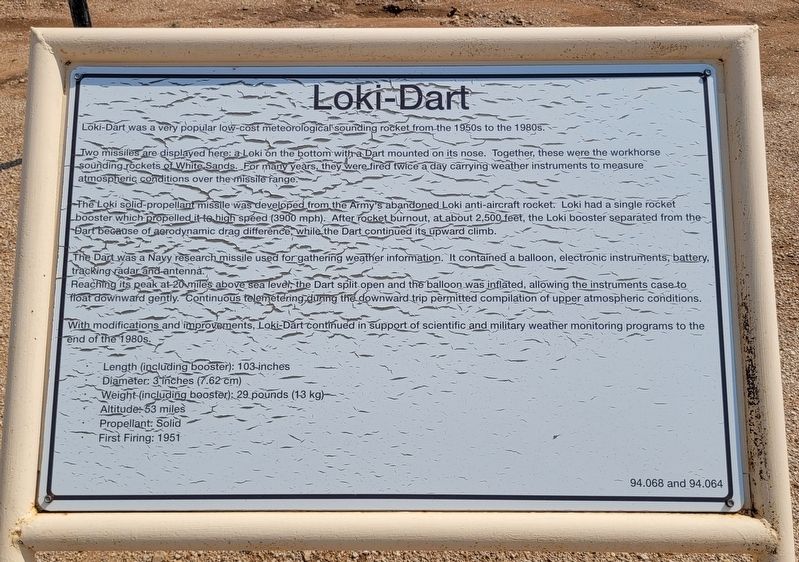
1. Loki-Dart Marker
Two missiles are displayed here: a Loki on the bottom with a Dart mounted on its nose. Together, these were the workhorse sounding rockets of White Sands. For many years, they were fired twice a day carrying weather instruments to measure atmospheric conditions over the missile range.
The Loki solid-propellant missile was developed from the Army's abandoned Loki anti-aircraft rocket. Loki had a single rocket booster which propelled it to high speed (3900 mph). After rocket burnout, at about 2,500 feet, the Loki booster separated from the Dart because of aerodynamic drag difference, while the Dart continued its upward climb.
The Dart was a Navy research missile used for gathering weather information. It contained a balloon, electronic instruments, battery, tracking radar and antenna.
Reaching its peak at 20 miles above sea level, the Dart split open and the balloon was inflated, allowing the instruments case to float downward gently. Continuous telemetering during the downward trip permitted compilation of upper
this page online
With modifications and improvements, Loki-Dart continued in support of scientific and military weather monitoring programs to the end of the 1980s.
Length (including booster): 103 inches
Diameter: 3 inches (7.62 cm)
Weight (including booster): 29 pounds (13 kg)
Altitude: 53 miles
Propellant: Solid
First Firing: 1951
Erected by White Sands Missile Range Museum. (Marker Number 94.068.)
Topics. This historical marker is listed in this topic list: Air & Space. A significant historical year for this entry is 1951.
Location. 32° 23.155′ N, 106° 28.695′ W. Marker is in White Sands, New Mexico, in Doña Ana County. It is on Wsmr P Rt 1 (New Mexico Route 213) 4 miles south of U.S. 70. The marker and various missiles are located on the grounds of the White Sands Missile Range Museum. Touch for map. Marker is in this post office area: White Sands Missile Range NM 88002, United States of America. Touch for directions.

Regionally, this marker is in the Rio Grande Valley. It is also in the American Borderlands and in the Southwest. Globally, it is in North America, the Western Hemisphere, the Western World,

Photographed by James Hulse, July 23, 2024
2. Closeup of Loki-Dart
Other nearby markers. At least 8 other markers are within walking distance of this marker: TOW Missile (a few steps from this marker); SAGMI (a few steps from this marker); GAR-1 Falcon (a few steps from this marker); Honest John (a few steps from this marker); SRAM (a few steps from this marker); Copperhead (a few steps from this marker); HIBEX (a few steps from this marker); 36.9 Megahertz Helix Antenna Doppler Velocity and Position (DOVAP) (a few steps from this marker). Touch for a list and map of all markers in White Sands.
More about this marker. The marker and museum are located on the White Sands Missile Range, an active U.S. military installation. The museum is open to the public, but appropriate identification is required for access.
Also see . . .
1. Welcome to the White Sands Missile Range Museum. White Sands Missile Range Museum (Submitted on August 2, 2024, by James Hulse of Medina, Texas.)
2. Loki (rocket). Wikipedia
Loki, officially designated 76mm HEAA Rocket T220, was an American unguided anti-aircraft rocket based on the German Taifun. Like the Taifun, Loki never saw service in its original role, but later found widespread use as a sounding rocket. It was so successful in this role that several advanced versions were developed on the basic Loki layout, including the final Super Loki.(Submitted on August 3, 2024, by James Hulse of Medina, Texas.)

Photographed by James Hulse, July 23, 2024
3. Loki-Dart Marker
Credits. This page was last revised on August 3, 2024. It was originally submitted on August 2, 2024, by James Hulse of Medina, Texas. This page has been viewed 313 times since then and 69 times this year. Photos: 1, 2, 3. submitted on August 3, 2024, by James Hulse of Medina, Texas.
