White Sands in Doña Ana County, New Mexico — The American Mountains (Southwest)
F-4 Phantom
Photographed by James Hulse, July 23, 2024
1. F-4 Phantom Marker
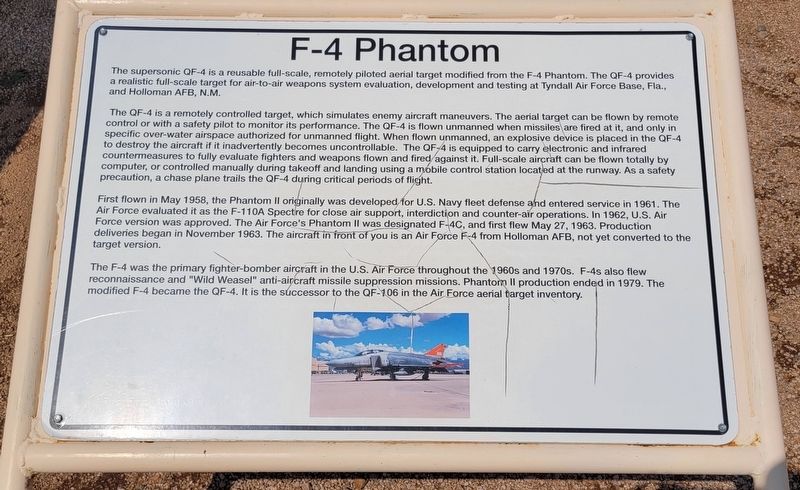
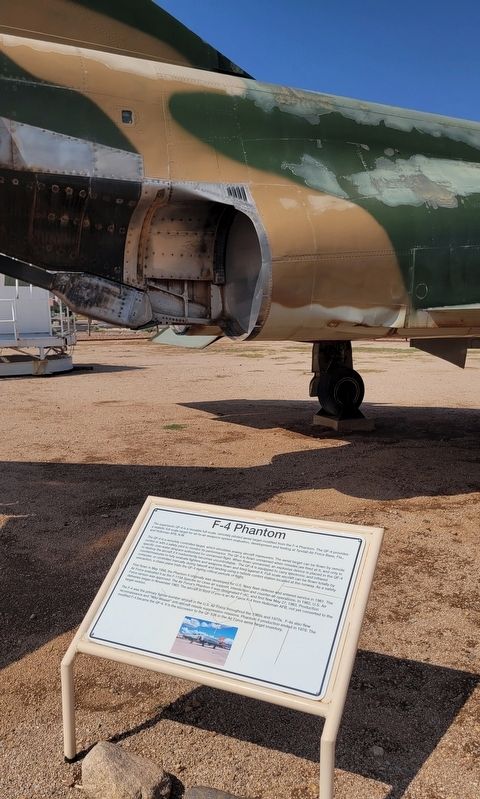
The QF-4 is a remotely controlled target, which simulates enemy aircraft maneuvers. The aerial target can be flown by remote control or with a safety pilot to monitor its performance. The QF-4 is flown unmanned when missiles are fired at it, and only in specific over-water airspace authorized for unmanned flight. When flown unmanned, an explosive device is placed in the QF-4 to destroy the aircraft if it inadvertently becomes uncontrollable. The QF-4 is equipped to carry electronic and infrared countermeasures to fully evaluate fighters and weapons flown and fired against it. Full-scale aircraft can be flown totally by computer, or controlled manually during takeoff and landing using a mobile control station located at the runway. As a safety precaution, a chase plane trails the QF-4 during critical periods of flight.
First flown in May 1958,
this page online
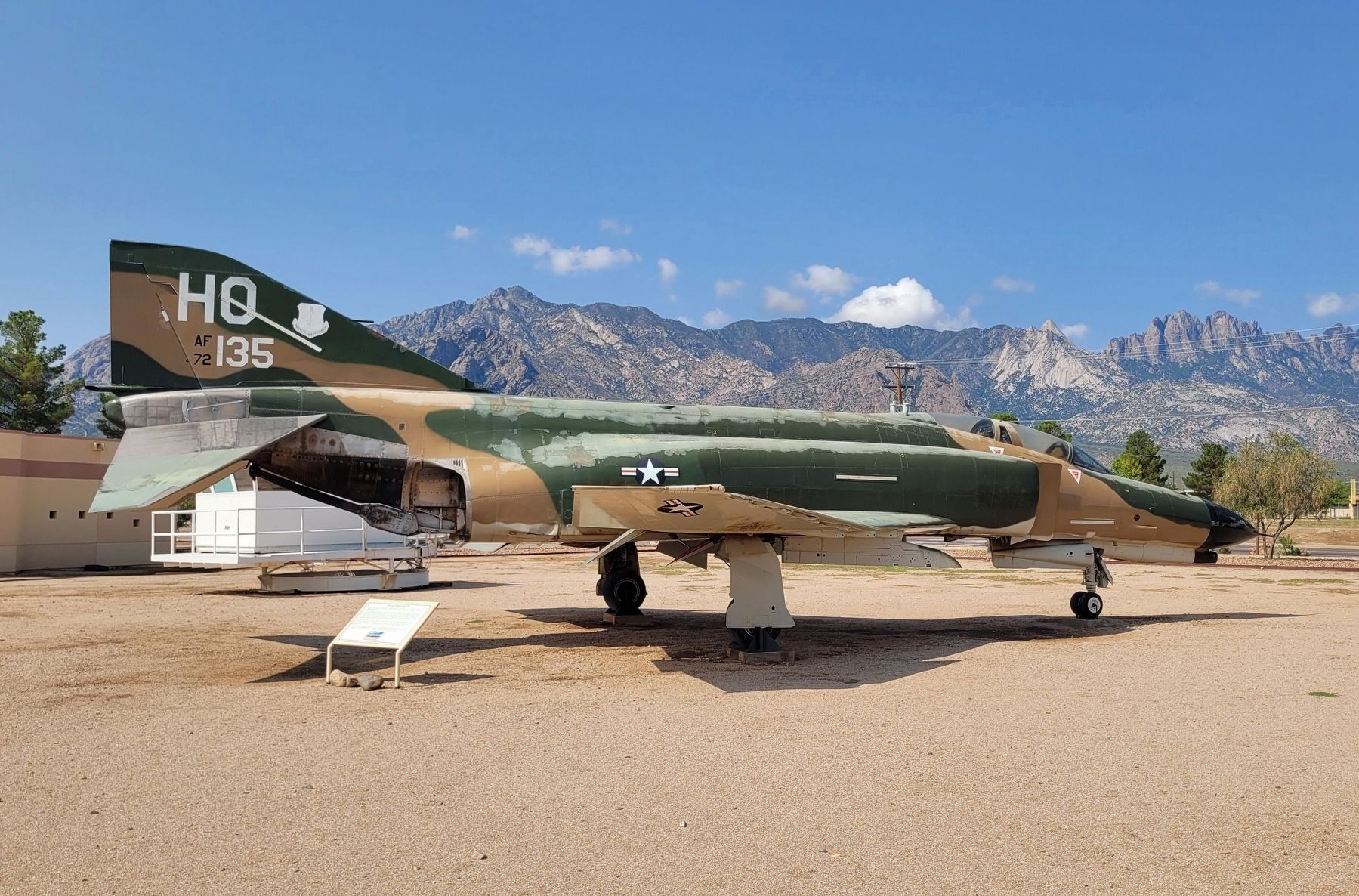
The F-4 was the primary fighter-bomber aircraft in the U.S. Air Force throughout the 1960s and 1970s. F-4s also flew reconnaissance and "Wild Weasel" anti-aircraft missile suppression missions. Phantom II production ended in 1979. The modified F-4 became the QF-4. It is the successor to the QF-106 in the Air Force aerial target inventory.
Erected by White Sands Missile Range Museum.
Topics. This historical marker is listed in this topic list: Air & Space. A significant historical month for this entry is May 1958.
Location. 32° 23.141′ N, 106° 28.725′ W. Marker is in White Sands, New Mexico, in Doña Ana County. It is on Wsmr P Rt 1 (New Mexico Route 213)
Photographed by James Hulse, July 23, 2024
2. F-4 Phantom Marker

Regionally, this marker is in the Rio Grande Valley. It is also in the American Borderlands and in the Southwest. Globally, it is in North America, the Western Hemisphere, the Western World, and the Anglosphere. Historically, it finds itself in what was once New Spain, the Gadsden Purchase, and the Republic of Texas.
Other nearby markers. At least 8 other markers are within walking distance of this marker: VC-6A Plane (a few steps from this marker); Huey Helicopter UH-1M (a few steps from this marker); Improved Hawk Rocket Test Sled (within shouting distance of this marker); Nike Hercules (within shouting distance of this marker); MQM-42 Redhead/Roadrunner Target Drone (within shouting distance of this marker); Mace (within shouting distance of this marker); Sidewinder (within shouting distance of this marker); Crossbow (within shouting distance of this marker). Touch for a list and map of all markers in White Sands.
More about this marker. The marker and museum are located on the White Sands Missile Range, an active U.S. military installation. The museum is open to the public, but appropriate identification is required for access.
Also see . . .
1. Welcome to the White Sands Missile Range Museum. White Sands Missile Range Museum (Submitted on August 2, 2024, by James Hulse of Medina, Texas.)
2. McDonnell Douglas F-4 Phantom II. Wikipedia
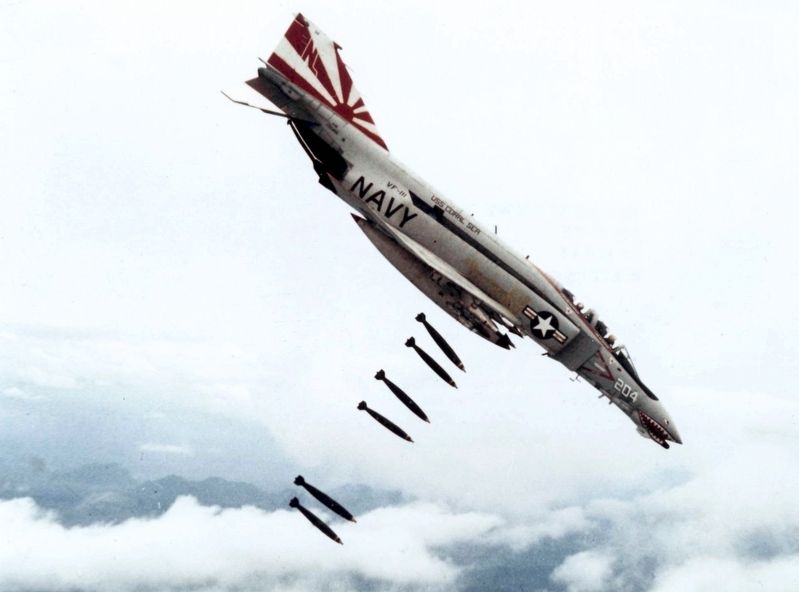
The McDonnell Douglas F-4 Phantom II is an American tandem two-seat, twin-engine, all-weather, long-range supersonic jet interceptor and fighter-bomber originally developed by McDonnell(Submitted on August 3, 2024, by James Hulse of Medina, Texas.)Aircraft for the United States Navy. Proving highly adaptable, it entered service with the Navy in 1961 before it was adopted by the United States Marine Corps and the United States Air Force, and by the mid-1960s it had become a major part of their air arms. Phantom production ran from 1958 to 1981 with a total of 5,195 aircraft built, making it the most produced American supersonic military aircraft in history, and cementing its position as a signature combat aircraft of the Cold War.Public Domain - U.S. Navy National Museum of Naval Aviation, November 25, 19713. F-4B VF-111 dropping bombs on VietnamA U.S. Navy McDonnell F-4B Phantom II of Fighter Squadron VF-111 Sundowners drops 227 kg Mk 82 bombs over Vietnam during 1971. VF-111 was assigned to Attack Carrier Air Wing 15 (CVW-15) aboard the aircraft carrier USS Coral Sea (CVA-43) for a deployment to Vietnam from 12 November 1971 to 17 July 1972.
Photographed by James Hulse, July 23, 2024
4. The F-4 Phantom and Marker
Credits. This page was last revised on August 3, 2024. It was originally submitted on August 2, 2024, by James Hulse of Medina, Texas. This page has been viewed 195 times since then and 31 times this year. Photos: 1, 2, 3, 4. submitted on August 3, 2024, by James Hulse of Medina, Texas.
