Ovillers-la-Boisselle in Somme, Upper France, France — Western Europe
The Bretons at La Boisselle
Photographed by J. Makali Bruton, June 10, 2024
1. The Bretons at La Boisselle Marker

19ème Régiment d'Infanterie
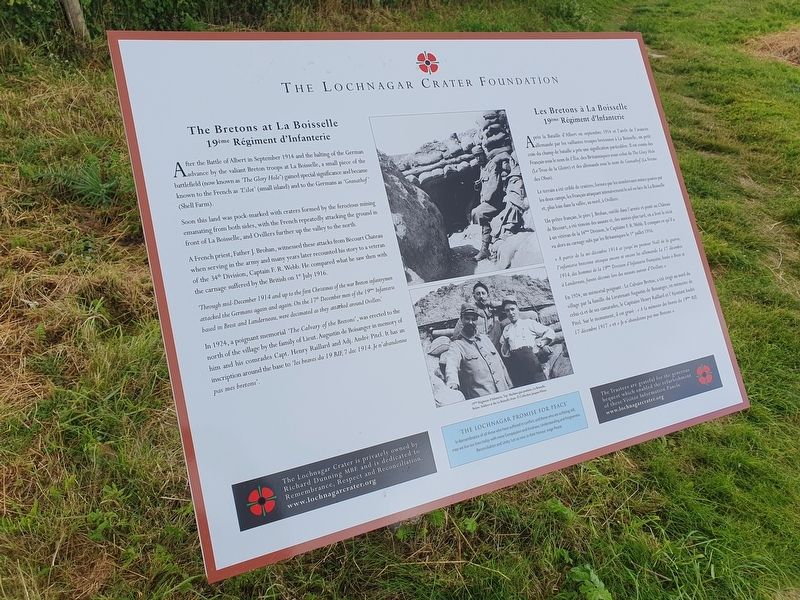
After the Battle of Albert in September 1914 and the halting of the German advance by the valiant Breton troops at La Boisselle, a small piece of the battlefield (now known as 'The Glory Hole') gained special significance and became known to the French as 'T'ilot' (small island) and to the Germans as 'Granathof' (Shell Farm).
Soon this land was pock-marked with craters formed by the ferocious mining emanating from both sides, with the French repeatedly attacking the ground in front of La Boisselle, and Ovillers further up the valley to the north.
A French priest, Father J. Brohan, witnessed these attacks from Bécourt Chateau when serving in the army and many years later recounted his story to a veteran of the 34th Division, Captain F. R. Webb. He compared what he saw then with the carnage suffered by the British on 1st July 1916.
“Through mid-December 1914 and up to the first Christmas of the war Breton infantrymen attacked the Germans again and again. On the 17th December men of the 19 Infanterie based in Brest and Landerneau, were decimated as
this page online
In 1924, a poignant memorial 'The Calvary of the Bretons', was erected to the north of the village by the family of Lieut. Augustin de Boisanger in memory of him and his comrades Capt. Henry Raillard and Adj. André Pitel. It has an inscription around the base to 'les braves du 19 RIF, 7 dec 1914. Je n'abandonne pas mes bretons'.
Caption
19eme Regiment d’Infanterie. Top: Machine-gun position, La Boiselle.
Below: Soldiers at the La Boiselle front. C Collection Jacques Pilven.
Lochnagar Crater is privately owned by Richard Dunning MBE and is dedicated to Remembrance, Respect and Reconciliation.
www.lochnagarcrater.org
'The Lochnagar Promise For Peace'
“In Remembrance of all those who have suffered in conflict, and those who are suffering still may we live our lives today with more Compassion and Kindness. Understanding and Forgiveness Reconciliation and Unity. Let us now, in their honour, wage Peace.”
The Trustees are grateful for the generous bequest which enabled the refurbishment of these Visitor Information Panels.
www.lochnagarcrater.org
Les Bretons à La Boisselle
19ème Régiment d'Infanterie
Après
Photographed by J. Makali Bruton, June 10, 2024
2. The Bretons at La Boisselle Marker
Le terrain a été criblé de cratères, formés par les nombreuses mines posées par les deux camps, les Français attaquant intensivement le sol en face de La Boisselle et, plus loin dans la vallée, au nord, à Ovillers.
Un prêtre français, le père J. Brohan, enrôlé dans l'armée et posté au Château de Bécourt, a été témoin des assauts et, des années plus tard, en a livré le récit à un vétéran de la 34ème Division, le Capitaine F. R. Webb. Il compare ce qu'il a vu alors au carnage subi par les Britanniques le 1er juillet 1916.
« A partir de la mi-décembre 1914 et jusqu'au premier Noël de la guerre, l'infanterie bretonne attaqua encore et encore les allemands. Le 17 décembre 1914, des hommes de la 19ème Division d'Infanterie Française, basée à Brest et à Landernau, furent décimés lors des assauts autour d'Ovillers. »
En 1924, un mémorial poignant: Le Calvaire Breton, a été érigé au nord du village par la famille du Lieutenant Augustin de Boisanger, en mémoire de celui-ci et de ses camarades, le Capitaine Henry Raillard et l'Ajoutant André Pitel. Sur le monument, il est gravé : « A la mémoire des braves du 19 RIF, 17 décembre 1917 » et « Je n'abandonne pas mes Bretons ».
Erected by The Lochnagar Crater Foundation.
Topics. This historical marker is listed in this topic list: War, World I. A significant historical date for this entry is July 1, 1916.
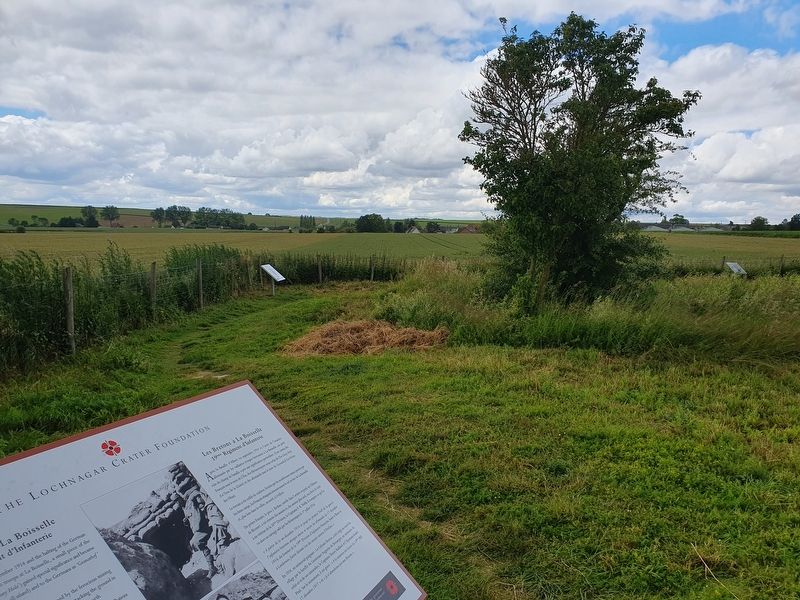
Location. 50° 0.917′ N, 2° 41.797′ E. Marker is in Ovillers-la-Boisselle, Hauts-de-France (Upper France), in Somme. It is on Route de la Grande Mine south of Route D20, on the right when traveling south. Touch for map. Marker is at or near this postal address: 6 Rte de la Grande Mine, Ovillers-la-Boisselle, Hauts-de-France 80300, France. Touch for directions.

Regionally, it is in the North Atlantic Region, Europe, the European Union, Atlantic Europe, the Schengen Area, Western Europe, a coastal Mediterranean country, and the Western World. Historically, it finds itself in what was once a French colony and also the Roman Empire.
Other nearby markers. At least 8 other markers are within walking distance of this marker: Attack: An account by Pte. Tom Easton, 2nd Battalion Tyneside Scottish (a few steps from this marker); RAF Mountain Rescue Association Veterans Memorial (a few steps from this marker); Roy Bealing and his best friend Pte. Alfred Moxham (within shouting distance of this marker); A German defender's experience (within shouting distance of this marker); Women of the Great War (within shouting distance of this marker); Pte. 1216 Charles R. Frankish (within shouting distance of this marker); The Sacrifice of All Nations (within shouting distance of this marker); Pilgrimage: Tom Easton's visits to his friends at Bécourt (about 90 meters away, measured in a direct line). Touch for a list and map of all markers in Ovillers-la-Boisselle.
Credits. This page was last revised on August 3, 2024. It was originally submitted on August 3, 2024, by J. Makali Bruton of Washington, District of Columbia. This page has been viewed 133 times since then and 25 times this year. Photos: 1, 2. submitted on August 3, 2024, by J. Makali Bruton of Washington, District of Columbia.
