Falls Township near Bordentown in Burlington County, New Jersey — The American Northeast (Mid-Atlantic)
19th Century Railroading in Bordentown
Photographed by R. C.
1. 19th Century Railroading in Bordentown Marker
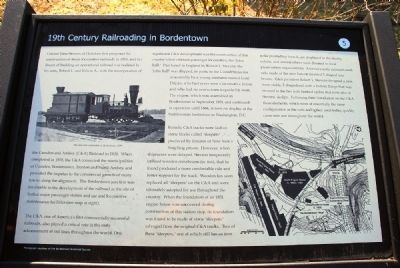
Colonel John Stevens of Hoboken first proposed the construction of steam locomotive railroads in 1810, and his dream of building an operational railroad was realized by his sons, Robert L. and Edwin A., with the incorporation of the Camden and Amboy (C&A) Railroad in 1830. When completed in 1838, the C&A connected the municipalities of Camden, Bordentown, Trenton and South Amboy, and provided the impetus to the commercial growth of many towns along the alignment. The Bordentown junction was invaluable to the development of the railroad as the site of both a major passenger station and car and locomotive maintenance facilities (see map at right).
The C&A, one of America's first commercially successful railroads, also played a critical role in the early advancement of rail lines throughout the world. One significant C&A development was the construction of this country's first efficient passenger locomotive, the "John Bull." Purchased in England by Robert L. Stevens, the "John Bull" was shipped, in parts, to the United States for re-assembly by a young mechanic named Isaac Dripps, who had never seen a locomotive before
this page online
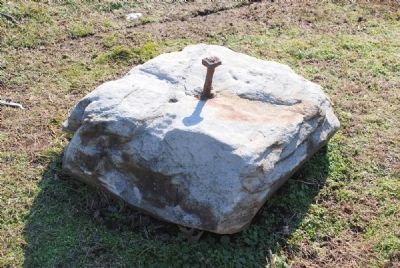
Initially C&A tracks were laid on stone blocks called "sleepers" produced by inmates of New York's Sing Sing prison. However, when shipments were delayed, Stevens temporarily utilized wooden crossbeams (or ties), that he found produced a more comfortable ride and better support for the track. Wooden ties soon replaced all "sleepers" on the C&A and were ultimately adopted for use throughout the country. When the foundation of an 1851 engine house was uncovered during construction of this station stop, its foundation was found to be made of stone "sleepers" salvaged from the original C&A tracks. Two of these "sleepers," one of which still has an iron spike protruding from it, are displayed in the nearby exhibit, and several others were donated to local preservation organizations. America's early railroads used rails made of flat iron bars or inverted T-shaped iron beams. C&A president Robert L. Stevens designed a new,
Photographed by R. C.
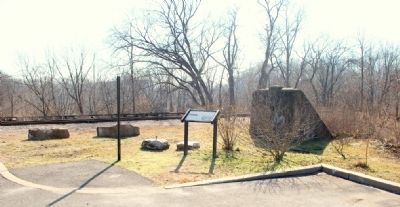
2. Static display of Bordentown Railroad Historic Materials
Erected by New Jersey Transit Corporation. (Marker Number 5.)
Topics. This historical marker is listed in this topic list: Railroads & Streetcars. A significant historical month for this entry is September 1831.
Location. 40° 8.8′ N, 74° 42.95′ W. Marker is near Bordentown, New Jersey, in Burlington County. It is in Falls Township. It can be reached from West Park Street 0.1 miles west of Prince Street, on the left when traveling west. Plaque and static display are at the far end of the Bordentown New Jersey Transit Rail Station parking lot. Touch for map. Marker is at or near this postal address: 228 Walnut St, Bordentown NJ 08505, United States of America. Touch for directions.

Regionally, this marker is in South Jersey and in Greater Philadelphia. It is also in the American Northeast, in the Mid-Atlantic, and on the Eastern
Photographed by R. C.
3. One of the original "sleepers" with an iron spike used in the original 1830's construction
Other nearby markers. At least 8 other markers are within walking distance of this marker: Point Breeze (about 400 feet away, measured in a direct line); An Early Transportation Hub (about 500 feet away); Discover Abbott Marshlands: A Natural & Historical Treasure (about 500 feet away); The Delaware: A National Treasure (about 600 feet away); The "Wye" and the Lower Bordentown Station (about 600 feet away); First Baptist Church (about 600 feet away); 50 Star Flag (approx. 0.2 miles away); World Wars I and II Memorial (approx. 0.2 miles away). Touch for a list and map of all markers in Bordentown.
Additional commentary.
1.
The stone blocks were generally quarried within 10 miles of the right of way. Sing Sing inmates only quarried Inwood Marble blocks.
— Submitted January 23, 2018, by Pierre Lacombe of Florence, New Jersey.
Photographed by R. C.
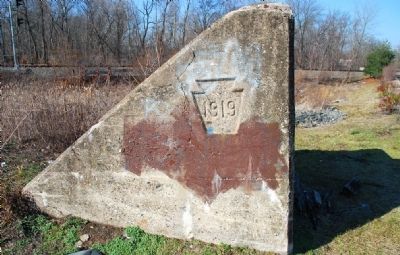
4. Portion of a railroad bridge or "trestle"
Credits. This page was last revised on August 6, 2024. It was originally submitted on April 24, 2008, by Ronald Claiborne of College Station, Texas. This page has been viewed 2,502 times since then and 182 times this year. Last updated on August 4, 2024, by Carl Gordon Moore Jr. of North East, Maryland. Photos: 1, 2, 3, 4. submitted on April 24, 2008, by Ronald Claiborne of College Station, Texas. • Devry Becker Jones was the editor who published this page.
