Near San Antonio in Socorro County, New Mexico — The American Mountains (Southwest)
The Establishment of Fort Craig

Photographed by James Hulse, July 23, 2024
1. The Establishment of Fort Craig Marker
One of these forts, Fort Conrad, was established along the Camino Real at the north end of the Jornada del Muerto in 1852, but it only operated for a short while. Although it was situated on an ideal spot from which to launch campaigns against the Apaches and Navajos and protect El Camino Real de Tierra Adentro, it was beset by construction problems, and was under constant threat of flash flooding. The following year, the U.S. Third Infantry began constructing Fort Craig on a bluff five miles away from Fort Conrad. The new fort was named in honor of Captain L.S. Craig, a popular young officer in the Mexican-American War, who had been killed by deserters while surveying the new international boundary.
this page online
Captions
The front page of the Treaty of Guadalupe Hidalgo
Topics. This historical marker is listed in this topic list: Forts and Castles. A significant historical month for this entry is February 1848.
Location. 33° 38.118′ N, 107° 0.891′ W. Marker is near San Antonio, New Mexico, in Socorro County. It is on Fort Craig Road 4½ miles south of Old US Hwy 85 (U.S. 1). The marker is located at the Fort Craig Historic Site along the visitor trail. Touch for map. Marker is at or near this postal address: 457 Ft Craig Rd, San Antonio NM 87832, United States of America. Touch for directions.

Regionally, this marker is in Southwest New Mexico and in the Rio Grande Valley. It is also in the American Southwest. Globally, it is in North America, the Western Hemisphere, the Western World, and the Anglosphere. Historically, it finds itself in what was once New Spain and also the Republic of Texas.
Other nearby markers. At least 8 other markers are within walking distance of this marker: Early Spanish Exploration (here, next to this marker); Fort Craig
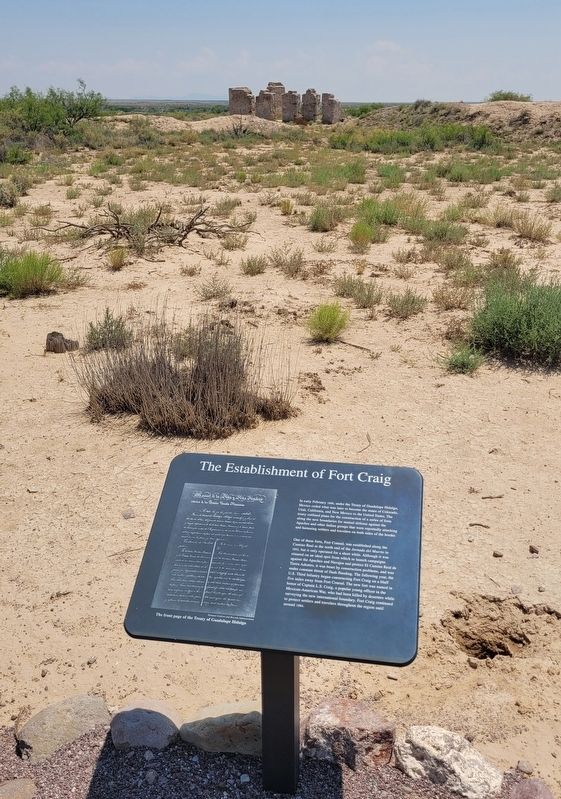
Photographed by James Hulse, July 23, 2024
2. The Establishment of Fort Craig Marker
More about this marker. At Fort Craig Historic Site, an ADA accessible, self-guided interpretive trail is open seven days a week, from 8:00 a.m. to one-hour before sunset. The visitor’s center is open Thursday through Monday from 8:00 a.m. to 5:00 p.m.
Also see . . .
1. Fort Craig Historic Site. blm.gov
Fort Craig, established in 1854, was one of the largest and most important frontier forts in the West. Set in the rugged beauty of Socorro County, N.M., it was one of the eight forts situated along the primary north-south road in the Rio Grande Valley. Fort Craig played a crucial role in Indian campaigns and the Civil War.(Submitted on August 5, 2024, by James Hulse of Medina, Texas.)
2. Treaty of Guadalupe Hidalgo.
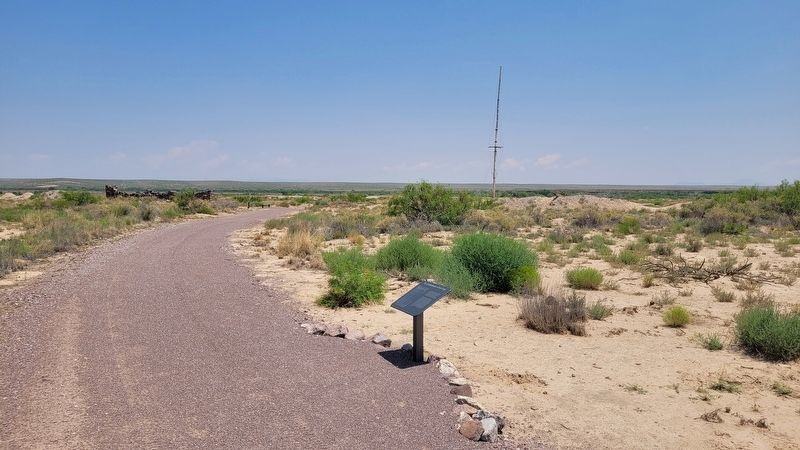
Photographed by James Hulse, July 23, 2024
3. The view of the Establishment of Fort Craig Marker along the trail
The Treaty of Guadalupe Hidalgo[a] officially ended the Mexican–American War (1846–1848). It was signed on 2 February 1848 in the town of Guadalupe Hidalgo.(Submitted on August 5, 2024, by James Hulse of Medina, Texas.)
After the defeat of its army and the fall of the capital in September 1847, Mexico entered into peace negotiations with the U.S. envoy, Nicholas Trist. The resulting treaty required Mexico to cede 55 percent of its territory including the present-day states of California, Nevada, Utah, most of Colorado, New Mexico and Arizona, and a small portion of Wyoming. Mexico also relinquished all claims for Texas and recognized the Rio Grande as the southern boundary of Texas.
Credits. This page was last revised on August 6, 2024. It was originally submitted on August 4, 2024, by James Hulse of Medina, Texas. This page has been viewed 182 times since then and 25 times this year. Photos: 1, 2, 3. submitted on August 5, 2024, by James Hulse of Medina, Texas.
