
Contalmaison in Somme, Upper France, France — Western Europe
Pozières Ridge
Photographed by J. Makali Bruton, June 10, 2024
1. Pozières Ridge Marker

July-August 1916
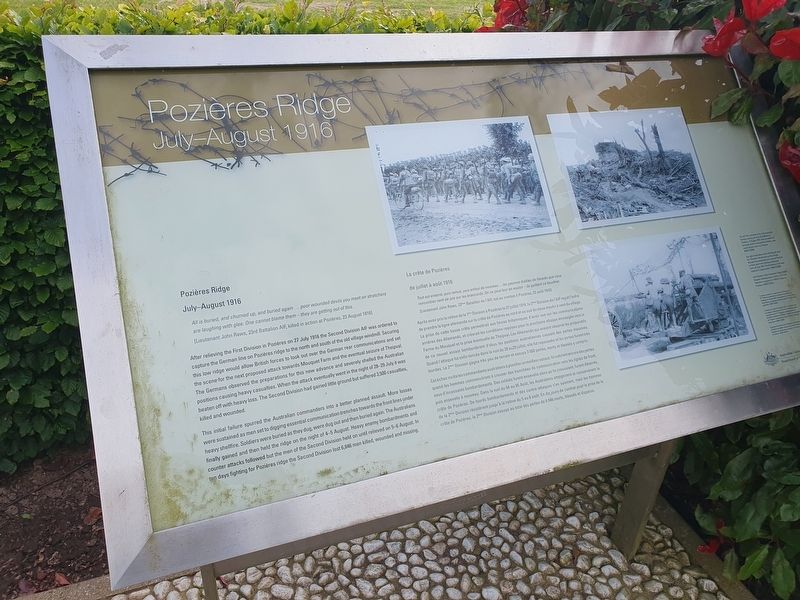
All is buried, and churned up, and buried again... poor wounded devils you meet on stretchers are laughing with glee. One cannot blame them-they are getting out of this.After relieving the First Division in Pozières on 27 July 1918 the Second Division AIF was ordered to capture the German line on Pozières ridge to the north and south of the old village windmill. Securing this low ridge would allow British forces to look out over the German rear communications and set the scene for the next proposed attack towards Mouquet Farm and the eventual seizure of Theipval. The Germans observed the preparations for this new advance and severely shelled the Australian positions causing heavy casualties. When the attack eventually went in the night of 28-29 July it was beaten off with heavy loss. The Second Division had gained little ground but suffered 3,500 casualties killed and wounded.
(Lieutenant John Raws, 23rd Battalion AIF, killed in action at Pozières, 23 August 1916)
This initial failure spurred the Australian commanders into a better planned
this page online
La crête de Pozières
de juillet à août 1916
Tout est enterré, puis remué, puis enfoui de nouveau... les pauvres diables de blessés que vous rencontrez rient de joie sur les brancards. On ne peut leur en vouloir - ils quittent ce bourbier.Après avoir pris la relive de la Division à Pozières le 27 juillet 1916, 2eme Division de l'AIF recut l'ordre de prendre la ligne allemande sur la crete de Pozières au nord et au sud de vieux moulin à vent du village. La prise de cette basse crete permettrait aux forces brittaniques d'avoir vue sur les communications arrières des Allemands, et créerait les conditions requises pour la prochaine ataque envisage vers la Ferme du Mouquet et la prise éventuelle de Theipval.
(Lieutenant John Raws, 2eme Bataillon de l’AIF, tué au combat à Pozieres, 23 aout 1916)
Photographed by J. Makali Bruton, June 10, 2024
2. Pozières Ridge Marker
Cet échec incita les commandants australiens à planifier un meilleur assaut. Ils subirent encore des pertes quand les hommes commencèrent à creuser des tranchées de communication vers les lignes de front, seus d'incessants bombardements. Des soldats furent ensevelis alors qu'is creusaient, furent dis puis ensevelis à nouveau. Dans la nuit du 04 au 05 Aout, les Australiens asignivent et conservirent la crète de Pozières. De lourds bombardements et des contre-attaques s'en suivirent, mais les hommes de la Division resistèrent jusqu'à la relève du 5 aut. En dis jours de combat pour la prise de la crete de Pozières, la 2eme Division essuya au total des pertes de 6848 morts, blessés et disparus.
Erected by Australian Government, Department of Veterans Affairs.
Topics. This historical marker is listed in this topic list: War, World I. A significant historical date for this entry is July 27, 1918.
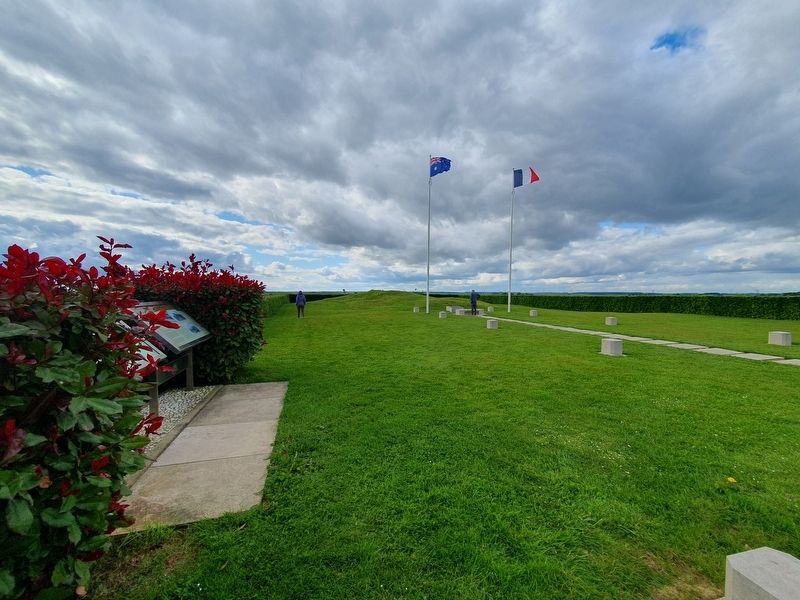
Location. 50° 2.686′ N, 2° 44.167′ E. Marker is in Contalmaison, Hauts-de-France (Upper France), in Somme. It is on Route de Baupaume (Route D929) south of Route D107, on the right when traveling south. Touch for map. Marker is at or near this postal address: 976 D929, Contalmaison, Hauts-de-France 80300, France. Touch for directions.

Regionally, it is in the North Atlantic Region, Europe, the European Union, Atlantic Europe, the Schengen Area, Western Europe, a coastal Mediterranean country, and the Western World. Historically, it finds itself in what was once a French colony and also the Roman Empire.
Other nearby markers. At least 8 other markers are within 3 kilometers of this marker, measured as the crow flies: The Windmill Site (here, next to this marker); Pozières Windmill (a few steps from this marker); Pozières France (a few steps from this marker); The Tank Corps (within shouting distance of this marker); Tanks (within shouting distance of this marker); Mouquet Farm (approx. 2.1 kilometers away); Bazentin (approx. 2.4 kilometers away); Peake Wood Cemetery (approx. 3.1 kilometers away). Touch for a list and map of all markers in Contalmaison.
Credits. This page was last revised on August 5, 2024. It was originally submitted on August 4, 2024, by J. Makali Bruton of Washington, District of Columbia. This page has been viewed 126 times since then and 14 times this year. Photos: 1, 2. submitted on August 4, 2024, by J. Makali Bruton of Washington, District of Columbia.
