Near La Plume in Lackawanna County, Pennsylvania — The American Northeast (Mid-Atlantic)
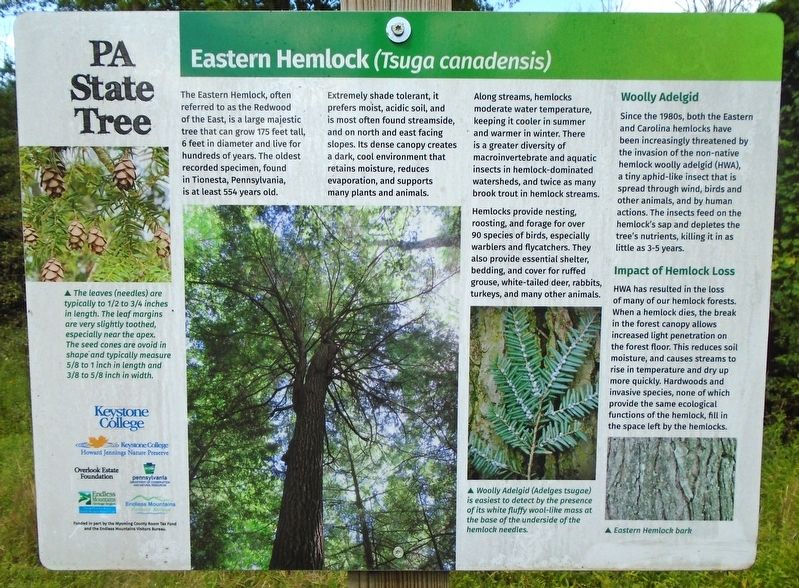
Eastern Hemlock (Tsuga canadensis)
PA State Tree
Photographed by William Fischer, Jr., July 26, 2024
1. Eastern Hemlock (Tsuga canadensis) Marker
The Eastern Hemlock, often referred to as the Redwood of the East, is a large majestic tree that can grow 175 feet tall, 6 feet in diameter and live for hundreds of years. The oldest recorded specimen, found in Tionesta, Pennsylvania, is at least 554 years old.
Extremely shade tolerant, it prefers moist, acidic soil, and is most often found streamside, and on north and east facing slopes. Its dense canopy creates a dark, cool environment that retains moisture, reduces evaporation, and supports many plants and animals.
Along streams, hemlocks moderate water temperature, keeping it cooler in summer and warmer in winter. There is a greater diversity of macroinvertebrate and aquatic insects in hemlock-dominated watersheds, and twice as many brook trout in hemlock streams.
Hemlocks provide nesting, roosting, and forage for over 90 species of birds, especially warblers and flycatchers. They also provide essential shelter, bedding, and cover for ruffed grouse, white-tailed deer, rabbits, turkeys, and many other animals.
Woolly Adelgid
Since the 1980s, both the Eastern and Carolina hemlocks have been increasingly threatened
this page online
Impact of Hemlock Loss
HWA has resulted in the loss of many of our hemlock forests. When a hemlock dies, the break in the forest canopy allows increased light penetration on the forest floor. This reduces soil moisture, and causes streams to rise in temperature and dry up more quickly. Hardwoods and invasive species, none of which provide the same ecological functions of the hemlock, fill in the space left by the hemlocks.
[Photo captions, left to right, read]
• The leaves (needles) are typically to 1/2 to 3/4 inches in length. The leaf margins are very slightly toothed, especially near the apex. The seed cones are ovoid in shape and typically measure 5/8 to 1 inch in length and 3/8 to 5/8 inch in width.
• [Eastern Hemlock, no caption]
• Woolly Adelgid (Adelges tsugae) is easiest to detect by the presence of its white fluffy wool-like mass at the base of the underside of the hemlock needles.
• Eastern Hemlock bark
Erected by Keystone
Photographed by William Fischer, Jr., July 26, 2024
2. Eastern Hemlock (Tsuga canadensis) Marker
Topics. This historical marker is listed in this topic list: Horticulture & Forestry.
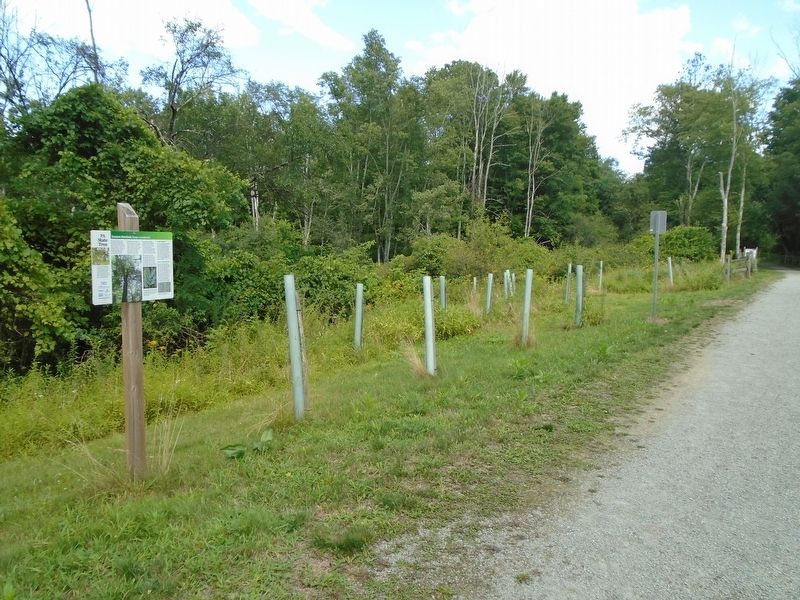
Location. 41° 33.347′ N, 75° 46.472′ W. Marker is near La Plume, Pennsylvania, in Lackawanna County. It can be reached from Hickory Ridge Road. Marker is along the Countryside Trolley Trail, about one quarter mile west of the Whitney Chamberlin Memorial Trailhead, on the Keystone College campus. Touch for map. Marker is in this post office area: La Plume PA 18440, United States of America. Touch for directions.

Regionally, this marker is in the Wyoming Valley and in Greater Scranton and Wilkes-Barre. It is also in the American Northeast, in the Mid-Atlantic, in Appalachia, and specifically in Northern Appalachia. Globally, it is in North America, the Western Hemisphere, the Western World, and the Anglosphere. Historically, it finds itself in what was once the Haudenosaunee (Iroquois) Confederacy and also one of the original Thirteen Colonies.
Other nearby markers. At least 8 other markers are within walking distance of this marker: After 25 Years...The Final Chapter (within shouting distance of this marker); Ticks, Mosquitoes & Gnats (about 400 feet away, measured in a direct line); Veterans Memorial (approx. 0.2 miles away); Harris Hall Bell Memorial (approx. ¼ mile away); The Northern Electric Interurban Trolley (approx. ¼ mile away); Christy Mathewson (approx. 0.3 miles away); Slowing the Flow (approx. 0.3 miles away); Keystone College Sugar Shack (approx. 0.4 miles away). Touch for a list and map of all markers in La Plume.
Also see . . . Eastern Hemlock (USDA Plant Guide). (Submitted on August 4, 2024, by William Fischer, Jr. of Reynoldsburg, Ohio.)
Credits. This page was last revised on August 5, 2024. It was originally submitted on August 4, 2024, by William Fischer, Jr. of Reynoldsburg, Ohio. This page has been viewed 242 times since then and 30 times this year. Photos: 1, 2. submitted on August 4, 2024, by William Fischer, Jr. of Reynoldsburg, Ohio.
