Normal in McLean County, Illinois — The American Midwest (Great Lakes)
Lincoln and Fell
⎯⎯⎯
Jesse Fell Home
| — | Looking for Lincoln | — |
Photographed by Duane and Tracy Marsteller, July 7, 2024
1. Lincoln and Fell side of marker
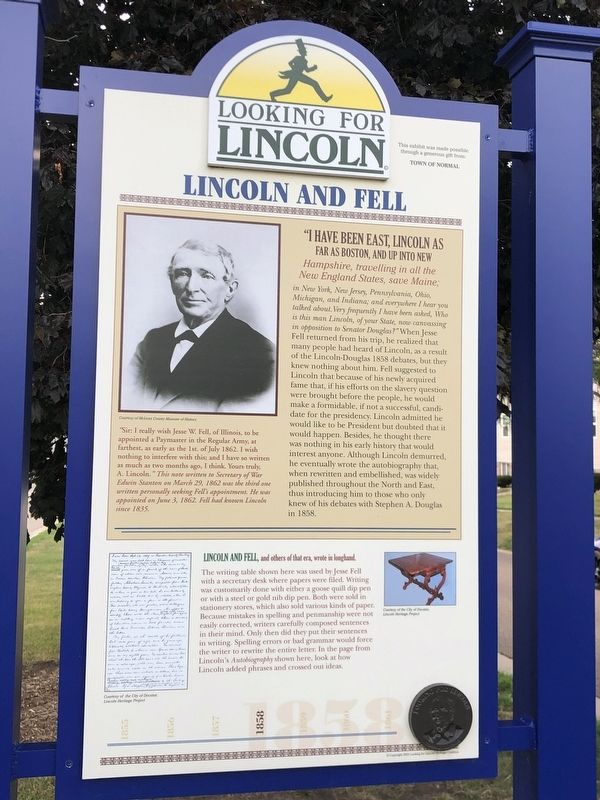
“I have been East, Lincoln as far as Boston, and up into New Hampshire, travelling in all the New England States, save Maine; in New York, New Jersey, Pennsylvania, Ohio, Michigan, and Indiana; and everywhere I hear you talked about. Very frequently I have been asked, Who is this man Lincoln, of your State, now canvassing in opposition to Senator Douglas?”When Jesse Fell returned from his trip, he realized that many people had heard of Lincoln, as a result of the Lincoln-Douglas 1858 debates, but they knew nothing about him. Fell suggested to Lincoln that because of his newly acquired fame that, if his efforts on the slavery question were brought before the people, he would make a formidable, if not a successful, candidate for the presidency. Lincoln admitted he would like to be President but doubted that it would happen. Besides, he thought there was nothing in his early history that would interest anyone. Although Lincoln demurred, he eventually wrote the autobiography that, when rewritten and embellished, was widely published throughout the North and East, thus introducing him to those who only knew
this page online
[Left column]
“Sir I really wish Jesse W. Fell, of Illinois, to be appointed a Paymaster in the Regular Army, at farthest, as early as the 1st. of July 1862. I wish nothing to interfere with this; and I have so written as much as two months ago, I think. Yours truly, A. Lincoln.”This note written to Secretary of War Edwin Stanton on March 29, 1862 was the third one written personally seeking Fell's appointment. He was appointed on June 3, 1862. Fell had known Lincoln since 1835.
Lincoln and Fell, and others of that era, wrote in longhand. The writing table shown here was used by Jesse Fell with a secretary desk where papers were filed. Writing was customarily done with either a goose quill dip pen or with a steel or gold nib dip pen. Both were sold in stationery stores, which also sold various kinds of paper. Because mistakes in spelling and penmanship were not easily corrected, writers carefully composed sentences in their mind. Only then did they put their sentences in writing. Spelling errors or bad grammar would force the writer to rewrite the entire letter. In the page from
Photographed by Duane and Tracy Marsteller, July 7, 2024
2. Jesse Fell Home side of marker
Photographed by Duane and Tracy Marsteller, July 7, 2024
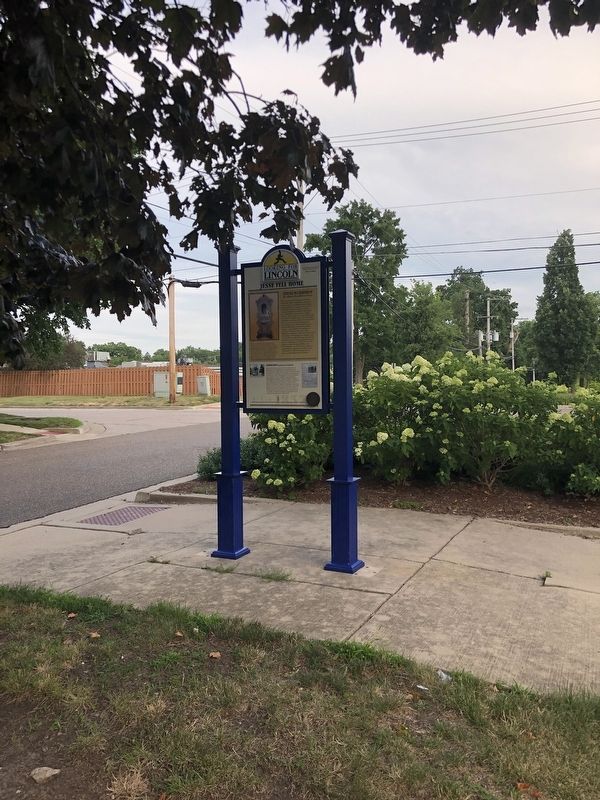
3. Lincoln and Fell / Jesse Fell Home Marker
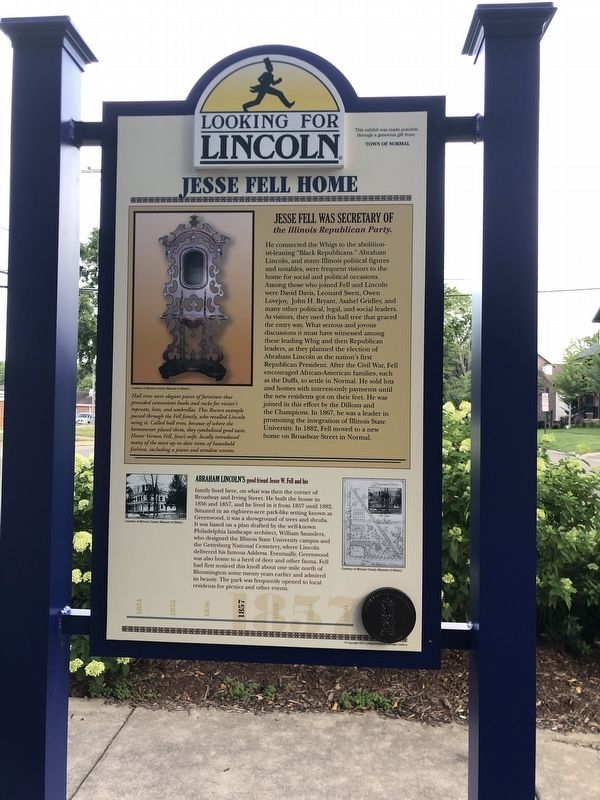
Abraham Lincoln's good friend Jesse Fell and his family lived here, on what was then the corner of Broadway and Irving Street. He built the house in 1856 and 1857, and he lived in it from 1857 until 18982. Situated in an eighteen-acre park-like setting known as Greenwood, it was a showground of trees and shrubs. It was based on a plan drafted by the well-known Philadelphia landscape architect, William Saunders, who designed the Illinois State University campus and the Gettysburg National Cemetery, where Lincoln delivered his famous Address. Eventually, Greenwood was also home to a herd of deer and other fauna. Fell had first noticed this knoll about one mile north of Bloomington some twenty years earlier and admired its beauty. The park was frequently opened to local residents for picnics and other events.
[Top left] Hall trees were elegant pieces of furniture that provided convenient hooks and racks for visitor's topcoats, hats and umbrellas. This Rococo example passed through the Fell family, who recalled Lincoln using it. Called hall trees, because
"Journal of the Illinois State Historical Society", 1916; via Google Books (Public Domain)
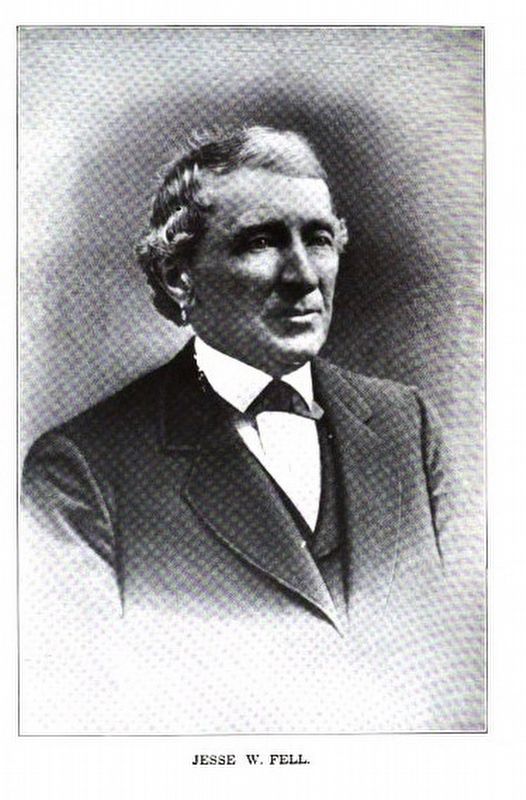
4. Jesse Weldon Fell (1808-1887)
Topics and series. This historical marker is listed in these topic lists: Architecture • Communications • Government & Politics. In addition, it is included in the Former U.S. Presidents: #16 Abraham Lincoln, and the Looking for Lincoln series lists. A significant historical date for this entry is March 29, 1862.
Location. 40° 30.409′ N, 88° 59.144′ W. Marker is in Normal, Illinois, in McLean County. It is at the intersection of Broadway and West Irving Street, in the median on Broadway. Touch for map. Marker is in this post office area: Normal IL 61761, United States of America. Touch for directions.

Regionally, this marker is in Central Illinois. It is also in the American Midwest and in the Corn Belt. Globally, it is in North America, the Western Hemisphere, the Western World, and the Anglosphere. Historically, it finds itself in what was once the territory of the Mississippian Culture and also the Northwest Territory.
Other nearby markers. At least 8 other markers are within walking distance of this marker: Normal Theater (approx. 0.2 miles away); Jesse W. Fell (approx. 0.3 miles away); Capital Stone from the Third McLean County Courthouse (approx. 0.3 miles away); Illinois State University Veterans Memorial (approx. 0.3 miles away); World War I Memorial Stone (approx. 0.3 miles away); Veterans Memorial (approx. 0.3 miles away); Old Main Bell (approx. 0.3 miles away); The Illinois State Normal University (approx. 0.4 miles away). Touch for a list and map of all markers in Normal.
Also see . . . Fell, Jesse Weldon. Jsse Weldon Fell was born on November 10, 1808 to Jesse Fell and Rebecca Roman Fell at his father's farm in New Garden Township, Chester County, Pennsylvania. He was a fourth generation Pennsylvanian, his great-grandfather having arrived from England in 1705. He was the third of nine children in a Quaker family. His father farmed and was a hat maker and his mother was a Hicksite preacher. (Anthony Bowman, The McLean County Museum of History, 2009) (Submitted on August 5, 2024, by Duane and Tracy Marsteller of Murfreesboro, Tennessee.)
Credits. This page was last revised on August 5, 2024. It was originally submitted on August 5, 2024, by Duane and Tracy Marsteller of Murfreesboro, Tennessee. This page has been viewed 483 times since then and 93 times this year. Photos: 1, 2, 3, 4. submitted on August 5, 2024, by Duane and Tracy Marsteller of Murfreesboro, Tennessee.
