Susteren in Echt-Susteren, Limburg, Netherlands — Northwestern Europe
Susteren World War II Liberation Memorial
Photographed by Andrew Ruppenstein, July 14, 2024
1. Susteren World War II Liberation Memorial

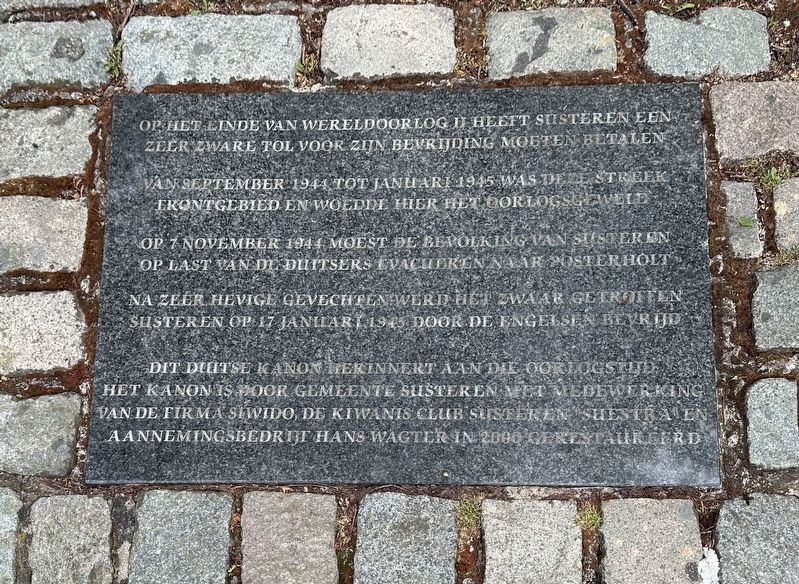
Van september 1944 tot januari 1945 was dese streek frontgebied en woedde hier het oorlogsgeweld
Op 7 november 1944 moest de bevolking van Susteren op last van de Duitsers evacueren naar Posterholt
Na zeer hevige gevechten werd het zwaar getroffen Susteren op 17 januari 1945 door de Engelsen bevrijd
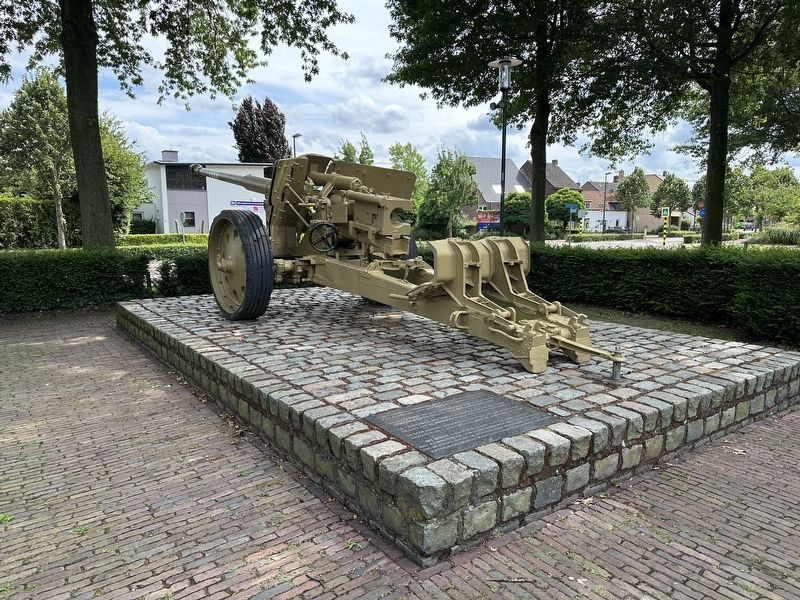
Dit duitse kanon herinnert aan die oorlogstijd
Het kanon is door Gemeente Susteren met medewerking van de firma Siwido, de Kiwanis Club Susteren “Suestra” en aannemingsbedrijt Hans Wagter in 2000 gerestaureerd
At the end of World War II, Susteren had to pay a very heavy price for its liberation.
From September 1944 to January 1945, this region was a frontline area and the violence of war raged here.
On November 7, 1944, the population of Susteren had to evacuate to Posterholt by order of the Germans.
After very heavy fighting, the badly hit Susteren was liberated by the English on January 17, 1945.
This German cannon is a reminder of that wartime. The cannon was
this page online
Topics. This memorial is listed in this topic list: War, World II. A significant historical date for this entry is January 17, 1945.
Location. 51° 3.947′ N, 5° 51.244′ E. Memorial is in Susteren, Limburg, in Echt-Susteren. It is at the intersection of Raadhuisplein and Oude Rijksweg Noord, on the right when traveling north on Raadhuisplein. Touch for map. Memorial is in this post office area: Susteren, Limburg 6114 JH, Netherlands. Touch for directions.

Regionally, it is in Europe, the European Union, Atlantic Europe, the Benelux Low Countries, the Schengen Area, Western Europe, and the Western World. Historically, it finds itself in what was once the Roman Empire and specifically also the Holy Roman Empire.
Other nearby markers. At least 8 other markers are within 16 kilometers of this marker, measured as the crow flies: Susteren Slachtoffers Tweede Wereldoorlog / Victims of WWII (about 90 meters away, measured in a direct line); Kazemat / Casemate (approx. 1.4
Photographed by Andrew Ruppenstein, July 14, 2024
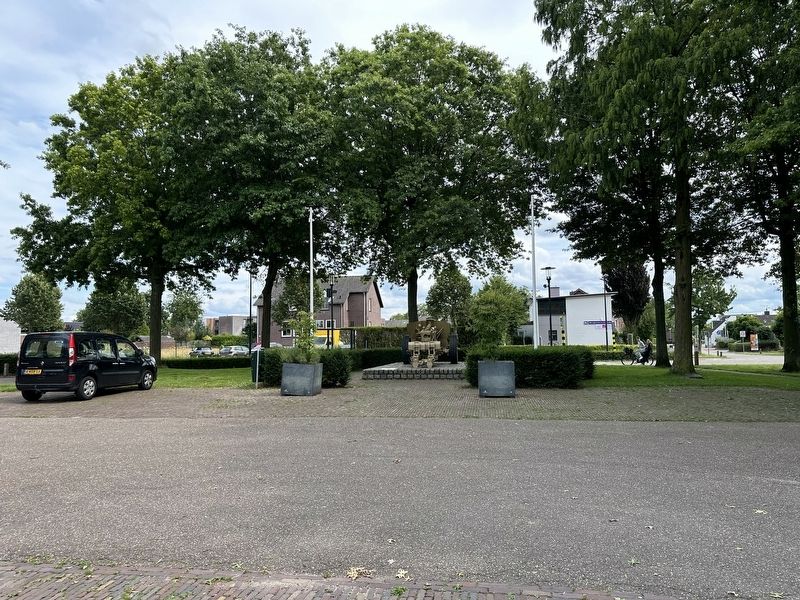
2. Susteren World War II Liberation Memorial - wide view
Regarding Susteren World War II Liberation Memorial. Some information about the cannon itself. It’s worth noting that another of the same model is in nearby Valkenburg, on the lawn of the town hall.
Excerpt (in Dutch): During World War II, the cannon was said to have been involved in fighting in the African Desert War between 1941 and 1943. In the fall of 1944, the cannon surfaced in Susteren, where it remained until January 1945. The cannon was used for the last time then and was hidden near the orchard of the Kreutzer family. At the request of the then mayor of Susteren, the cannon was donated to the municipalityby the Allies after the war as a reminder of the war.Photographed by Andrew Ruppenstein, July 14, 20243. Susteren World War II Liberation Memorial - wider view
The Susteren Cannon was originally made in Germany. It is a PAK 43, which stands for Anti-tank gun, with a caliber of 8.8 cm. In the beginning, it was intended as an anti-aircraft gun, but later it was converted into an anti-tank gun because of its technical performance. What makes this cannon special is that it stood out above other weapons. This was not only due to its ability to easily overcome obstacles and its good maneuverability, but also because it could shoot in all directions and had a large range. A disadvantage of the cannon was that it offered little protection on the sides and top. The fact that people were exposed to great dangers at the time is still visible from the damage to the cannon. Nevertheless, it was a very popular weapon at the time. Particularly on the Eastern Front. Here the front lines changed quickly. The cannon was ideal because it could be deployed quickly and was also greatly feared by the Russians. Today, only a few of these cannons remain.
Credits. This page was last revised on August 7, 2024. It was originally submitted on August 6, 2024, by Andrew Ruppenstein of Lamorinda, California. This page has been viewed 348 times since then and 30 times this year. Photos: 1, 2, 3. submitted on August 6, 2024, by Andrew Ruppenstein of Lamorinda, California.
