Amsterdam-Centrum , North Holland, Netherlands — Northwestern Europe
Voormalig Hoofdkantoor Joodsche Raad
⎯⎯⎯
Former Headquarters of the Jewish Council

Photographed by Andrew Ruppenstein, July 15, 2024
1. Voormalig Hoofdkantoor Joodsche Raad / Former Headquarters of the Jewish Council Marker

Opdrachtgever: Benjamin Nunes Henriques
Voormalige woonhuis van koopman en politicus
S.W. Josephus Jitta (1818-1897)
Voormalig hoofdkantoor Joodsche Raad
De Joodsche Raad werd in 1941 door de Duitse bezetter opgericht als vertegenwoordiger van de Amsterdamse, en later van alle Nederlandse Joden.
De Raad nam de zorg op zich voor de Joodse bevolking, maar diende bovendien als doorgeefluik van de anti-Joodse maatregelen.
Deze positie en de overtuiging zo 'erger te voorkomen' bracht de Raad er vanaf zomer 1942 toe te onderhandelen over voorlopige vrijstelling van weinigen ten koste van de deportatie van velen.
In september 1943 werden leiding en medewerkers van de Joodsche Raad zelf gedeporteerd.
(English translation of the Dutch text above:)
Years of construction: between 1724 and 1732
Client: Benjamin Nunes Henriques
Former residence of merchant and politician S.W. Josephus Jitta (1818-1897)
Former Headquarters of the Jewish Council
The Jewish Council was established in 1941 by the German occupiers as the representative body of the Amsterdam Jews, and later of all Dutch Jews.
The Council took care of the Jewish population, but also served as a conduit for the anti-Jewish measures.
This position and the conviction to 'prevent worse' led the Council to negotiate from the summer of 1942 onwards about the temporary exemption of a few at the expense of the deportation of many.
In September 1943, the management and employees of the Jewish Council were themselves deported.
Topics and series. This historical marker is listed in this topic list:
this page online
Location. 52° 21.888′ N, 4° 54.281′ E. Marker is in Amsterdam, Noord-Holland (North Holland). It is in Amsterdam-Centrum. It is on Nieuwe Keizersgracht, on the right when traveling east. Touch for map. Marker is at or near this postal address: Nieuwe Keizersgracht 58, Amsterdam, Noord-Holland 1018 DX, Netherlands. Touch for directions.

Regionally, it is in Europe, the European Union, Atlantic Europe, the Benelux Low Countries, the Schengen Area, Western Europe, and the Western World. Historically, it finds itself in what was once the Holy Roman Empire.
Other nearby markers. At least 8 other markers are within walking distance of this marker: Chaje Bas-Trobuschicht (about 120 meters away, measured in a direct line); Abraham Bas (about 120 meters away); De Schaduwkade (Shadow Wall) (about 150 meters away); E.J. van Detschool (about 180 meters away); E.J. van Det School Memorial (about 180 meters away); J.C. Amman School Memorial (about 180 meters away); Christiaan Andriessen (about 180 meters away);
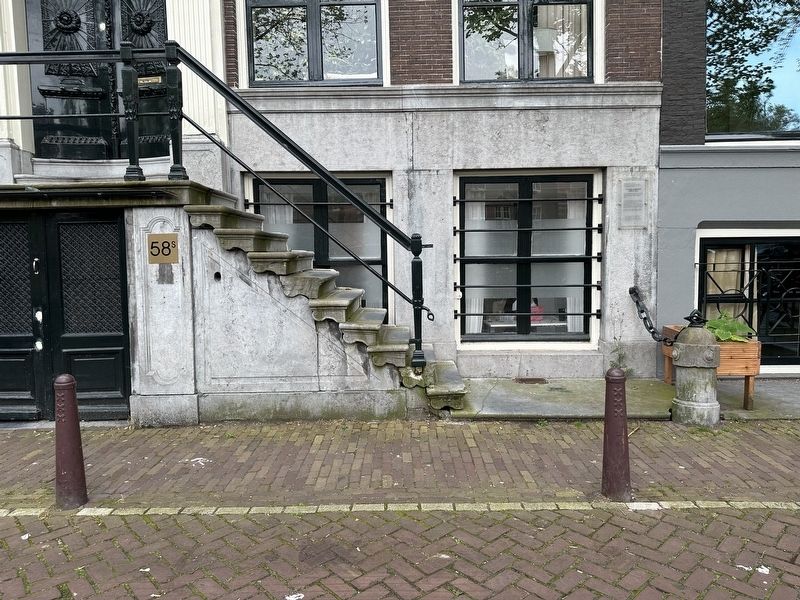
Photographed by Andrew Ruppenstein, July 15, 2024
2. Former Headquarters of the Jewish Council Marker - wide view
The marker is visible here to the right of the window. It isn’t easily visible from any distance.
Also see . . . De Joodse Raad. The Jewish Council (Joods Monument).
Excerpt: In the Netherlands the Amsterdam Jewish Council was established on February 11, 1941. It was led by the diamond manufacturer and chairman of the Church Council of the Netherlands - Israelite main Synagogue, Abraham Asscher and the professor of ancient history, also the president of the Committee for Jewish Refugees, David Cohen. In addition, another twenty Jews were seated on the board….(Submitted on August 6, 2024.)
The Nazi's had also set up the system of Jewish Councils in the occupied countries in Eastern Europe. The first Judenrat in Prague served as a model for this. The ultimate aim was that the Jews would contribute to the successful completion of The Final Solution. The Jewish Councils had to operate as a sort of government body. They were given various competences, but were deprived of any real power. In practice, the councils were deliberately used the encourage the isolation of the Jews from the non-Jewish population.To great satisfaction of the occupying forces, leading Jews were willing to serve the Jewish Counsel, which meant that the reputation and authority of that body increased amongst the Jews in the Netherlands. The Jewish Council insisted that the Jewish Community should strictly observed the German degrees. It was feared that failing to observe the German orders would result in even harsher measures. The Joodse dagblad (the Jewish Weekly), which was the official magazine of the Counsel, published by the occupying forces. The Jewish Council played a controversial role. The leaders were constantly weighting up cooperating with the occupying forces "in order to prevent even worse" against standing up for the interest of the Jewish community. The council tried to exempt as many Jews as possible from being deported. As Cohen described the policy _ though it was probably wring. " We must save what we save can be saved". When the deportation started, the Jewish Council could only influence the way in which list of names was drawn up. Prominent Jews and people working for the Council were exempted for the time being. The last Jews were departed from Amsterdam in September 1943, including Ascher and Cohen. This also meant the end of the Jewish Council.Photographed by Andrew Ruppenstein, July 15, 20243. Former Headquarters of the Jewish Council Marker - wider view

Additional keywords. Holocaust
Credits. This page was last revised on August 6, 2024. It was originally submitted on August 6, 2024, by Andrew Ruppenstein of Lamorinda, California. This page has been viewed 148 times since then and 18 times this year. Photos: 1, 2, 3. submitted on August 6, 2024, by Andrew Ruppenstein of Lamorinda, California.
