Sentrum in Oslo, Norway — Northern Europe (a Nordic Country in Scandinavia)
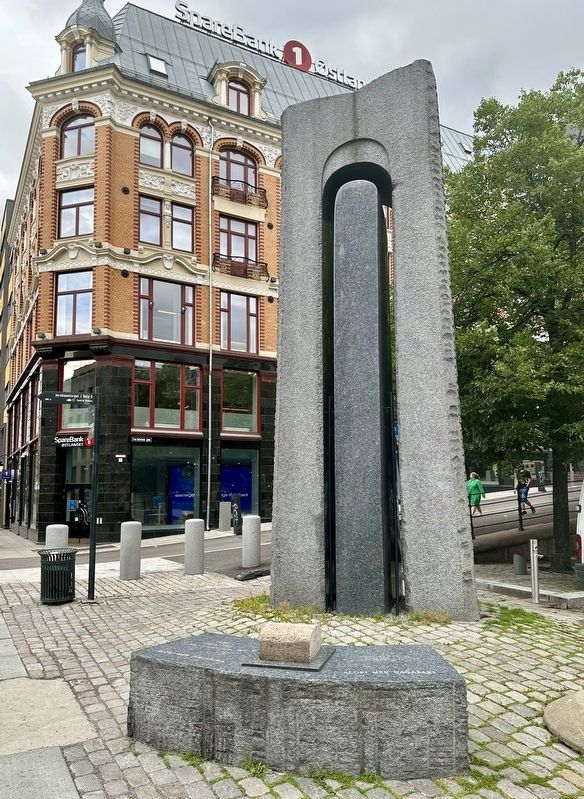
Aldri Mer - Never Again: Hiroshima and Nagasaki Memorial

Photographed by Andrew Ruppenstein, July 8, 2024
1. Aldri Mer - Never Again: Hiroshima and Nagasaki Memorial

Solidaritet
Rettferdighet
(Peace, Solidarity, Justice)
Aldri mer Hiroshima
(Never again Hiroshima)
Stein fra O-punkt
Stone from O-point
(Japanese not transcribed)
Aldri mer Nagasaki
(Never again Nagasaki)
Erected 1995 by Nei til Atomvåpen, Landsorganisasjonen i Norge.
Topics. This memorial is listed in these topic lists: Peace • War, World II.
Location. 59° 54.875′ N, 10° 44.924′ E. Memorial is in Oslo. It is in Sentrum. It is on Eva Kolstads gate. The memorial is located in the southwest corner of Youngstorget. Touch for map. Memorial is at or near this postal address: Eva Kolstads gate 5, Oslo 0181, Norway. Touch for directions.

Regionally, it is in the North Atlantic Region, on the Atlantic Arc, in Europe, in Atlantic Europe, in Scandinavia, in the Nordic Countries, in the Schengen Area, and in the Western World.
Other nearby markers. At least 8 other markers are within walking distance of this marker: Youngstorget / Youngs Square (within shouting distance of this marker); Nytorvets Basar / “New Square Bazaar” (within shouting distance of this marker); Hoved Politistasjon / Main Police Station (about 90 meters away, measured in a direct line); Folkets Hus / “People’s House”
this page online
Also see . . . Atomic bombings of Hiroshima and Nagasaki (Wikipedia).
Overview: On 6 and 9 August 1945, the United States detonated two atomic bombs over the Japanese cities of Hiroshima and Nagasaki. The bombings killed between 150,000 and 246,000 people, most of whom were civilians, and remain the only use of nuclear weapons in an armed conflict. Japan surrendered to the Allies on 15 August, six days after the bombing of Nagasaki and the Soviet Union's declaration of war against Japan and invasion of Japanese-occupied Manchuria. The Japanese government signed the instrument of surrender on 2 September, effectively ending the war.(Submitted on August 10, 2024.)
Scholars have extensively studied the effects of the bombings on the social and political character of subsequent world history and popular culture, and there is still much debate concerning the ethical and legal justification for the bombings. According to supporters, the atomic bombings were necessary to bring an end to the war with minimalcasualties and ultimately prevented a greater loss of life; according to critics, the bombings were unnecessary for the war's end and were a war crime, raising moral and ethical implications.Photographed by Andrew Ruppenstein, July 8, 20242. Aldri Mer - Never Again: Hiroshima and Nagasaki Memorial
Credits. This page was last revised on August 10, 2024. It was originally submitted on August 8, 2024, by Andrew Ruppenstein of Lamorinda, California. This page has been viewed 488 times since then and 44 times this year. Photos: 1. submitted on August 8, 2024, by Andrew Ruppenstein of Lamorinda, California. 2. submitted on August 10, 2024, by Andrew Ruppenstein of Lamorinda, California.
