Alfred Dickey
First Lieutenant Governor of North Dakota
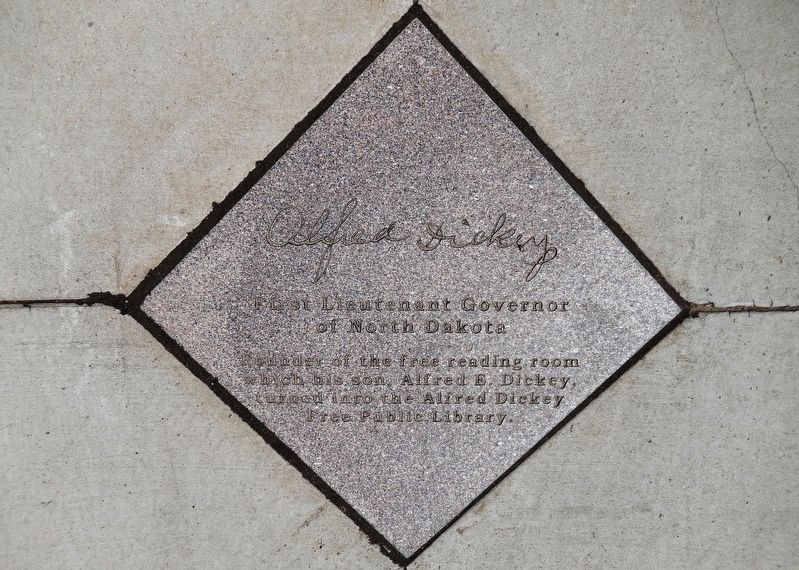
Topics and series. This historical marker is listed in these topic lists: Charity & Public Work • Education • Notable Buildings. In addition, it is included in the National Register of Historic Places (NRHP) series list.
Location. 46° 54.391′ N, 98° 42.498′ W. Marker is in Jamestown, North Dakota, in Stutsman County. It is at the intersection of 1st Avenue South (U.S. 52/281) and 3rd Street Southwest, on the right when traveling north on 1st Avenue South. The marker is embedded in the sidewalk near the northeast corner of the intersection. Touch for map. Marker is at or near this postal address: 105 3rd Street Southeast, Jamestown ND 58401, United States of America. Touch for directions.

Regionally, this marker is in North Dakota’s Drift Prairie. It is also in the American Lewis & Clark Corridor, on the prairies, and on the Northern Plains. Globally, it is in North America, the Western Hemisphere, the Western World, and the Anglosphere.
this page online
Other nearby markers. At least 8 other markers are within walking distance of this marker: Edna LaMoore Waldo (a few steps from this marker); Posthouse (within shouting distance of this marker); Dr. Helena K. Wink (within shouting distance of this marker); Elizabeth White (about 400 feet away, measured in a direct line); The Hansen Arts Park (about 500 feet away); Seiler Building (about 800 feet away); Stutsman County World War Memorial (about 800 feet away); In Celebration of the Two Hundredth Year Birthday of the United States of America, 1976 (about 800 feet away). Touch for a list and map of all markers in Jamestown.
Regarding Alfred Dickey. The Alfred Dickey Free Public Library is listed on the National Register of Historic Places, #80004545, and is also a contributing property in the Jamestown Historic District, National Register of Historic Places #88000987.
From the National Register Nomination prepared by Jackie Sluss, Historical Assistant & Kurt Schweigert, Architectural Historian, State Historical Society of North Dakota, 3/19/1980:The library was funded by and named for Alfred M. Dickey and his son, Alfred E. Dickey, who were very prominent in regional, commercial, financial, and political matters in the early settlement period of 1879-1900. The elder Dickey was a partner in the Wells-Dickey Land Company, which at one time controlled large areas in the James River Valley for speculative purposes. He also served as North Dakota's first Lieutenant Governor in 1889, and was honored by having Dickey County, North Dakota, named for him. In 1901 he pledged funds to support a permanent library in Jamestown, and after his death the same year his son renewed the pledge. The younger Dickey himself died in 1910 and willed $30,000 for construction of a building and a library stock. The building was finally constructed in 1917, and has served as the community's only public library since that time.Photographed by Cosmos Mariner, June 28, 20242. Alfred Dickey MarkerLooking northeast from 3rd Street Southwest; 1st Avenue South is to the left; the Alfred Dickey Public Library is on the right. The marker is embedded in the sidewalk.

Also see . . .
1. Alfred Dickey: The Last Good Work of His Life (By Carole Butcher).
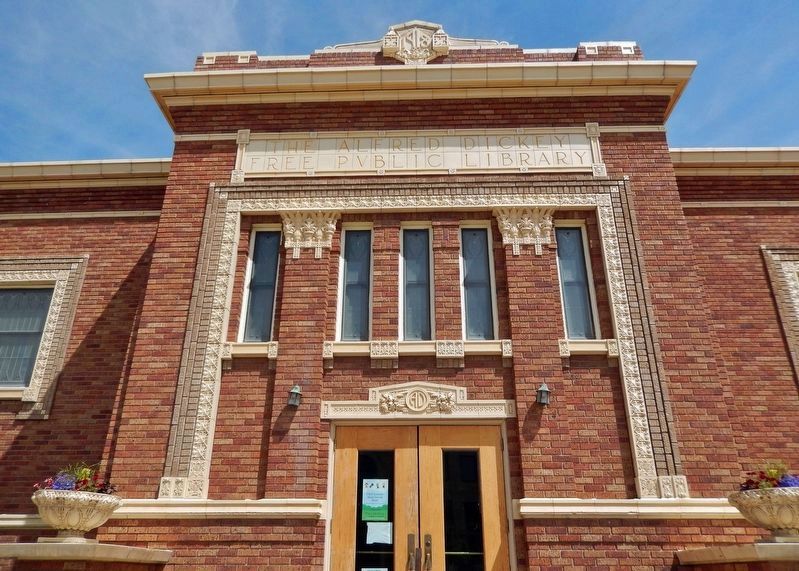
Excerpt: Dickey permanently moved his family to Jamestown in 1884 and he became a respected local figure. He served as North Dakota’s first lieutenant governor from 1889 to 1891. While(Submitted on August 9, 2024, by Cosmos Mariner of Cape Canaveral, Florida.)he never served in office again, he continued in public service. In 1892 he planned the North Dakota exhibit for the Chicago World’s Fair.Photographed by Cosmos Mariner, June 28, 20243. Alfred Dickey Free Public Library (entrance detail)His most lasting legacy began with a public reading room. Memberships paid for much of the cost, but Dickey personally paid for janitorial services and bought magazine subscriptions. Dickey wanted everyone to benefit and knew some people couldn’t afford a membership, so in 1901 he announced plans for a free reading room. Dickey never lived to see it, however. He passed away in January 1901, only weeks before the room opened.
Dickey considered the reading room the “last good work of his life,” but there was more...
2. James River Valley Library System: Our History.
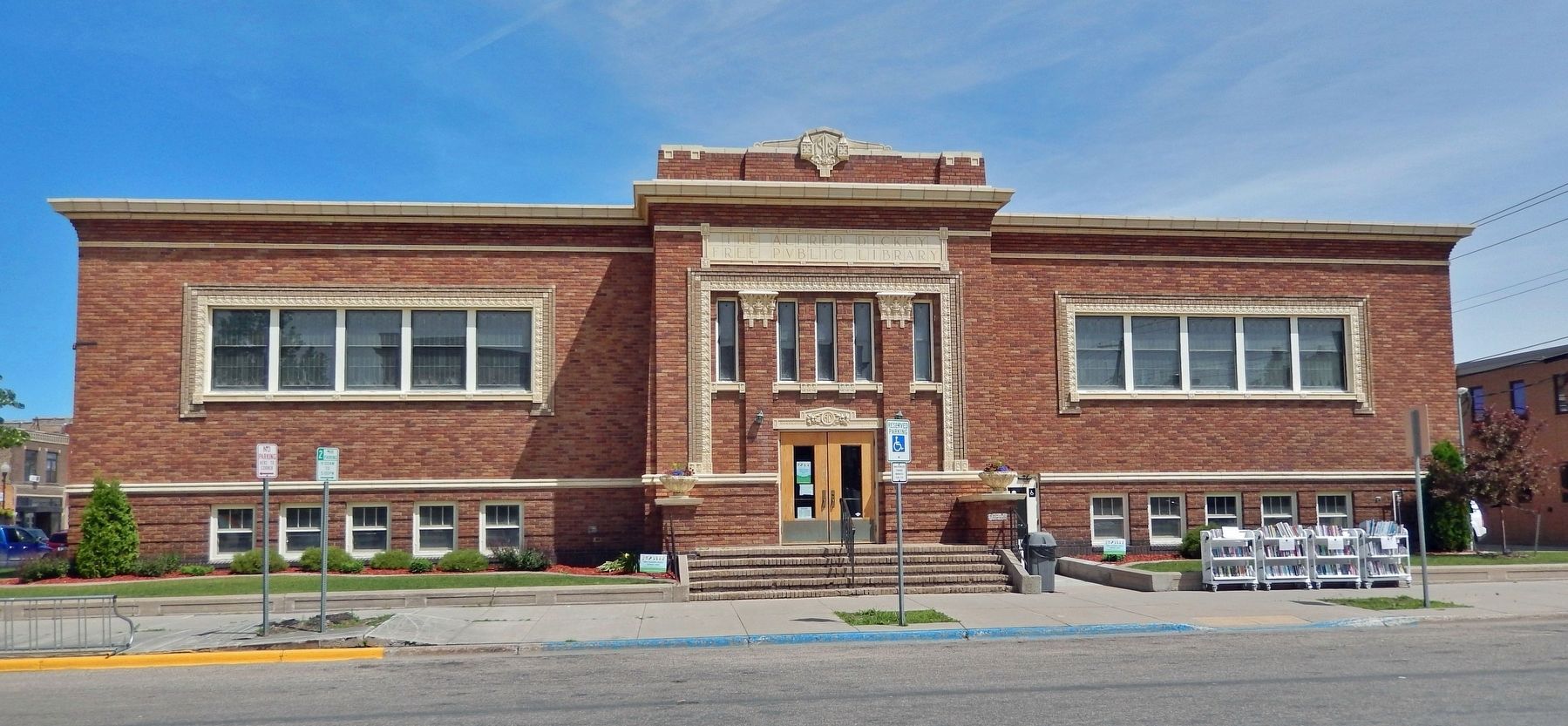
Excerpt: The reading room was opened on February 16, 1901, in a room in the Opera House Block. The room was open to the public as a free reading room. For $1 a year a library cardholder could borrow books. In 1908 the city of Jamestown voted to support the library with city taxes and in January 1909 the library was moved to the city hall and(Submitted on August 9, 2024, by Cosmos Mariner of Cape Canaveral, Florida.)the first trained, full-time librarian was hired. Alfred E. Dickey died in 1910. In his will he left $20,000 to the Board of Directors of the library for a new library building. The city was to provide the site. He also left $15,000 as an endowment fund with the interest to be used for the upkeep of the library. In 1917, with contributions from businessmen and city funds, the site for the library was purchased. By 1919 the Alfred Dickey Free Library was in its new home, with approximately 7,000 books. In 1980 the Alfred Dickey Free Library building was entered in the National Register of Historic Places.Photographed by Cosmos Mariner, June 28, 20244. Alfred Dickey Free Public Library (south/front elevation)From the National Register Nomination: The Alfred E. Dickey Free Library is significant both for its clear expression of an architectural style and its role in community education. The building is an excellent example of true Prairie School architecture, and is one of two known applications of that style to public buildings in North Dakota. The Egyptian decorative motif, one of many ancient stylized forms borrowed by Prairie School architects, is also a rarity in North Dakota. The building was designed in 1917 by the architectural partnership of J. H. Shannon and Henry J. Scherer, but it is believed that Scherer produced the actual design. Scherer may have been influenced by the Prairie School philosophy both in his education at St. Johns University in Minnesota and in his early employment with architectural firms in Chicago and Minneapolis.The principal design element of the single-story brick structure is its horizontal movement. The lineality of the rectangular front facade is expressed in the running bond of the brickwork, stained glass ribbon windows, and terra cotta stringcourse and cornice on the first story level. Three brick stringcourses and corbeling at the ground level are less obvious but reinforcing elements. Characteristic of the Prairie School design, the naturalistic motif, smooth finish and buff color of the terra cotta ornament contrasts with the rough surface and dark color of the brick. An Egyptian motif runs throughout the building, the lotus flower being the main component of the design.
Credits. This page was last revised on August 10, 2024. It was originally submitted on August 9, 2024, by Cosmos Mariner of Cape Canaveral, Florida. This page has been viewed 245 times since then and 42 times this year. Photos: 1, 2, 3, 4. submitted on August 9, 2024, by Cosmos Mariner of Cape Canaveral, Florida.
