Alamogordo in Otero County, New Mexico — The American Mountains (Southwest)
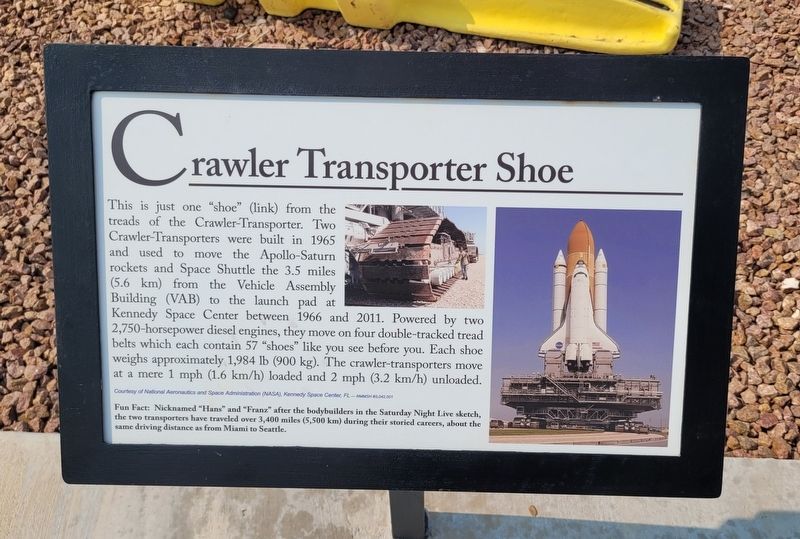
Crawler Transporter Shoe
Photographed by James Hulse, July 24, 2024
1. Crawler Transporter Shoe Marker
Fun Fact: Nicknamed "Hans" and "Franz" after the bodybuilders in the Saturday Night Live sketch, the two transporters have traveled over 3,400 miles (5,500 km) during their storied careers, about the same driving distance as from Miami to Seattle.
Captions
Courtesy of National Aeronautics and Space Administration (NASA), Kennedy Space Center, FL-NMMSH BIL042.001
Erected by New Mexico Museum of Space History.
Topics. This historical marker is listed in this topic list: Air & Space. A significant historical year for this entry is 1965.
Location. 32° 55.282′ N,
this page online

Regionally, this marker is in New Mexico’s Pecos Valley. It is also in the American Borderlands and in the Southwest. Globally, it is in North America, the Western Hemisphere, the Western World, and the Anglosphere. Historically, it finds itself in what was once New Spain, the Comanchería, and the Republic of Texas.
Other nearby markers. At least 8 other markers are within walking distance of this marker: Little Joe 2 (here, next to this marker); X-37B Orbital Test Vehicle Mockup (a few steps from this marker); PTV Parachute Test Vehicle (a few steps from this marker); IGOR Intercept Ground Optical Recorder (a few steps from this marker); V-2 Rocket Engine (within shouting distance of this marker); X-7A Test Vehicle (within shouting distance of
Photographed by James Hulse, July 24, 2024
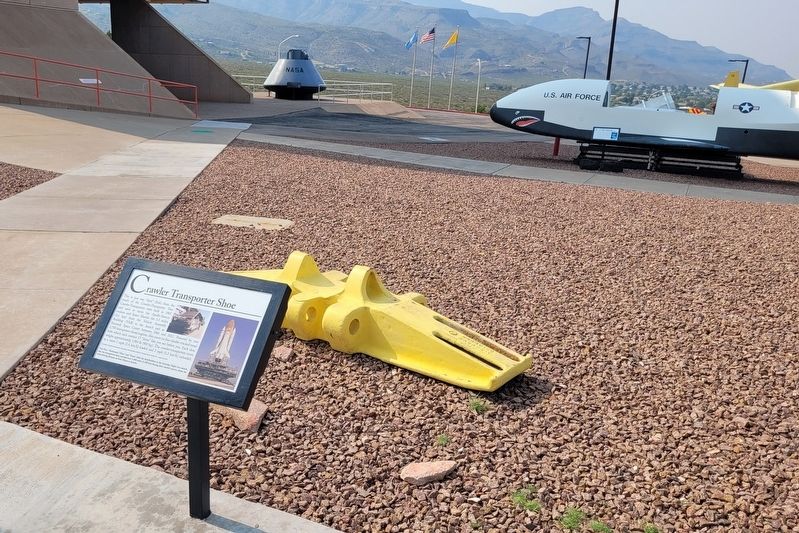
2. The Crawler Transporter Shoe and Marker
Also see . . . Crawler-transporter. Wikipedia
The crawler-transporters, formally known as the Missile Crawler Transporter Facilities, are a pair of tracked vehicles used to transport launch vehicles from NASA's Vehicle Assembly Building (VAB) along the Crawlerway to Launch Complex 39. They were originally used to transport the Saturn IB and Saturn V rockets during the Apollo, Skylab and Apollo–Soyuz programs. They were then used to transport Space Shuttles from 1981 to 2011. The crawler-transporters carry vehicles on the mobile launcher platforms used by NASA, and after each launch return to the pad to take the platform back to the VAB.(Submitted on August 10, 2024, by James Hulse of Medina, Texas.)
Photographed by James Hulse, July 24, 2024
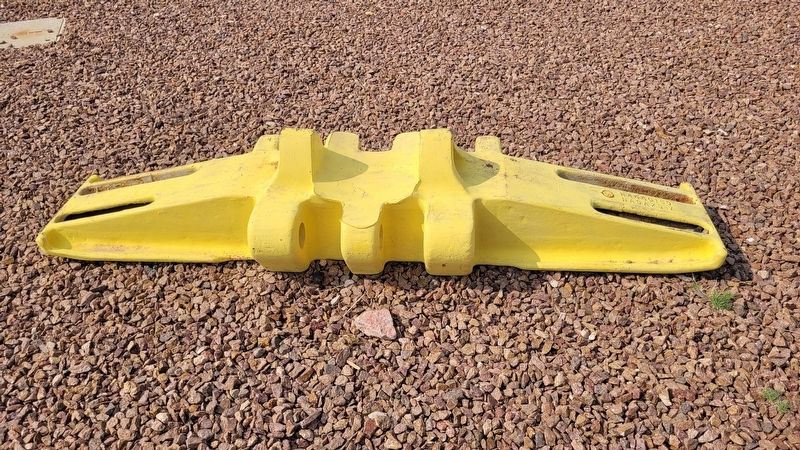
3. Closeup of the Crawler Transporter Shoe
Public Domain - NASA photo, June 15, 2005
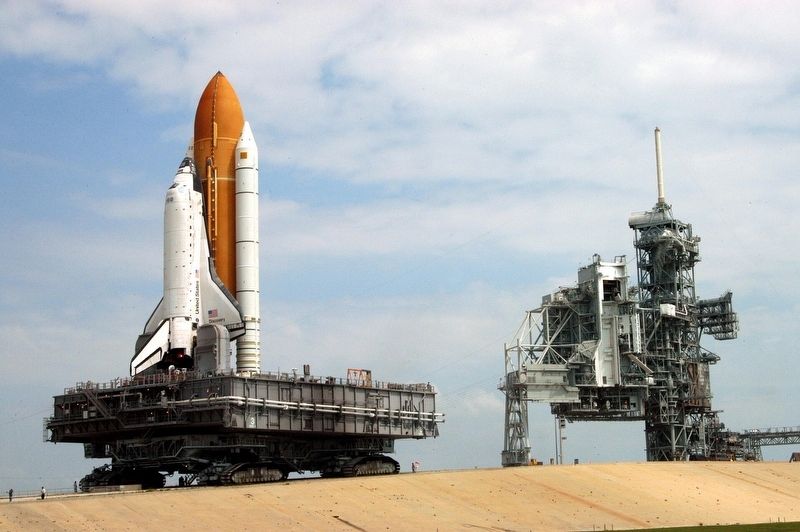
4. The Space Shuttle Discovery STS-114 on the Crawler Transporter
Space Shuttle Discovery makes its way to the hardstand of Launch Pad 39B in Florida
Credits. This page was last revised on August 11, 2024. It was originally submitted on August 9, 2024, by James Hulse of Medina, Texas. This page has been viewed 222 times since then and 26 times this year. Photos: 1, 2, 3, 4. submitted on August 10, 2024, by James Hulse of Medina, Texas.
